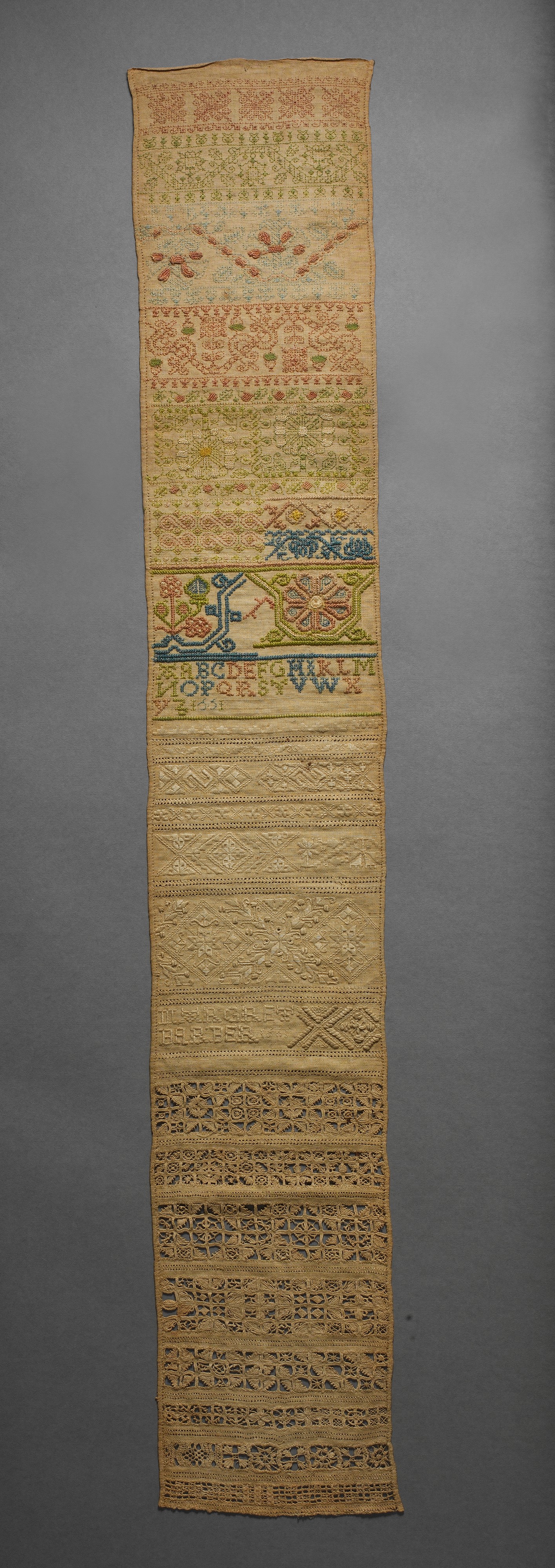
Sampler: A Global Heritage Study in Linen and Silk
The sampler occupies a singular position within the history of textile practice. Neither garment nor furnishing, neither purely utilitarian nor wholly ornamental, it functions as a pedagogical instrument, a technical archive, and an autobiographical document simultaneously. The present study examines a standalone sampler executed in linen and worked with silk and linen thread, employing reticella, double running, eye, cross, satin, and Gobelin stitches. Its provenance is located within the broad and porous category of global heritage, a designation that acknowledges the transmission of embroidery vocabularies across cultures while resisting the reductive attribution of the form to any single national tradition.
The Material Substrate: Linen as Ground and Discipline
Linen serves as the foundational matrix of the sampler, and its selection is far from incidental. As a bastioned fabric woven from flax, linen presents a rigid, low-stretch surface whose warp and weft establish an unforgiving grid. Unlike cotton, which tolerates improvisation, or silk, which drapes and yields, linen demands precision. Every stitch placed upon its surface is registered with documentary clarity; misalignment cannot be disguised by the fabric's own movement, because linen does not move. For the embroiderer, this translates into a discipline of hand and eye that is both physical and cognitive.
The choice of linen also signals economic and geographic positioning. Flax cultivation and linen production have historically been distributed across Northern Europe, the Mediterranean basin, and parts of Asia, making the fabric itself a carrier of trade routes and agricultural knowledge. A sampler worked on linen is therefore embedded within networks of material exchange that predate the finished object by centuries. The ground is not neutral; it is a palimpsest of agrarian and commercial history.
Thread and Chromatic Counterpoint
The sampler's articulation depends upon the interplay of two thread types: silk and linen. Silk contributes lustre, fineness, and a capacity for tonal modulation that linen thread cannot replicate. Where silk is deployed, the surface catches light and shifts in response to the viewer's position, introducing a kinetic dimension to an otherwise static object. Linen thread, by contrast, offers matte density and structural integrity. It anchors the composition, providing visual weight and textural contrast.
This dual-thread strategy is not merely aesthetic. It reflects a sophisticated understanding of how different fibres behave under tension, how they age, and how they interact with the linen ground. Silk, being protein-based, responds differently to environmental conditions than cellulose-based linen. The sampler thus becomes a study in material compatibility, a quiet experiment in how disparate fibres can be made to converse within a single frame.
Stitch Vocabulary: Six Techniques, Six Logics
The technical range of this sampler is considerable, encompassing six distinct stitch families, each with its own historical lineage and structural logic.
Reticella represents the most architecturally ambitious of the techniques present. A form of needle lace that emerged from the cutwork traditions of sixteenth-century Italy, reticella involves the removal of ground threads and the reconstruction of geometric patterns through buttonhole stitching. Its presence on a sampler signals an engagement with the highest tier of Renaissance needlework, where the embroiderer effectively becomes an architect of void and structure.
Double running stitch, also known as Holbein stitch, produces a reversible line of remarkable uniformity. Its logic is one of economy and elegance: the embroiderer travels the line twice, filling the gaps left on the first pass. The result is a continuous, identical pattern on both faces of the fabric, a quality prized in cultures where textiles were viewed from multiple angles, from Islamic architectural hangings to English domestic linens.
Eye stitch introduces a radial geometry, typically forming star-like or circular motifs. It is a counted-thread technique that demands meticulous attention to the grid, and its visual effect is one of optical vibration, as the eye is drawn into the centre of each motif and then outward again.
Cross stitch is the most democratised of the six, its simplicity belying its global ubiquity. From Eastern European folk embroidery to Chinese minority textiles, the cross stitch operates as a universal unit of pictorial construction. Its presence here grounds the sampler in the vernacular even as other stitches elevate it toward the courtly.
Satin stitch offers surface coverage and sheen, its parallel threads laid closely to create a smooth, reflective plane. Historically associated with the depiction of flesh, foliage, and heraldic devices, satin stitch is the sampler's primary vehicle for figuration and colour saturation.
Gobelin stitch, a tent-stitch variant worked over counted threads, carries associations with tapestry and the production of pictorial textiles. Its inclusion expands the sampler's reference field from embroidery proper into the adjacent domain of woven narrative, suggesting that the embroiderer was conversant with multiple textile disciplines.
Global Heritage and the Politics of Attribution
To describe this sampler as belonging to global heritage is to acknowledge that its constituent techniques are not the property of any single culture. Reticella emerged in Italy but drew upon Byzantine and Islamic precedents. Double running stitch appears in archaeological finds from Egypt and in traditional Palestinian dress. Cross stitch has been independently developed across Europe, Asia, and the Americas. Satin and Gobelin stitches are similarly polygenetic.
The sampler, therefore, is not a national document but a nodal point within a global network of technique and meaning. It records the movement of hands, materials, and ideas across geographies and centuries. Its value lies precisely in this hybridity, in its refusal to resolve into a single origin story.
Conclusion: The Sampler as Epistemic Object
This sampler, worked in linen and silk upon a linen ground, is ultimately an epistemic object. It encodes knowledge that is not verbal but haptic, not theoretical but procedural. The six stitches it deploys constitute a grammar of textile thought, and the sampler itself is the sentence. In an era of digital reproduction and algorithmic design, such an object reminds us that knowledge can reside in the hand as surely as in the mind, and that heritage is not a fixed inheritance but a practice continually renewed at the point of the needle.