Heritage Asset Analysis: Poem to Xu Qianzhi — Symbolic Capital and the 2026 Luxury Horizon
Object Provenance and Material Constitution
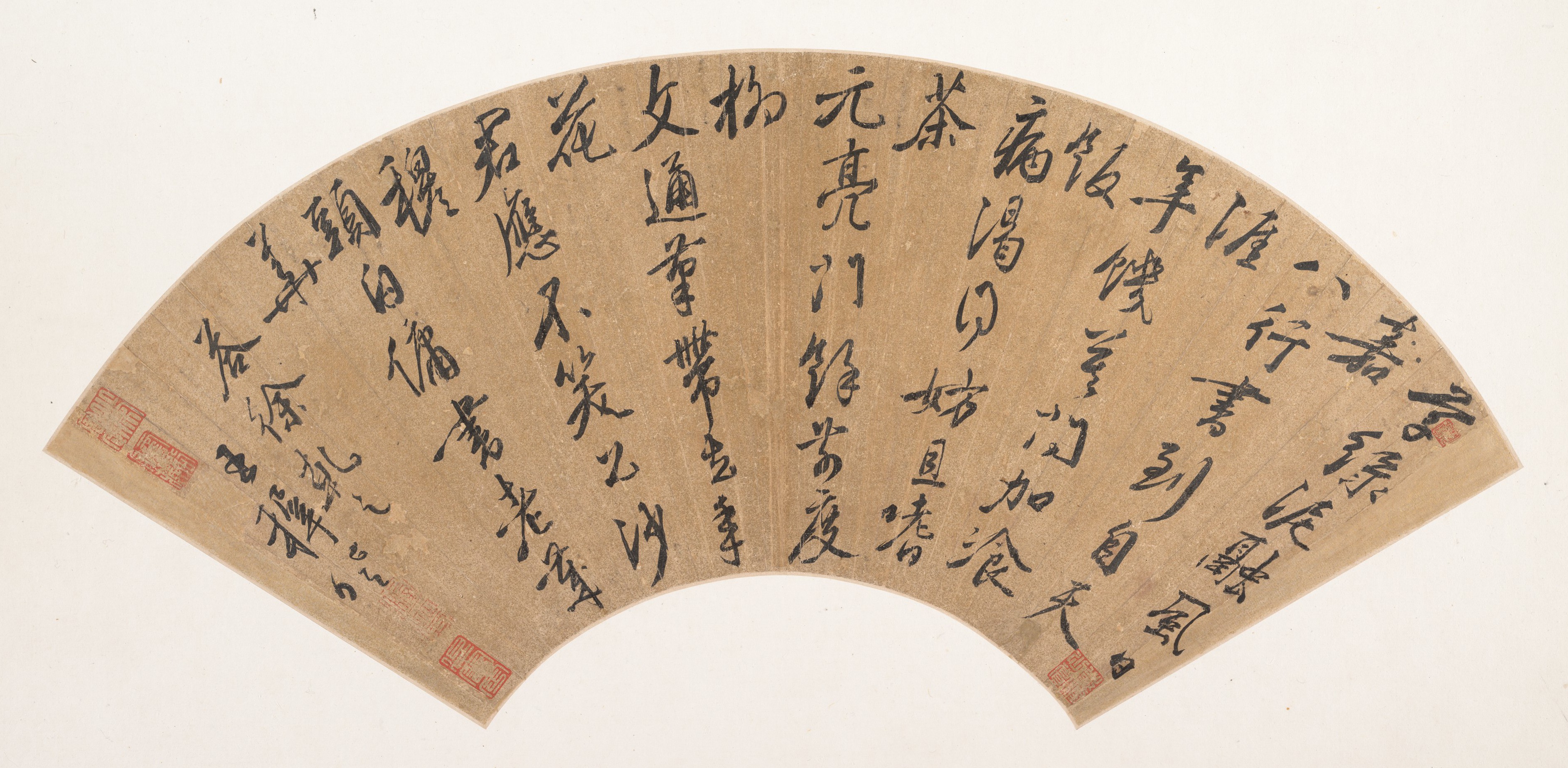
The artifact under review — a folding fan mounted as an album leaf, executed in ink on gold paper — represents a convergence of Chinese literati aesthetics and material luxury that is seldom matched in the surviving corpus of Ming and Qing dynasty works. The object is not merely a functional fan; it is a deliberate act of cultural synthesis. The folding fan, introduced to China from Japan and Korea during the tenth and eleventh centuries, was rapidly assimilated into the scholar-gentleman's toolkit as a portable emblem of refinement. Its mounting as an album leaf, however, signals a secondary transformation: the object was elevated from a utilitarian or performative instrument into a collectible, viewable, and contemplative work of art. The gold paper substrate — a material requiring meticulous preparation and considerable expense — introduces a layer of sumptuary significance. Gold in Chinese visual culture is not merely decorative; it connotes permanence, imperial authority, and the transmutation of the mundane into the sacred. The application of ink calligraphy over this surface creates a tension between the ephemeral gesture of the brush and the enduring nature of the support, a dialectic that sits at the heart of literati philosophy.
Symbolic Power: Calligraphy as Moral and Spiritual Cartography
The poem dedicated to Xu Qianzhi functions as more than a literary exchange; it is an act of social and spiritual positioning. In the Chinese literati tradition, the dedication of a poem to a named individual — particularly when executed in the calligrapher's own hand — constitutes a form of moral portrait. The recipient is not merely flattered; they are inscribed into a lineage of virtue, learning, and aesthetic discernment. The brushwork itself carries semiotic weight: the density of the ink, the rhythm of the characters, and the spatial composition of the text across the fan's folds all communicate the emotional and intellectual tenor of the relationship. The folding fan's radial structure imposes a unique constraint on the calligrapher — the text must accommodate the fan's pleats and curvature, a challenge that transforms the act of writing into a meditation on adaptation and harmony. The gold paper amplifies the spiritual dimension: in Daoist and Buddhist contexts, gold is associated with the incorruptible, the luminous, and the transcendent. A poem written on gold paper is thus not simply a poem but a talisman of sorts — a material prayer for the enduring bond between the poet and the recipient.
Historical Adornment and the Politics of Display
The mounting of the fan as an album leaf reveals much about the object's historical lifecycle. In its original form, a folding fan is a mobile, social object — carried, displayed, and used in the company of others. Its conversion into an album leaf suggests a shift from public performance to private reverence. The owner, likely a collector or a descendant of the original recipient, chose to preserve the work in a format that prioritizes contemplation over utility. This act of recontextualization is itself a form of adornment: the album leaf, often bound in silk or brocade, becomes a jewel-like object that can be leafed through in the seclusion of a study. The gold paper, now protected from the elements, retains its luminosity, while the ink remains sharp and legible. In the hierarchy of Chinese art objects, the album leaf occupies a privileged position — it is intimate, portable, and resistant to the vulgarities of public exhibition. For the contemporary luxury strategist, this is a critical insight: the most powerful heritage assets are those that have been recontextualized for private, ritualized engagement rather than mass display.
Spiritual Meaning and the Aesthetics of Restraint
The spiritual content of the Poem to Xu Qianzhi is encoded in its restraint. Unlike Buddhist sutras or Daoist talismans, which often employ dense, repetitive iconography, the literati poem operates through suggestion and ellipsis. The calligrapher's brush moves with a confidence that implies years of disciplined practice, yet the overall effect is one of effortlessness. This is the aesthetic of wu wei — action without forced effort — translated into visual form. The gold paper, far from being ostentatious, serves to isolate the ink strokes, allowing each character to resonate in a void of luminous emptiness. The poem's dedicatee, Xu Qianzhi, is thus placed within a spiritual economy where the highest honor is not material wealth but the gift of a well-crafted verse. For Katherine Fashion Lab, this suggests a model of luxury that prioritizes intellectual and spiritual capital over conspicuous consumption. The object's power lies in what it withholds as much as what it reveals.
2026 Luxury Strategy: Translating Heritage into High-End Value
As we look toward 2026, the luxury market is undergoing a profound shift. The era of logo-driven, mass-produced luxury is giving way to a demand for authenticity, provenance, and narrative depth. The Poem to Xu Qianzhi offers a blueprint for this transition. First, its materiality — ink on gold paper — suggests a palette and texture strategy for upcoming collections: deep blacks, luminous golds, and the subtle grain of handmade paper or silk. Second, its format — the album leaf — points to a product architecture based on intimacy and ritual. Imagine a limited-edition collection of accessories or objets d'art designed to be stored in a custom folio, each piece revealed one at a time, like a leaf turned in a scholar's studio. Third, its symbolic content — the dedication to a named individual — offers a model for personalization that goes beyond monogramming. Katherine Fashion Lab could develop a bespoke service where clients commission a poem, a calligraphic work, or a symbolic motif that is then integrated into a garment or accessory, creating a truly singular heritage object. Finally, the spiritual dimension of the work — its quiet, contemplative power — aligns with the growing consumer interest in mindfulness, sustainability, and emotional resonance. In 2026, the most valuable luxury will not shout; it will whisper, and it will carry the weight of centuries.
In sum, the Poem to Xu Qianzhi is not a passive relic. It is an active strategic asset, rich in symbolic power, historical adornment, and spiritual meaning. For Katherine Fashion Lab, it offers a roadmap for a luxury future that is rooted in cultural depth, material integrity, and the timeless human desire for connection, meaning, and beauty.