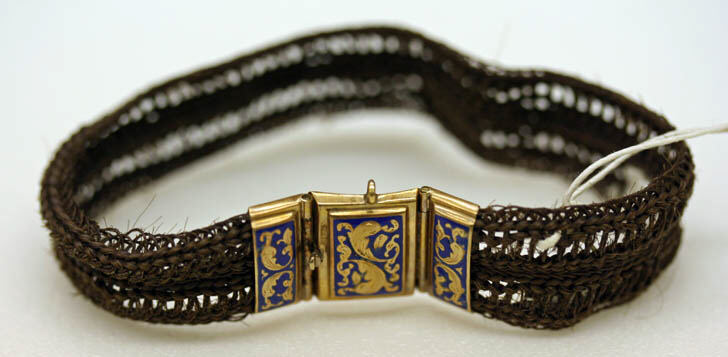
Victorian Sentiment to American Luxury: The Hair-and-Enamel Bracelet as Heritage Asset
Within the Katherine Fashion Lab heritage portfolio, few objects carry the strategic density of the American bracelet executed in hair, metal, and enamel. Ostensibly a mourning ornament of the nineteenth century, this composite artifact encodes a value proposition — memory made wearable, intimacy made permanent — that luxury houses have spent two decades attempting to reconstruct through narrative marketing. The bracelet did it first, and it did it with materials that today's consumer would not immediately recognize as precious. That paradox is precisely why it merits standalone strategic research.
Historical Adornment: The American Mourning Bracelet
The form emerged in the United States between roughly 1830 and 1890, reaching its commercial and emotional apex during the Civil War and the subsequent Victorian mourning culture that permeated American domestic life. Hair, harvested from the deceased or from a living loved one, was woven, braided, or encased under glass and set into gold-filled or solid gold bands. Enamel — black for deep mourning, white for children and the unmarried dead, occasionally blue for sentimental attachment — provided the chromatic code. The bracelet was not a peripheral curiosity; it was a mainstream American product, sold through Sears catalogues, jewellers, and mail-order houses. It was, in modern terms, a mass-customized luxury good.
The medium hierarchy deserves scrutiny. Hair was the primary asset, not the metal. It carried DNA, texture, and individuality — a biometric signature before the concept existed. Metal served as architecture; enamel served as signal. This inversion of conventional material value is the bracelet's most instructive heritage lesson for a 2026 luxury strategy.
Symbolic Power and Spiritual Meaning
The bracelet's symbolic grammar operates on three registers. First, continuity: hair does not decay at the rate of flesh, and its preservation in metal and enamel literalized the promise of enduring connection. Second, containment: the enclosure of hair beneath glass or within a locket-bracelet hybrid enacted the Victorian conviction that grief required disciplined form. Third, witness: worn on the wrist, the object was visible to the wearer at every gesture. It functioned as a private altar with public legibility.
Spiritually, the American mourning bracelet sits at the intersection of Protestant memorial practice and the broader sentimental materialism of the era. It was not consecrated in the Catholic sense, nor was it purely secular. It occupied a liminal zone — a domestic sacramental — that allowed grief to be carried without being spoken. For contemporary luxury strategy, this is the critical insight: the bracelet did not sell mourning. It sold permission — permission to feel, to remember, to display interiority within socially sanctioned form.
Material Intelligence: Hair, Metal, Enamel
Each material contributed distinct strategic equity. Hair supplied provenance and uniqueness — no two bracelets identical, each traceable to a specific body. Metal supplied durability and status, with gold content functioning as a visible price signal. Enamel supplied codified meaning, a colour language that could be read across a room. The triad prefigures the modern luxury formula of rarity, craft, and semiotics, yet it achieved this without a designer name, without a logo, and without a global supply chain.
It is worth noting that the craft labour embedded in a fine hair-work bracelet — weaving, setting, enamelling — often exceeded the material cost. This labour-to-material ratio anticipates the artisan-economy argument that underpins contemporary high-end positioning. The bracelet was expensive because it was slow, not because it was loud.
2026 Luxury Strategy: From Relic to Proposition
For Katherine Fashion Lab, the strategic question is not revival but translation. The mourning bracelet's original market is gone; its emotional architecture is not. Four moves follow.
First, reposition memory as material. The 2026 luxury consumer, saturated with digital nostalgia and bespoke memorialization services, responds to objects that hold rather than display. A contemporary bracelet using ethically sourced hair, recycled precious metal, and vitreous enamel can occupy the same psychological territory without the funerary connotation — reframed as a continuity piece, commissioned for milestones rather than deaths.
Second, restore the material hierarchy. Luxury has over-indexed on metal and stone. The hair-and-enamel bracelet argues for a hierarchy in which the organic and the coded outrank the merely expensive. This supports a pricing model based on provenance and craft hours rather than carat weight — a model more defensible under ESG scrutiny and more resonant with the collector demographic.
Third, codify the enamel language. Enamel's colour system is a ready-made semiotic asset. A proprietary palette — grief, joy, transition, endurance — gives the house a visual grammar that is ownable, teachable, and difficult to imitate. Semiotic ownership is the most durable form of luxury IP.
Fourth, embrace the wrist as altar. The bracelet's original power was proximity: it was touched, seen, and carried daily. In a market increasingly oriented toward display cases and vaults, the wrist remains the most intimate high-value real estate a luxury object can occupy. Strategy should privilege wearability over spectacle.
Conclusion
The American hair, metal, and enamel bracelet is not a quaint footnote in the history of adornment. It is a case study in how luxury creates meaning from mortality, how materials can be reordered to serve emotion, and how a codified visual language can carry a brand across generations. For Katherine Fashion Lab, its heritage value lies less in its form than in its logic: intimacy engineered into permanence. That logic, translated with restraint and material integrity, is a viable proposition for 2026 and beyond — not as nostalgia, but as strategy.