Introduction: The Aesthetics of Evanescence
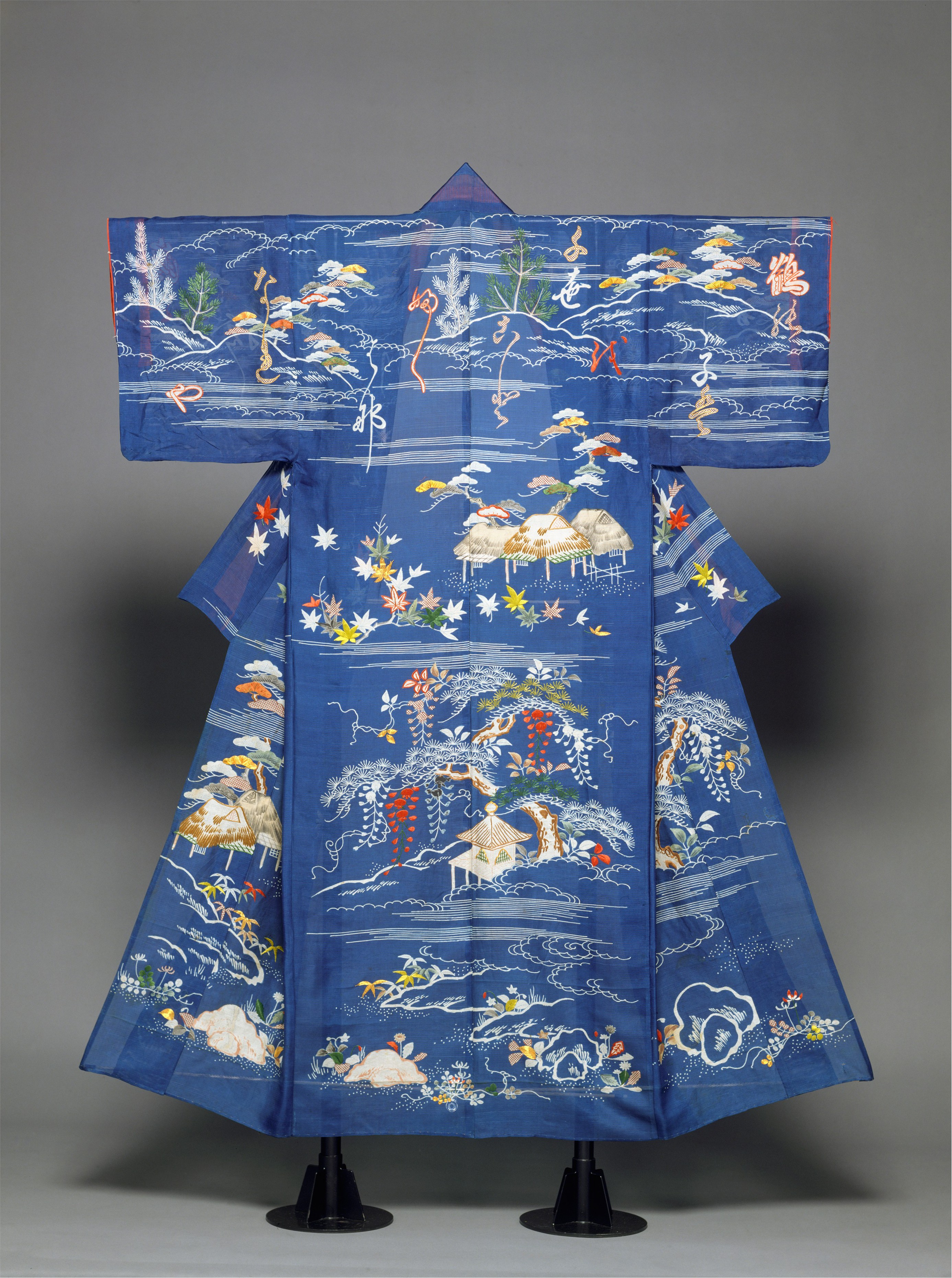
The unlined summer kimono, known in Japanese as hito-e, occupies a singular position within the broader taxonomy of East Asian textiles. Unlike the densely layered formal kosode of winter or ceremonial occasions, the hito-e is a garment conceived for breathability, lightness, and the fleeting weeks of high summer. The example under examination at Katherine Fashion Lab—a gauze-weave silk hito-e featuring landscapes, seasonal flowers, and an inscribed poem—represents a convergence of technical mastery, literary allusion, and the Japanese philosophy of mono no aware (the pathos of things). As a standalone study, this piece invites analysis not merely as costume but as a portable painting, a poem made wearable, and a meditation on impermanence rendered in thread and dye.
Materiality and Structure: Gauze-Weave Silk and the Physics of Air
The Technical Logic of Hito-e
The foundational material of this kimono is gauze-weave silk, known variously as ro (a leno weave with twisted warps) or sha (a plain-weave gauze with open spaces). Unlike the tight, lustrous rinzu or nishijin silks used for formal wear, gauze-weave silk is defined by its structural porosity. The weaver intentionally leaves gaps between warp and weft, creating a fabric that is simultaneously translucent and structurally sound. In the context of a hito-e, this openness serves a dual function: it permits air circulation against the skin—critical in Japan’s humid summers—and it transforms the wearer’s body into a diffused silhouette, a gesture that aligns with the Japanese aesthetic preference for suggestion over revelation.
From a conservation and connoisseurship perspective, the fragility of gauze silk is significant. The open weave is prone to snagging, distortion, and the degradation of dyes. That this piece survives with its paste-resist patterns and embroidery intact suggests either exceptional historical care or a deliberate choice of a robust sha ground. The very materiality of the garment, therefore, encodes a paradox: it is a luxury object designed for a season of decay, worn when both the weather and the flowers are at their most transient.
Paste-Resist Dyeing (Katazome / Yuzen) and the Landscape Motif
The landscape elements—likely distant mountains, a winding watercourse, and perhaps a bridge or pavilion—are executed through paste-resist dyeing. In traditional Japanese practice, this involves applying a rice-paste resist through a stencil or freehand before brushing on dyes. The technique allows for painterly gradations, known as bokashi, which mimic the misty atmospheric perspective of sumi-e ink painting. Here, the landscape is not a literal topography but a symbolic space, often alluding to classical poetic sites such as Yoshino (cherry blossoms) or Tatsuta (maple leaves). The resist-dyed areas would have been steamed to set the color, a process that risks bleeding and requires immense skill to maintain crisp boundaries between, for example, a mountain silhouette and the open sky of undyed silk.
Embellishment: Embroidery and Couched Gold Thread
Seasonal Flowers as Temporal Markers
Overlaying the dyed landscape are embroidered seasonal flowers—likely susuki (pampas grass), kikyo (bellflower), or fujibakama (thoroughwort), all associated with autumn in the Japanese poetic canon. However, the hito-e as a summer garment complicates a strictly autumnal reading. It is possible that the flowers are summer-specific: yugao (moonflower), asagao (morning glory), or renge (lotus). The choice matters because in Japanese textile art, flowers are not decorative but calendrical. They announce the month, the festival, and the appropriate poetic mood. Embroidery in silk floss adds a sculptural dimension to the flat resist-dyed ground, catching light and casting micro-shadows that shift with the wearer’s movement.
Couched Gold Thread: Authority and Fragility
The inclusion of couched gold thread—where a thin strip of gold-wrapped silk or paper is laid on the surface and secured with tiny silk stitches—elevates the kimono from a summer garment to a statement of wealth and cultural literacy. Couched gold (koma-nuri or hishiku) was historically expensive, requiring specialized craftspeople. On a gauze foundation, however, gold thread is technically risky: the open weave may not support the weight of metal-wrapped thread, leading to sagging or tearing. The presence of couched gold here suggests that the kimono was intended for limited, high-status occasions—perhaps a tea gathering, a poetry circle, or a moon-viewing party—rather than daily wear. The gold also introduces a temporal contradiction: it is incorruptible and eternal, while the gauze and dyes are ephemeral. This tension between permanence and decay is central to the piece’s intellectual appeal.
The Inscribed Poem: Text as Ornament and Narrative
The poem, likely written in kana or man’yogana script, is not merely a caption but a structural element of the composition. In Japanese textile tradition, calligraphy may be resist-dyed, embroidered, or painted. Here, the poem likely weaves through the landscape, its characters echoing the curves of a stream or the slope of a hill. The content—perhaps a waka from the Kokin Wakashu or Shin Kokinshu—would have been recognizable to an educated wearer and her audience. The poem might reference the specific flowers depicted, the season, or a famous site. Crucially, the text activates the garment as a site of performance: the wearer does not simply display the poem but embodies it. To read the kimono is to read the poem; to wear it is to become a line of verse.
Conclusion: The Hito-e as a Model of Integrated Design
This unlined summer kimono resists reduction to any single category. It is a textile, a painting, a poem, and a philosophical proposition. The gauze-weave silk provides the physical and conceptual ground—open, breathable, and vulnerable. The paste-resist landscape establishes spatial depth, the embroidery introduces tactile seasonality, and the couched gold thread asserts hierarchy and permanence. Finally, the poem unifies these elements into a narrative of transience. For Katherine Fashion Lab, this piece serves as a benchmark for how fashion can operate as an intellectual and sensory system, where material, technique, and text are not additive but mutually constitutive. In an era of digital reproduction and disposable trends, the hito-e reminds us that true luxury lies not in durability alone but in the courage to create beauty that is designed to fade—and in the skill to make that fading unforgettable.