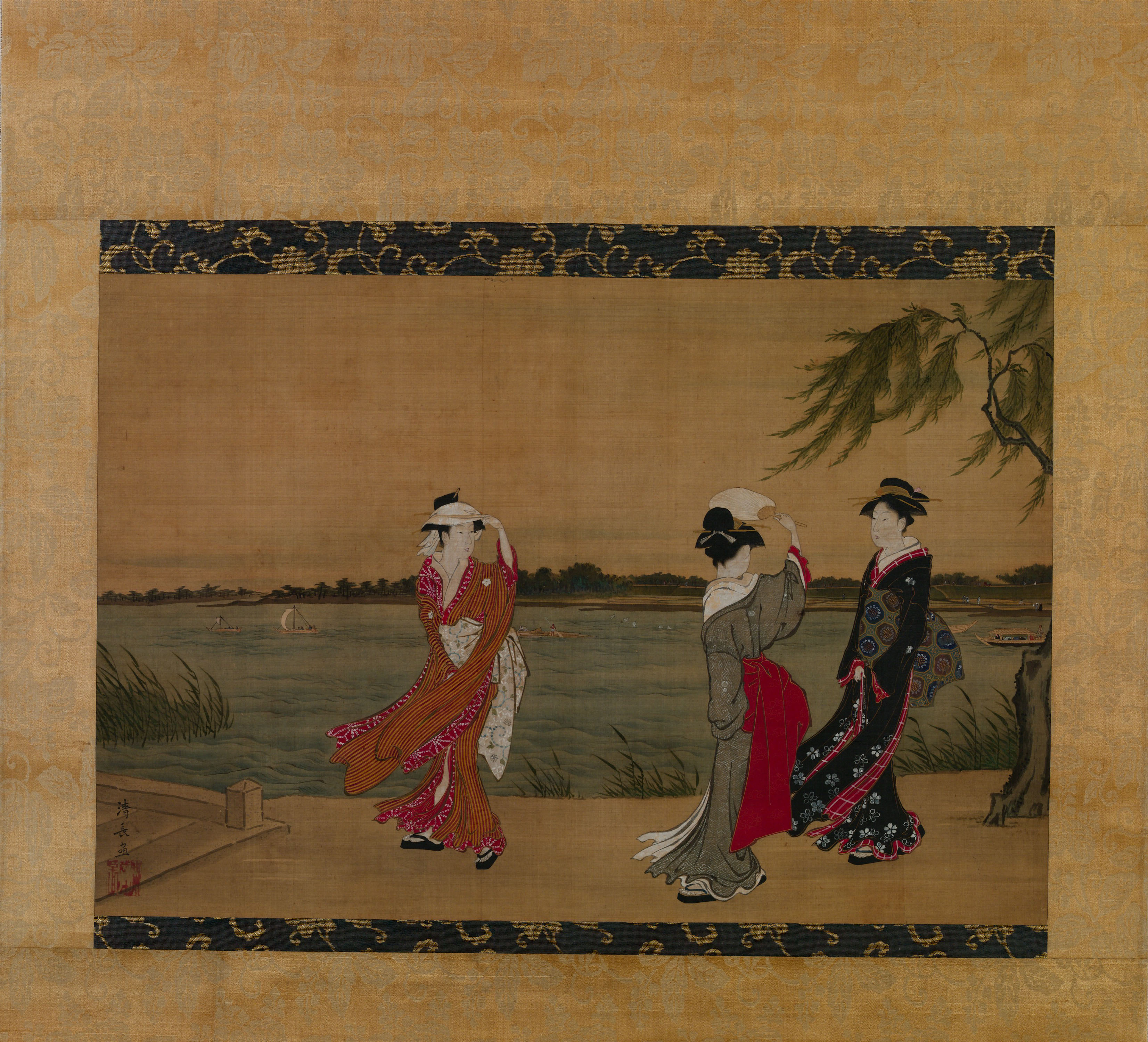
Three Women on a Riverbank: A Study in Restrained Elegance
Within the distinguished holdings that define the Katherine Fashion Lab's curatorial purview, certain objects resist easy categorization. Three Women on a Riverbank, a hanging scroll executed in ink and color on silk, is precisely such a work. Neither a fully narrative genre painting nor a purely decorative screen composition, it occupies an interstitial space in the Japanese pictorial tradition—a standalone study that rewards sustained formal analysis. For the fashion historian and textile scholar alike, the scroll offers a rare opportunity to examine how garment, gesture, and landscape converge to articulate a refined aesthetic of seasonal contemplation.
Materiality and Medium: Silk as a Vehicle for Subtlety
The choice of silk as a support is consequential. Unlike paper, which absorbs ink with a certain crispness, silk possesses a woven structure that softens the diffusion of pigment, producing edges that are at once precise and atmospheric. The artist exploits this quality to render the women's robes with a luminosity that would be difficult to achieve on paper. The mineral and vegetable pigments—likely applied in layered washes—sit upon the silk's surface, allowing light to pass through the fabric and return to the viewer's eye with a muted, pearlescent glow.
This technical dimension matters for our understanding of surface as signifier. In the context of East Asian painting, the material support is never neutral. Silk connotes formality, expense, and a certain courtly or elite milieu. That the artist selected silk for a scene of three figures by a riverbank signals that this is not a casual sketch but a considered meditation. The hanging scroll format further implies a viewing context of verticality—unrolled for private contemplation, perhaps in a tea room or study, where the eye travels downward from the empty upper register through the figures to the water's edge.
Compositional Architecture: The Riverbank as Stage
The riverbank functions as more than a setting; it is a compositional device that organizes the pictorial field into registers of near, middle, and far. The three women occupy the middle ground, their bodies arranged in a subtle triangular configuration that anchors the lower half of the scroll. Above them, negative space—what Japanese aesthetics terms yohaku—dominates, suggesting mist, distance, or simply the void of unarticulated atmosphere. This asymmetry is deliberate. By refusing to fill the upper register, the artist directs attention to the relationships among the figures and between the figures and the water.
The river itself is rendered with minimal brushwork—a few horizontal strokes that imply current and reflection without describing every ripple. This economy of means is characteristic of the sumi-e tradition, even when color is present. The water becomes a mirror not only for the women's forms but for the viewer's own act of looking. We are invited to stand on the opposite bank, as it were, and to project ourselves into the scene's quietude.
Dress as Narrative: Reading the Garments
For the fashion analyst, the women's attire is the scroll's most eloquent passage. Each figure wears layered robes—kosode and outer garments—whose patterns and colors differentiate them without disrupting the group's harmony. The leftmost figure is dressed in a robe of muted indigo with a subtle lattice motif, suggesting a restrained, perhaps older or more senior status. The central figure wears a warmer palette—ochre and faded vermilion—with a floral pattern that reads as autumnal. The rightmost figure's garment is palest, almost silvery, with linear accents that echo the water's horizontals.
These are not arbitrary choices. The color progression from cool to warm to neutral creates a visual rhythm that guides the eye across the composition. More importantly, the garments encode seasonal and social information. The floral motifs, the weight of the fabrics as suggested by the fall of the drapery, and the absence of heavy outer coats all point to late spring or early autumn—transitional moments when the air is mild and the landscape is in flux. The women are not engaged in labor; their postures are upright but relaxed, their hands largely hidden within sleeves. This is a scene of leisure, of cultivated idleness.
Gesture and Interrelation: The Choreography of Silence
The three figures do not make eye contact. Their gazes are directed variously—one toward the water, one toward a companion's sleeve, one into the middle distance. This dispersal of attention is a hallmark of certain Japanese narrative traditions, where the absence of a focal point encourages the viewer to construct meaning rather than receive it. The women are together, yet each is alone with her thoughts. The riverbank becomes a metaphor for interiority—a liminal space between the domestic and the wild, between speech and silence.
Their gestures are minimal: a slight inclination of the head, a hand raised to adjust a sleeve, a shift of weight from one foot to the other. In the vocabulary of fashion, these micro-movements are what allow a garment to come alive. The scroll captures not the static display of costume but the performance of wearing—the way silk pools at the wrist, the way a collar sits against the nape of the neck, the way a hem sweeps the ground. For the contemporary designer, this is a masterclass in how clothing behaves in motion, even when the motion is barely perceptible.
Conclusion: A Standalone Study in Lasting Relevance
Three Women on a Riverbank endures because it refuses to resolve into a single reading. It is at once a landscape, a figure study, and a treatise on dress. Its silk support and hanging scroll format situate it within a specific material and ritual context, while its compositional restraint and chromatic subtlety speak to broader aesthetic principles that continue to inform contemporary fashion practice. At the Katherine Fashion Lab, we regard such works not as historical curiosities but as active interlocutors—objects that ask us to slow down, to look closely, and to consider how the simplest arrangement of figures and fabric can produce a profound and lasting beauty.