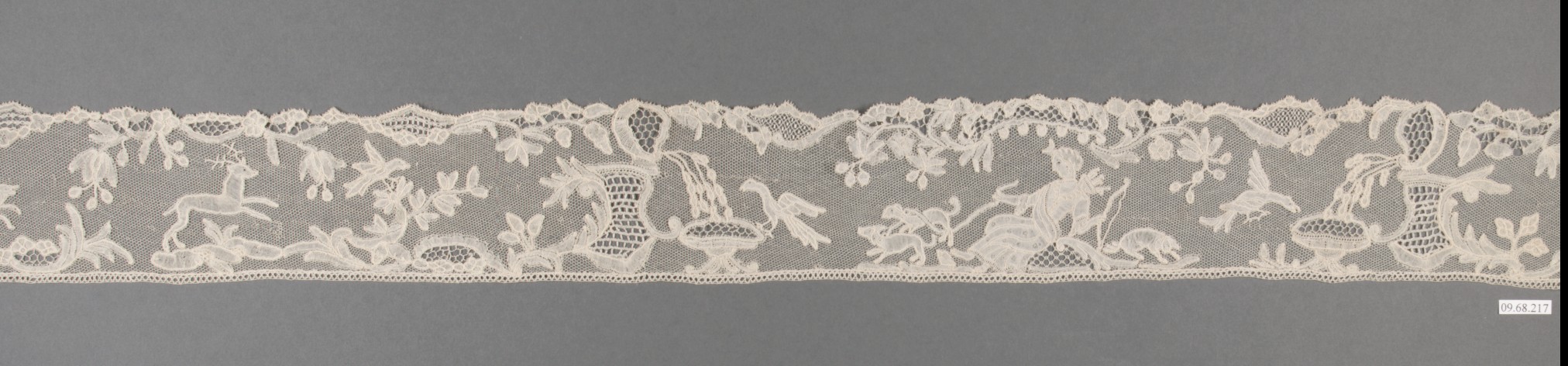
Strip: A Standalone Study in Bobbin Lace and Point d'Angleterre
The strip is couture's most unassuming radical. Neither garment nor ornament in isolation, it occupies a liminal category that fashion history has long under-theorized: a linear textile structure whose value derives precisely from its capacity to be cut, joined, and recontextualized. Within the Katherine Fashion Lab's ongoing investigation into structural minimalism, the strip emerges as a test case for how material intelligence—specifically the global heritage of bobbin lace and the refined discipline of point d'Angleterre—can transform a simple band of cloth into an object of considerable semiotic density.
Material Foundations: Bobbin Lace as Structural Logic
Bobbin lace is not embellishment; it is architecture executed at the scale of thread. Developed across European textile centers from the sixteenth century onward—Flanders, Venice, Alençon, and later the Devon and Buckinghamshire workshops—bobbin lace constitutes a woven lattice in which multiple threads, wound on bobbins, are interlaced and twisted according to a pricked pattern. Its structural logic is fundamentally modular. Each motif is built from repeated units, which means the strip—a continuous, narrow band of lace—is not a reduction of the form but its native expression.
This matters for couture analysis because the strip format exposes the technical grammar of bobbin lace without the distraction of a full garment silhouette. In a standalone study, the viewer reads the lace as a text: the ground mesh, the whole stitch and half stitch variations, the tension of the worker's hand preserved in the density of the cloth. The strip becomes a specimen slide through which lace's global heritage—Flemish, French, Italian, and later English—can be examined in microcosm.
Point d'Angleterre: The Paradox of the English Point
Point d'Angleterre presents one of textile history's more elegant ironies. Despite its name, the technique is widely understood to have originated in Brussels, with the designation "English point" applied in the seventeenth and eighteenth centuries because English merchants dominated its export and because English consumers prized it above nearly all other laces. The term thus encodes not a geography of production but a geography of desire—a reminder that luxury categories are frequently constructed by trade rather than by origin.
Technically, point d'Angleterre is characterized by a fine ground—typically a drochel or tulle-like mesh—against which floral and foliate motifs are worked with extraordinary precision. The motifs are often outlined with a thicker thread, creating a subtle relief that catches light along the edges. In a strip format, this technique produces a distinctive visual rhythm: the eye travels along the band, registering alternating zones of transparency and density, openness and weight.
For the couturier, point d'Angleterre offers a specific proposition. Its fineness permits the strip to function almost as a drawn line—a graphic mark against skin or fabric—while its density at the motifs provides enough body to hold shape without backing. This dual character is central to the strip's couture potential.
The Strip as Couture Proposition
In contemporary couture practice, the strip has been recuperated as a device of both economy and excess. Economy, because a narrow band of rare lace can be deployed across multiple garments or joined end-to-end to create larger panels without waste. Excess, because the labor embedded in a single meter of point d'Angleterre—often hundreds of hours—renders even a modest strip an object of significant value.
When a strip of bobbin lace is presented as a standalone study, several analytical questions surface:
- Edge behavior: How does the picot or footing edge terminate the strip, and what does that termination imply about joining?
- Directionality: Does the motif sequence establish a clear top and bottom, or is the strip reversible?
- Scale: How does the width of the strip relate to the scale of its motifs—does the pattern feel compressed or generously spaced?
- Transparency gradient: Where does the ground mesh open most fully, and how does that aperture interact with the body beneath?
These are not merely technical queries. They are the terms on which the strip enters couture discourse. A strip that reads as a finished edge—with a clean, reinforced footing—invites application to a hem or neckline. A strip with raw or picot edges invites joining, layering, or suspension. The material's global heritage, from Brussels to Bedfordshire, is carried in these decisions.
Heritage and the Ethics of Appropriation
Any serious analysis of bobbin lace and point d'Angleterre must acknowledge the colonial and mercantile networks that circulated these techniques. The same trade routes that carried lace from Flanders to England also carried enslaved labor, raw materials, and extracted wealth. The strip, as a portable and tradeable unit, was itself a commodity in these networks. A contemporary couture study that treats the strip as a neutral formal device risks erasing this history.
The more rigorous position—and the one Katherine Fashion Lab adopts—is to read the strip as a document. Its materials record specific hands, specific regions, specific economies. Point d'Angleterre's misnomer is not a trivia item but evidence of how luxury naming obscures labor. To work with the strip is to work with that record, and to decide, consciously, what to do with it.
Conclusion: The Strip as Method
The strip is not a fragment awaiting completion. It is a complete proposition: a linear textile whose value lies in its portability, its joinability, and its capacity to carry the full technical and historical weight of bobbin lace and point d'Angleterre in miniature. In a standalone study, the strip allows couture analysis to proceed at the scale of the thread—where structure, heritage, and desire are most legible. For the Katherine Fashion Lab, the strip is less an object than a method: a way of reading lace that refuses to separate technique from history, or beauty from its conditions of production.