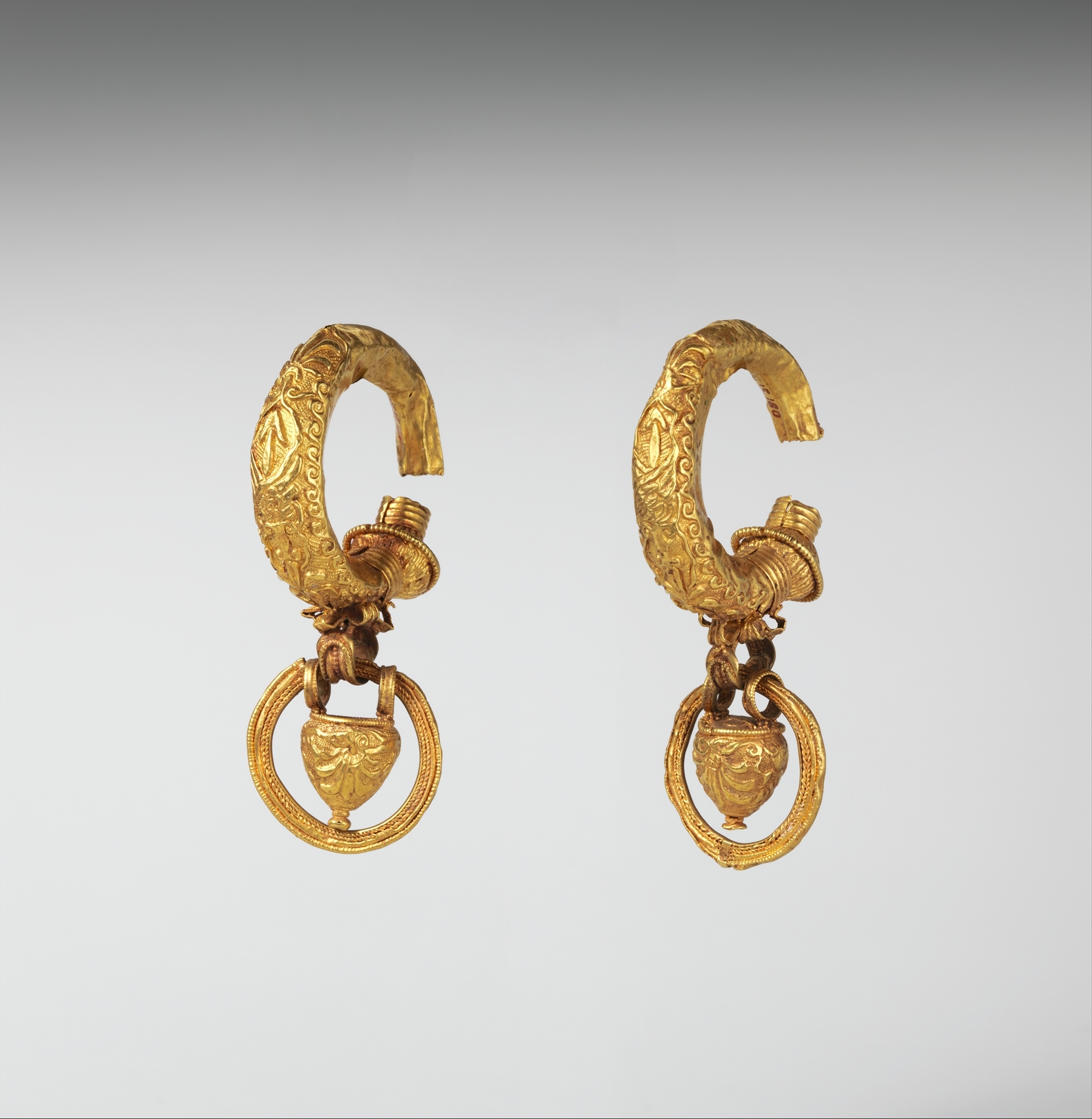
Etruscan Gold Earrings with Pendant Vase and Ring: A Heritage Analysis for Katherine Fashion Lab
Introduction: The Etruscan Aesthetic and Its Enduring Legacy
Among the great civilizations of the ancient Mediterranean, the Etruscans occupy a singular position in the history of adornment. Flourishing in central Italy between the eighth and third centuries BCE, they developed a goldsmithing tradition whose technical virtuosity and symbolic density remain unmatched in the pre-Roman world. The earrings under examination—gold ornaments featuring a pendant vase suspended beneath a ring—represent a mature expression of this tradition. For Katherine Fashion Lab, these objects are not merely archaeological curiosities; they are strategic assets. They encode a philosophy of adornment in which the body becomes a site of cosmological meaning, a proposition that speaks directly to the values of the 2026 luxury consumer.
The Etruscan goldsmith worked with techniques that would not be rediscovered in Europe until the Renaissance: granulation, in which microscopic gold spheres are fused to a surface to create texture and pattern; filigree, in which fine wires are twisted into lace-like structures; and repoussé, in which the metal is worked from behind to produce relief. The earrings in question likely employ a combination of these methods. The pendant vase is a hollow form, possibly embellished with granulated motifs, suspended from a ring that itself may be decorated with spiral or braided wire. The overall effect is one of lightness and complexity—an object that appears to have been grown rather than manufactured.
Symbolic Power: The Vase, the Ring, and the Architecture of Meaning
The pendant vase is not a neutral decorative choice. In Etruscan material culture, the vase—particularly the amphora and the oinochoe—is a polyvalent symbol. It signifies the storage and transportation of precious substances: wine, oil, perfume, and water. It is also a funerary motif, appearing in tomb paintings and on sarcophagi as an emblem of the transition between life and death. When worn on the ear, the vase becomes a miniature vessel for the wearer's essence, a portable container for identity, memory, and vitality. The ring above it, meanwhile, evokes the circularity of time and the binding power of oath and covenant. Together, the two elements create a vertical axis: the ring at the top, associated with the heavens and the eternal; the vase below, associated with the earth, the body, and the transient. The earring thus functions as a microcosm, a wearable cosmology.
This symbolic layering is directly relevant to Katherine Fashion Lab's research context. The study of the Mirror with Split-Leaf—with its dual surfaces of polished silver and carved stone—explores the tension between reflection and narrative, between the smooth surface of the present and the stratified depth of the past. The Etruscan earrings operate on a similar principle. The gold surface is reflective, catching the light and the gaze of the viewer. But beneath that surface lies a dense network of cultural associations: the vase as vessel, the ring as cycle, the gold as incorruptible matter. The wearer of such an object is not simply adorned; she is inscribed into a system of meaning that predates and outlasts her.
Historical Adornment: The Etruscan Woman and the Politics of Display
Etruscan society, unlike its Greek and Roman neighbors, accorded women a remarkable degree of social visibility. Tomb evidence and literary sources suggest that Etruscan women participated in public banquets, owned property, and commissioned their own funerary monuments. Their adornment was therefore not merely ornamental but political. Gold earrings with pendant vases and rings were likely worn by women of the aristocratic class, and their display signaled not only wealth but also cultural sophistication and spiritual authority. The earring was a public statement of interiority: it announced that the wearer was a person of depth, a keeper of secrets, a participant in the mysteries of life and death.
This historical context offers a powerful narrative for Katherine Fashion Lab. The Etruscan woman was not a passive object of the male gaze; she was an agent of her own representation. Her jewelry was a technology of self-fashioning, a means of projecting a complex identity into the public sphere. For the contemporary luxury brand, this is a compelling heritage story: one that aligns with the values of autonomy, self-expression, and cultural literacy that define the high-end consumer of 2026.
Spiritual Meaning: Gold as Incorruptible Matter
In Etruscan religion, gold was associated with the sun, with immortality, and with the divine. It was used in temple dedications, in votive offerings, and in the adornment of the dead. The choice of gold for earrings was therefore not merely aesthetic but metaphysical. Gold does not tarnish or corrode; it resists the passage of time. To wear gold was to participate in a material that belonged to the gods, a substance that could bridge the gap between the mortal and the eternal. The pendant vase, suspended in gold, becomes a vessel not only for perfume or wine but for the soul itself—a reminder that the wearer, though mortal, carries within her a spark of the imperishable.
This spiritual dimension is essential for the 2026 luxury strategy. The contemporary consumer, particularly in the high-net-worth segment, is increasingly interested in objects that offer meaning beyond material value. They seek provenance, narrative, and a sense of connection to something larger than themselves. The Etruscan earrings, with their layered symbolism and their association with a civilization that celebrated both life and death, offer precisely this. They are not disposable fashion items; they are heirlooms in waiting, objects designed to be passed down through generations.
2026 High-End Luxury Strategy: From Heritage to Innovation
For Katherine Fashion Lab, the Etruscan earrings should serve as a template for a new category of luxury object: the archaeological heirloom. This category is defined by four principles. First, material integrity: the use of gold, silver, and gemstones in their purest forms, worked with techniques that honor historical craft. Second, symbolic density: designs that reward close looking and invite interpretation, drawing on a deep well of cultural reference. Third, narrative transparency: the provision of detailed provenance and research, allowing the consumer to understand the object's origins and meanings. Fourth, generational durability: construction methods that ensure the object will survive not only the wearer's lifetime but those of her descendants.
The 2026 luxury market is characterized by a shift away from logo-driven consumption and toward what analysts call "quiet luxury"—understated, high-quality pieces that signal taste rather than wealth. The Etruscan earrings are the ultimate quiet luxury object. They are small, intricate, and deeply encoded. They do not shout; they whisper. But for those who know how to listen, they tell a story that spans two and a half millennia.
Katherine Fashion Lab is uniquely positioned to translate this heritage into a contemporary collection. By collaborating with archaeologists, goldsmiths, and cultural historians, the brand can produce a line of earrings that are not reproductions but reanimations—objects that carry the spirit of the Etruscan original into the present. The pendant vase, the ring, the granulated gold: these are not merely forms. They are arguments about the nature of beauty, the persistence of meaning, and the power of adornment to connect the wearer to the eternal.
Conclusion: The Earring as Portal
The Etruscan gold earrings with pendant vase and ring are more than artifacts. They are portals. They offer access to a world in which jewelry was philosophy, in which the body was a temple, and in which the act of wearing gold was an act of spiritual significance. For Katherine Fashion Lab, they represent an opportunity to lead the 2026 luxury market not by following trends but by reviving truths. The brand that can make its customers feel like Etruscan women—powerful, mysterious, and adorned with meaning—will not merely sell products. It will create devotees.