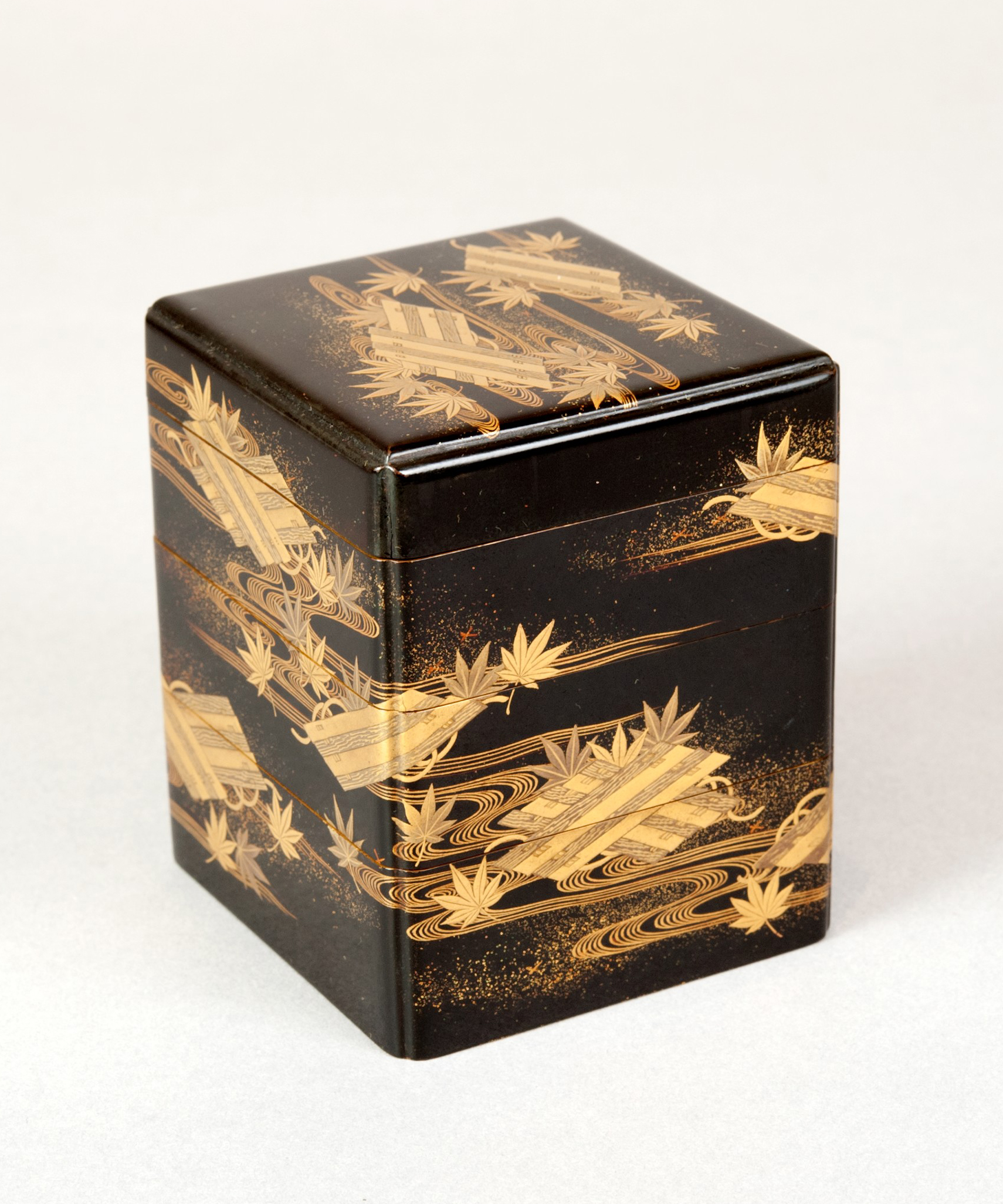
Heritage Analysis: Tiered Box with Design of Maple and Raft (Japan)
Object Overview and Material Authority
The Tiered Box with Design of Maple and Raft represents a pinnacle of Japanese lacquer craftsmanship, executed in gold and silver maki-e on black lacquer. This multi-tiered container—likely a jūbako or an ornamental storage box—combines utilitarian function with profound aesthetic and spiritual intent. The black lacquer ground serves as a night-time void, against which gold (kinpun, kindei) and silver (ginpun) powders are scattered, layered, and burnished to render a river scene: a solitary raft drifting beneath overhanging maple branches. The palette is deliberately restrained—black, gold, silver—yet the maki-e technique introduces subtle relief, where light catches the metallic particles differently depending on viewing angle. This material authority is not merely decorative; it encodes a worldview.
Symbolic Power: Maple, Raft, and the River of Transience
In Japanese visual culture, the maple (momiji) is a potent symbol of autumn, but its meaning extends beyond seasonality. Maple leaves, particularly in the iroha poem tradition, evoke impermanence (mujō) and the bittersweet beauty of decline. The raft, by contrast, is a vessel of passage—often associated with ukiyo (the floating world) or with the Buddhist metaphor of the raft of the Dharma that carries souls across the sea of suffering. When combined, maple and raft create a layered narrative: the raft drifts through a landscape of falling leaves, suggesting a journey through time, memory, and spiritual transition. The black lacquer, absorbing light, reinforces the idea of void (kū)—not emptiness as absence, but as potentiality. The gold and silver maki-e then become moments of enlightenment or fleeting beauty emerging from that void.
Historical Adornment and Courtly Context
Maki-e reached its zenith during the Heian (794–1185) and Muromachi (1336–1573) periods, when lacquerware became a marker of aristocratic refinement. Tiered boxes were used in gagaku ceremonies, tea gatherings, and gift exchanges among the samurai and court nobility. The maple-and-raft motif appears in several extant works from the Edo period (1603–1868), often associated with the Rinpa school, particularly Ogata Kōrin’s stylized river scenes. The use of silver maki-e alongside gold was a technical and economic statement: silver tarnishes over time, introducing an element of wabi-sabi—the acceptance of decay. Thus, the box was never meant to remain pristine; its beauty was designed to evolve with the owner’s life, deepening in patina and meaning.
Spiritual Meaning: Zen, Shinto, and the Aesthetics of Restraint
From a spiritual perspective, the tiered box embodies Zen Buddhist principles of simplicity, asymmetry, and naturalness. The raft is not a grand ship but a humble, improvised vessel—a reminder that enlightenment is found in the ordinary. The maple branches are depicted with kanshitsu (dry lacquer) or togidashi (burnished) techniques, allowing the leaves to appear as if suspended in mid-air, neither fully attached nor detached. This floating quality mirrors the Shinto concept of musubi—the generative power of connection between things. The box’s tiers themselves are symbolic: each level represents a stage of spiritual ascent, from the mundane (bottom tier) to the transcendent (top tier). Opening the box becomes a ritual of unveiling, not unlike a tea ceremony’s choreography.
2026 High-End Luxury Strategy: Heritage as Strategic Asset
For Katherine Fashion Lab, this object offers a blueprint for strategic standalone research that bridges heritage and high-end luxury in 2026. The global luxury market is shifting toward experiential authenticity—consumers demand provenance, narrative, and ethical materiality. The Tiered Box with Maple and Raft delivers all three. Its symbolic power can be translated into a limited-edition accessory line: a tiered vanity case, a modular handbag, or a fragrance coffret. The maki-e technique, with its gold-silver-on-black palette, aligns with 2026’s forecasted “nocturnal opulence” trend—dark bases punctuated by metallic accents.
More importantly, the box’s spiritual meaning offers a counter-narrative to disposable luxury. By emphasizing impermanence (the tarnishing silver, the falling leaves), Katherine Fashion Lab can position its products as heirlooms that age gracefully. The raft motif suggests journey and adaptability—key values for a post-pandemic, climate-conscious luxury consumer. Finally, the tiered structure invites modularity and personalization: clients could commission additional tiers or interchangeable lids, turning the object into a living archive of their own life passages. This strategy moves beyond mere reproduction of Japanese motifs; it adopts the philosophy of maki-e—layering, restraint, and the celebration of time’s passage—as a luxury business model.
Conclusion: From Lacquer to Legacy
The Tiered Box with Design of Maple and Raft is not a static artifact. It is a strategic asset for Katherine Fashion Lab, offering a rare synthesis of symbolic density, historical pedigree, and spiritual depth. In an era of hyper-competition and cultural flattening, this object reminds us that true luxury is not about speed or volume, but about meaning that survives generations. By centering our 2026 strategy on such heritage narratives, we do not merely sell products—we invite clients into a river of beauty, where every tier opened is a step toward understanding, and every maple leaf a meditation on the art of letting go.