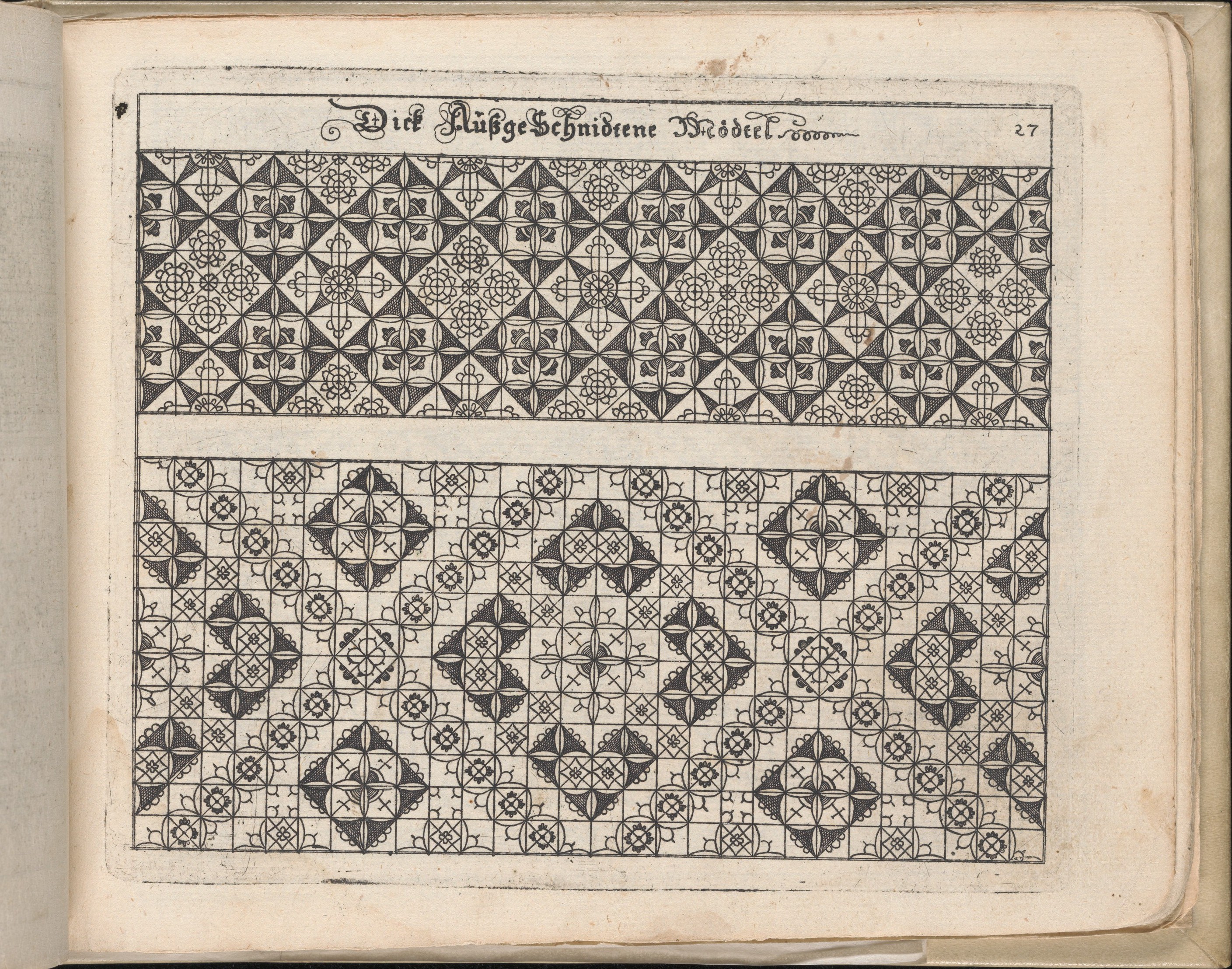
Schön Neues Modelbuch, Page 32 Recto: A Standalone Study in Etched Couture Grammar
The Schön Neues Modelbuch occupies a foundational position in the historiography of European ornament and dress. Published in the sixteenth century and attributed to the Nuremberg engraver and pattern-draughtsman Peter Flötner, the volume belongs to the earliest generation of printed model books—those portable compendia of lace, embroidery, and grotesque motifs that circulated among goldsmiths, weavers, and court embroiderers across the German-speaking lands. Page 32 recto, preserved within the Global Heritage corpus as a standalone study, presents a single etched plate whose density of line and economy of means reward sustained couture analysis. It is not a garment, yet it is unmistakably a grammar of garments: a page that teaches the hand how to think in repeats, in symmetries, and in the disciplined excess that would later define the ceremonial dress of the Habsburg and Valois courts.
Medium and Method: The Discipline of the Etching Needle
The plate is executed in etching, a technique that in the sixteenth century still carried connotations of the armourer's workshop rather than the painter's studio. The etcher draws through a wax ground with a needle, exposing copper to acid; the resulting line is wiry, uniform, and slightly tremulous—qualities that distinguish it from the swelling stroke of the engraver's burin. On Page 32 recto, this technical signature is decisive. The lines do not model volume in the manner of a chiaroscuro woodcut; instead, they articulate structure. Each motif is built from parallel hatching and interlocking scrolls, so that the eye reads not a picture but a system—a repeatable unit of ornament that a lacemaker or embroiderer could translate directly into thread.
For the couture historian, this matters enormously. Etching permitted rapid, inexpensive multiplication, which in turn democratized ornament. A pattern conceived in Nuremberg could be adapted in Antwerp, Venice, or Lyon within a season. Page 32 recto therefore functions as a node in a transnational network of taste, a single leaf whose motifs were destined to reappear—transformed by local materials and courtly patronage—on bodices, sleeves, and ruffs across the continent.
Motif Architecture: Scrollwork, Symmetry, and the Logic of the Repeat
The composition is organized around a central vertical axis, flanked by mirrored foliate scrolls that curl inward and terminate in stylized blossoms. Between these scrolls, the etcher has inserted smaller grotesques—hybrid figures, urns, and ribbon-like bands—that create a rhythmic counterpoint to the larger curves. The overall effect is one of controlled asymmetry within symmetry: the halves correspond, yet the interior details vary just enough to prevent mechanical monotony.
This is precisely the logic that governs sixteenth-century court dress. A gown's bodice and sleeves were never decorated with a single continuous image; they were covered with repeating units—bands of embroidery, applied lace, or woven passementerie—whose repetition signaled both wealth and discipline. To wear ornament was to demonstrate that one could afford not merely rare materials but coordinated design. Page 32 recto, read as a standalone study, reveals the underlying grammar of that coordination: the scroll that becomes a sleeve seam, the blossom that becomes a shoulder knot, the grotesque that becomes a jeweled clasp.
Material Translation: From Copper Plate to Cloth of State
What distinguishes the Schön Neues Modelbuch from later pattern books is its material agnosticism. The motifs on Page 32 recto do not specify whether they are to be worked in gold thread, silk, linen lace, or cut leather. This ambiguity is not a deficiency but a strategic openness. It allowed the same etched line to serve the embroiderer of a bishop's cope, the lacemaker of a court ruff, and the goldsmith designing a bookbinding or a dagger sheath.
In couture terms, this is the prehistory of the textile swatch. Before the printed pattern, ornament traveled by example—by the physical exchange of finished cloth or the migration of skilled hands. After the model book, ornament traveled by image, detached from any single material destiny. Page 32 recto thus marks a pivotal moment in the commodification of design: the point at which a motif could be conceived, etched, sold, and re-executed in a medium its original draughtsman never touched.
Standalone Study: Why This Page Merits Isolation
Most model books are studied as bound volumes, their pages subordinated to the logic of the sequence. To treat Page 32 recto as a standalone study is to recover the autonomy of the single plate. Unbound, the page becomes what it was for many sixteenth-century users: a working document, pinned to a workshop wall, annotated, pricked for transfer, and eventually worn out through use. Its survival in the Global Heritage corpus is therefore something of an anomaly—a survivor of utility, not of connoisseurship.
For the contemporary couture analyst, this autonomy is instructive. It reminds us that ornament is not decoration but infrastructure. The scrolls and grotesques of Page 32 recto are not merely pleasing; they are load-bearing, in the sense that they determine how a garment is cut, seamed, embroidered, and finally read by its audience. A court gown without such infrastructure would be cloth; with it, the gown becomes a statement of order—cosmological, political, and personal.
Conclusion: The Etched Line as Couture Inheritance
The Schön Neues Modelbuch, Page 32 recto, is finally less an artwork than a tool—and it is precisely as a tool that it achieves its highest significance. Its etched lines encode the procedural knowledge of the Renaissance luxury trades: how to distribute ornament across a surface, how to balance repetition with variation, how to translate a two-dimensional design into a three-dimensional body. For Katherine Fashion Lab, this standalone study offers a historical benchmark against which contemporary couture's own relationship to pattern, repeat, and material translation can be measured. The needle that cut this plate in sixteenth-century Nuremberg still points, however faintly, toward the atelier's cutting table today.