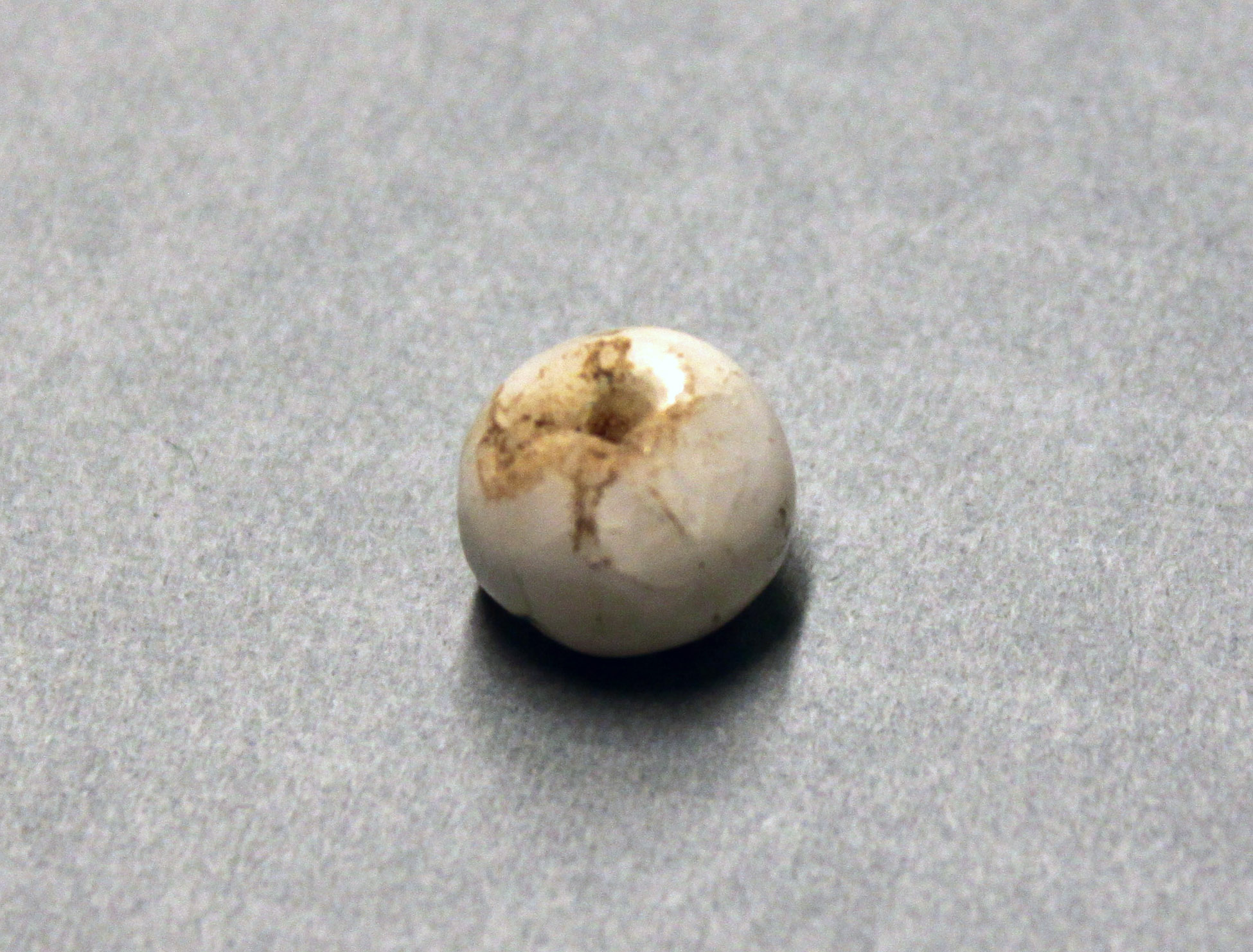
Heritage Asset Analysis: The Stone Bead in Ancient Civilization
Executive Summary
Within the material culture of the world's earliest stratified societies, few artifacts carry the strategic density of the stone bead. Long dismissed by early archaeology as incidental ornament, the bead has been reassessed as a precision-engineered object, a marker of emergent hierarchy, and one of humanity's first durable currencies of meaning. For Katherine Fashion Lab, the bead represents a foundational heritage asset: a category that predates writing, coinage, and the fashion system itself, yet continues to structure contemporary desire. This analysis examines the stone bead's symbolic authority, its function in historical adornment, its spiritual grammar, and its translation into a 2026 luxury strategy.
Origin and Material Ambiguity: Reading the Question Mark
The designation of "Stone (?)" in the research brief is itself analytically significant. Across the Neolithic and Early Bronze Age horizons—from the Natufian burials of the Levant to the Mehrgarh deposits of the Indus Valley and the elite tombs of Predynastic Egypt—bead assemblages reveal a deliberate calculus of material selection. Artisans worked carnelian, lapis lazuli, turquoise, jasper, steatite, and gold with equal fluency. The stone bead was rarely merely stone: it was a decision. The parenthetical uncertainty in our own catalogue mirrors the scholarly reality that provenance, trade route, and workshop attribution remain contested for many unprovenanced pieces. For a luxury house, this ambiguity is not a liability but a curatorial responsibility—an invitation to position the bead within a rigorous, evidence-led narrative rather than a romanticised one.
Symbolic Power: The Bead as Proto-Currency and Status Code
The symbolic power of the stone bead operated on three interlocking registers. First, as value storage: beads were among the earliest standardized units of exchange, with drilled apertures enabling stringing, counting, and accumulation. A necklace was, functionally, a ledger. Second, as status differentiation: burial archaeology consistently demonstrates that bead quantity, material rarity, and craft precision correlate with social rank. The wearer of lapis in a region without lapis deposits was announcing access to long-distance networks—an early form of supply-chain signalling. Third, as aesthetic authorship: the symmetry of drilled holes, the graduated sizing of strands, and the polishing of surfaces evidence intentional design intelligence. The bead is therefore not a precursor to jewellery; it is jewellery's first fully realised argument.
Historical Adornment: The Body as Institutional Surface
In ancient civilizations, adornment was never private. The body served as an institutional surface on which political, marital, and sacerdotal identities were inscribed. Stone beads encircled the necks of Mesopotamian priestesses, weighted the hems of Egyptian ceremonial dress, and accompanied the dead into intergenerational memory. Unlike textiles, which perish, stone beads survive as direct physical contact with the historical body—a quality of evidentiary intimacy that few heritage categories can claim. This durability gives the bead a unique advantage in brand storytelling: it is simultaneously artefact and heirloom, archaeology and inheritance.
Spiritual Meaning: Apotropaic Function and Material Cosmology
The spiritual grammar of the stone bead is inseparable from ancient material cosmology. Specific stones were understood to carry specific agencies: carnelian as the blood of vitality, lapis as the celestial vault, turquoise as protection against malevolent forces. Drilling the stone was itself a metaphysical act—transforming an inert mineral into a conduit. Strung beads formed protective circuits around the wearer, and the repetition of identical units produced a rhythmic, almost liturgical effect. In funerary contexts, beads functioned as passports, amulets, and offerings. For contemporary luxury, this spiritual layer offers a vocabulary of intention, protection, and continuity—values that resonate with a 2026 consumer seeking meaning over mere display.
Strategic Translation: The 2026 Luxury Position
The 2026 high-end market is defined by provenance literacy, material integrity, and quiet authority. The stone bead aligns with all three. A recommended strategy for Katherine Fashion Lab comprises four pillars. First, evidence-led provenance: publish verifiable research on material sourcing and historical reference, converting scholarly ambiguity into curatorial credibility. Second, modular luxury: position beads as collectible units—strands that can be added, inherited, and reconfigured, echoing their ancient function as accumulative value. Third, restrained symbolism: avoid literal mysticism; instead, articulate spiritual meaning through material choice and craft narrative. Fourth, cross-category extension: translate the bead's grammar into leather goods hardware, timepiece indices, and architectural store design, ensuring the heritage asset functions as a systemic brand code rather than a seasonal motif.
Conclusion
The stone bead is not a decorative footnote to ancient civilization; it is one of its most articulate surviving arguments about value, identity, and belief. Its symbolic power, historical ubiquity, and spiritual density make it an exceptionally durable heritage asset. For Katherine Fashion Lab, the strategic opportunity lies in treating the bead with the same precision its ancient makers applied—drilling carefully, stringing deliberately, and allowing the material to speak with the authority it has carried for ten millennia.