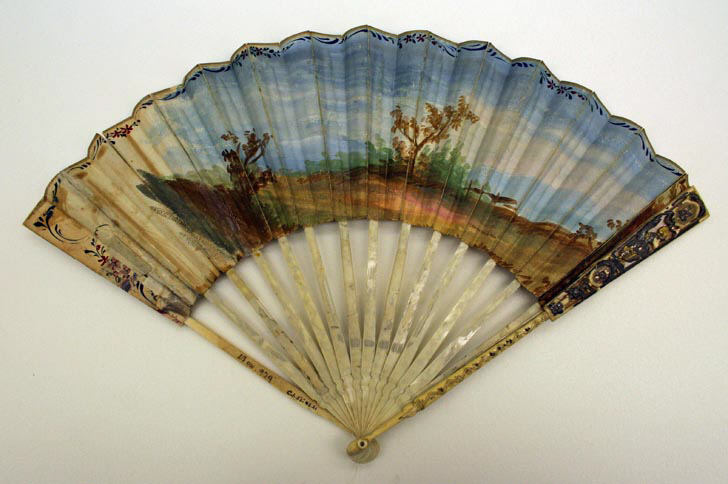
Heritage Analysis: The French Fan as Instrument of Symbolic Power
Introduction: A Strategic Object of Desire
Within the material culture of the French aristocracy, few objects carried the semiotic density of the folding fan. Crafted from ivory, gold, and silver, the fan functioned simultaneously as a cooling device, a canvas for miniature painting, and a coded instrument of social navigation. For Katherine Fashion Lab, the fan represents a strategic heritage asset: an object whose rarity, craftsmanship, and layered symbolism align precisely with the demands of the 2026 high-end luxury market. This analysis examines the fan's symbolic power, historical adornment, and spiritual meaning, and translates those dimensions into a forward-looking luxury strategy.
Symbolic Power: The Fan as Political and Social Instrument
In the French court, particularly from the seventeenth through the eighteenth centuries, the fan was never merely decorative. Its material composition—ivory, gold, and silver—signaled access to global trade networks and artisanal mastery. Ivory arrived through colonial routes; gold and silver required metallurgical refinement and the patronage of master guilds. To hold such a fan was to display economic and political capital simultaneously.
More significantly, the fan encoded power through gesture. The French developed an elaborate "language of the fan," a system of coded movements that allowed women to communicate across crowded salons without speaking. A fan held closed against the lips might signal secrecy; a slow opening could indicate a request for a private audience. This semiotic system transformed the fan into a portable instrument of agency, enabling its bearer to navigate restrictive social codes while appearing compliant. For luxury strategy, this history demonstrates that the fan's enduring value lies not in utility but in its capacity to signify—an insight directly applicable to contemporary consumers who seek objects that communicate identity and discernment.
Historical Adornment: Craftsmanship as Competitive Advantage
The French fan industry, centered in Paris and later in the Jura region, operated under strict guild regulations that ensured exceptional quality. Ivory was carved, pierced, and etched with microscopic precision. Gold and silver were applied through gilding, filigree, and inlay techniques. The fan's monture—the sticks and guards—often required the collaboration of several specialists: the tabletier for ivory, the orfèvre for metalwork, and the peintre for the leaf. This division of labor produced objects of extraordinary complexity, where a single fan could require hundreds of hours of skilled work.
This historical adornment model offers a direct strategic lesson. In an era of mass production, the fan's value proposition rests on verifiable provenance, artisanal scarcity, and multi-disciplinary craftsmanship. The integration of ivory, gold, and silver was not arbitrary; each material contributed a distinct sensory and symbolic register. Ivory provided tactile warmth and a surface for miniature painting. Gold and silver added luminosity, durability, and a direct association with the sacred and the royal. For Katherine Fashion Lab, the fan's material hierarchy can inform a 2026 collection that treats material selection as narrative architecture rather than mere decoration.
Spiritual Meaning: From Liturgical Use to Secular Ritual
Before its secular adoption by the French court, the fan carried spiritual significance in multiple traditions. In Catholic liturgy, the flabellum—a large fan made of feathers or parchment—was used to keep insects from the Eucharist. By the Middle Ages, French ecclesiastical fans were sometimes crafted from precious metals and ivory, transforming a practical tool into a liturgical object. This spiritual lineage infused the fan with an aura of the sacred, even as it entered the salon and the boudoir.
In the French context, the fan also acquired a quasi-religious role in the rituals of courtship and mourning. Black fans were used in mourning, white in courtship, and gold in ceremonial contexts. The fan thus mediated between the sacred and the profane, the public and the private, the spiritual and the social. For contemporary luxury, this duality is strategically potent. Objects that bridge ritual and adornment—that feel both meaningful and beautiful—command premium positioning. The fan's spiritual history allows Katherine Fashion Lab to frame its products as secular talismans: objects that carry memory, intention, and presence.
2026 High-End Luxury Strategy: Translating Heritage into Desire
The 2026 luxury landscape will be defined by three consumer demands: provenance transparency, experiential craftsmanship, and symbolic relevance. The French fan addresses all three. First, its history is geographically and materially specific—French, ivory, gold, silver—making it an authentic heritage asset rather than a generic luxury signifier. Second, its production requires multi-disciplinary ateliers, enabling Katherine Fashion Lab to develop limited-edition collections with verifiable artisanal narratives. Third, its symbolic power—gesture, status, spiritual resonance—offers a rich platform for storytelling that transcends mere aesthetics.
Strategically, the fan should be positioned not as a nostalgic artifact but as a contemporary instrument of agency. A 2026 collection could reinterpret the language of the fan for digital and physical spaces: a fan that signals privacy in a hyper-connected world, or one that encodes personal meaning through custom materials. Ivory can be replaced with ethically sourced alternatives or antique reclaimed pieces to address sustainability concerns. Gold and silver can be used sparingly, as accents that elevate the object into the realm of jewelry. The fan becomes a wearable heirloom—part accessory, part archive.
Furthermore, the fan's compact form and high perceived value make it an ideal entry point for new luxury clients. It is less intimidating than haute couture yet more distinctive than a handbag. It invites touch, performance, and conversation. For Katherine Fashion Lab, the fan is not a relic but a strategic vehicle: a way to claim heritage authority while innovating in material ethics and symbolic design.
Conclusion: The Fan as Strategic Heritage Asset
The French fan, crafted in ivory, gold, and silver, embodies a rare convergence of symbolic power, historical adornment, and spiritual meaning. Its history demonstrates that luxury objects endure not because they are useful, but because they are legible—they communicate status, intention, and belonging. For Katherine Fashion Lab, the fan offers a 2026 strategy built on provenance, craftsmanship, and ritual. By treating the fan as an instrument of agency rather than a decorative curiosity, the brand can position itself at the intersection of heritage and innovation, where the most compelling luxury narratives are written.