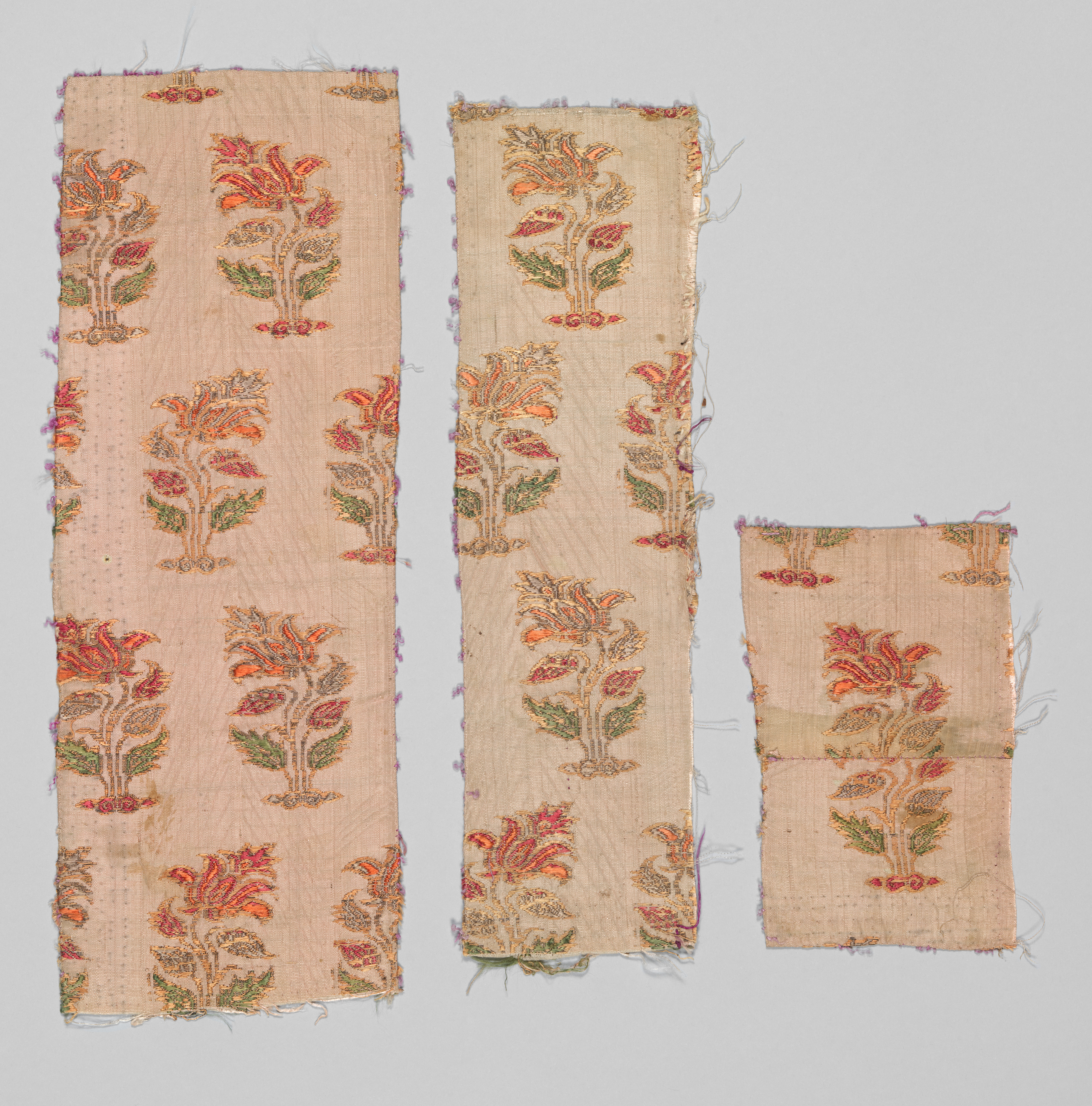
Three Textile Fragments: A Study in Silk, Metal, and Memory
The three textile fragments under examination represent a convergence of material sophistication, cultural exchange, and artisanal mastery that transcends their modest physical scale. Woven from silk and metal-wrapped thread in a brocaded structure, these fragments function as standalone studies—objects whose value resides not in their completeness but in the density of information they encode. For the couture analyst, they offer a rare opportunity to interrogate the relationship between textile technology, ornamental grammar, and the transmission of aesthetic knowledge across geographies.
Materiality: The Logic of Silk and Metal
The foundational decision to combine silk with metal-wrapped thread is neither incidental nor merely decorative. Silk, with its long staple fibers and natural luster, provides a substrate of extraordinary tensile strength and drape. Metal-wrapped thread—typically a core of silk or cotton wound with flattened strips of silver or gold—introduces a second optical system: light is not absorbed but reflected, producing a surface that shifts with the wearer's movement and the ambient illumination. In couture terms, this is an early instance of what we might call performative materiality—the garment or textile does not simply exist; it behaves.
The brocaded structure complicates this further. Unlike a simple supplementary weft, brocading allows the metal thread to appear selectively, creating pattern through interruption. The weaver thus operates as a kind of binary programmer: silk ground, metal figure, silk ground, metal figure. The resulting textile is not a flat image but a low-relief sculpture, with the metal passages standing proud of the ground. For the contemporary couturier, this technique anticipates the logic of jacquard and, by extension, digital textile design—where pattern is encoded as a sequence of discrete decisions.
Ornamental Grammar: Reading the Fragment
Each fragment, though truncated by time, retains sufficient pattern to suggest a larger ornamental system. The motifs—whether geometric, vegetal, or epigraphic—are not arbitrary. They belong to what we might term a transregional visual lexicon, one that moved along trade routes from the Silk Roads to the Mediterranean and beyond. A repeated lotus rosette, for instance, may appear in a Central Asian fragment, a Byzantine silk, and a later Italian brocade, each time inflected by local taste but retaining a recognizable structural DNA.
This raises a critical point for the couture historian: ornament is not mere surface. It is a form of material memory. The weaver who executed these fragments was not inventing ex nihilo but working within a tradition that had already codified certain proportions, symmetries, and color relationships. The metal thread, in this context, functions as a kind of highlight—it draws the eye to the most significant nodes of the pattern, much as a couturier might use sequins or metallic embroidery to articulate a neckline or a seam.
Technique as Cultural Interface
The brocaded structure also reveals the mobility of technical knowledge. The drawloom, the predecessor of the jacquard, required a complex apparatus of cords and lashes to control individual warp threads. Its presence in a given region implies not only access to raw materials but also the presence of a trained labor force and a market sophisticated enough to value such labor. When we examine these fragments, we are therefore examining infrastructure—the unseen networks of sericulture, metalworking, and trade that made them possible.
For the contemporary fashion lab, this has direct implications. The current enthusiasm for "heritage" techniques—handloom weaving, natural dyeing, metallic embroidery—often treats them as static traditions to be preserved. These fragments suggest the opposite: that textile traditions are dynamic, hybrid, and constantly recombining. The metal thread in a Central Asian fragment may have been traded from Persia; the silk may have originated in China; the pattern may reflect Indian or Hellenistic influence. The fragment is a node, not a root.
Standalone Study: The Aesthetics of Incompleteness
To study these fragments as standalone objects is to embrace a particular aesthetic discipline. Unlike a complete garment, which offers a unified silhouette and a clear function, the fragment resists closure. It invites the viewer to reconstruct—to imagine the missing warp, the original scale, the garment or furnishing it once adorned. This is not a deficiency but a generative constraint. The fragment becomes a prompt for design thinking.
In couture terms, this resonates with the contemporary practice of déconstruction—the deliberate exposure of seams, the use of raw edges, the fragmentation of the garment into its constituent parts. But where deconstruction often signals irony or critique, the historical fragment signals continuity. It is a piece of a larger whole that we can never fully recover, yet whose logic we can still read. The metal thread, tarnished but still reflective, reminds us that luxury is not a static category. It is a negotiation between materials, techniques, and the passage of time.
Conclusion: Toward a Material Philology
For Katherine Fashion Lab, these three fragments are not curiosities. They are case studies in what we might call a material philology—a method that reads textiles as texts, attending to fiber, structure, and pattern as carefully as a literary critic attends to syntax and metaphor. The silk provides the grammar; the metal thread provides the accent; the brocaded structure provides the syntax. Together, they articulate a sentence in a language that predates the fashion system but continues to inform it.
The couture designer who engages with such fragments does not merely borrow motifs. They enter into a conversation with a tradition that was already global, already hybrid, already sophisticated. The challenge is not to replicate the fragment but to understand its logic—and then to translate that logic into the materials and technologies of the present. In this sense, the fragment is not a relic. It is a prototype.