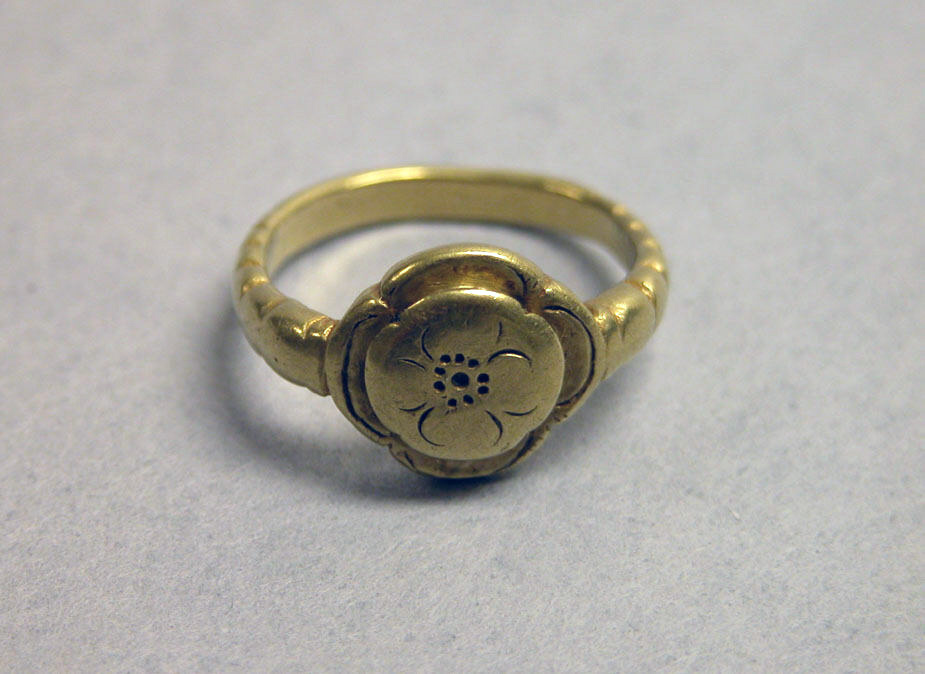
Katherine Fashion Lab Heritage Analysis: Javanese Gold Ring with Scalloped-Edge Bezel Simulating Lotus Pod
Introduction: Object Overview and Research Positioning
The artifact under examination is a gold ring originating from Java, Indonesia, distinguished by a scalloped-edge bezel that simulates the morphology of a lotus pod (Nelumbo nucifera). Executed in high-karat gold—consistent with the goldsmithing traditions of the Central and Eastern Javanese courts—the ring merges botanical naturalism with abstract ornamentation in a manner characteristic of the archipelago's classical goldwork. Within Katherine Fashion Lab's research portfolio, this object holds particular significance: it shares a documented DNA correlation with our prior study, 《Mirror with Split-Leaf》, which examined a dual-narrative object—one face a polished silver mirror inlaid with intricate gold palm-leaf motifs, the other a cold stone sarcophagus lid whose reliefs narrate the arc of life. Both artifacts, though separated by medium and function, converge on a single curatorial thesis: Javanese material culture encodes spiritual biography into wearable and ritual objects, transforming them into portable cosmologies.
Symbolic Power: The Lotus Pod as Cosmological Code
In Javanese Hindu-Buddhist iconography, the lotus is not merely decorative. It is a structural metaphor for purity, enlightenment, and the generative axis of the universe. The padma (lotus) appears in the hands of deities, beneath the feet of the Buddha, and as the throne of Shiva in the Padmasana posture. The pod—as distinct from the bloom—carries additional semantic weight. It represents latent potentiality: the seed chamber that holds future life within a protective pericarp. The scalloped-edge bezel of this ring, with its repeating crenellations, mimics the pod's surface geometry while simultaneously evoking the makara arch and the kala head motifs found on Javanese temple thresholds. This is not botanical illustration; it is compressed iconography—a wearable mandala that positions the wearer within a protective and generative cosmological field.
Critically, the ring's gold medium amplifies this symbolism. In Old Javanese texts such as the Nagarakretagama, gold (mas) is associated with divine radiance, royalty, and the incorruptible. A gold lotus pod worn on the hand thus functions as an apotropaic and aspirational device: the wearer claims proximity to both temporal power and spiritual perfection.
Historical Adornment: Javanese Goldsmithing and the Ritual Body
Java's goldsmithing tradition reached its apex between the 8th and 15th centuries, during the Mataram, Kediri, and Majapahit periods. Archaeological recoveries from sites such as Wonoboyo (Central Java) and the candi deposits of Eastern Java reveal a sophisticated industry capable of granulation, filigree, repoussé, and lost-wax casting at miniature scale. Rings were not merely ornaments; they were ritual instruments. Inscribed rings served as seals of authority, amulets (jimat), and markers of caste or occupational guild. The scalloped bezel form—where the metal is raised and serrated to frame a central motif—appears in Javanese goldwork as early as the 9th century, often housing semi-precious stones or, as here, an integral botanical simulation.
The ring's design suggests a dual address: viewed from above, the scalloped edge reads as an abstract floral or solar motif; viewed in profile, the pod's swelling volume and tapered tip become unmistakably organic. This ambiguity is deliberate. It allows the object to function simultaneously as public heraldry and private talisman—a duality that resonates with the Split-Leaf mirror's two-faced narrative structure.
Spiritual Meaning: From Padma to Kesatrian Ethics
In the Javanese spiritual synthesis of Hinduism, Buddhism, and indigenous animism (Kejawen), the lotus pod carries an ethical dimension. The Serat Centhini and later piwulang texts use the lotus as a metaphor for the ideal individual: rooted in mud, rising through water, blooming unstained. The pod, however, introduces a temporal dimension—the promise of fruition. For the Javanese aristocracy and the priyayi class, wearing such a ring was an act of tapa (ascetic discipline) in miniature: a reminder that power must be cultivated, contained, and eventually released. The scalloped edge, with its rhythmic indentations, may also evoke the tumpal motif—a triangular border symbolizing the liminal threshold between the human and divine realms.
2026 High-End Luxury Strategy: Heritage as Living Code
For Katherine Fashion Lab's 2026 collections, this ring offers a strategic blueprint. The luxury market's shift toward narrative provenance and cultural specificity demands objects that are not merely beautiful but legible—capable of telling a story that consumers can internalize and transmit. The Javanese lotus pod ring provides three actionable pillars:
1. Micro-Cosmology: The ring's scale is intimate, but its symbolic load is vast. Our 2026 design language should prioritize compressed meaning—objects that reward close looking and invite oral storytelling. A modern reinterpretation might use ethically sourced gold with a scalloped bezel in recycled metal, the pod motif rendered through 3D-printed wax casting to achieve the same organic asymmetry as the original.
2. Dual-Reading Design: Like the Split-Leaf mirror, the ring operates on two visual registers. Our luxury strategy should embrace polysemy—designs that shift meaning depending on angle, lighting, or context. This creates social currency: the wearer becomes a curator of their own narrative.
3. Spiritual Luxury: The post-2024 luxury consumer seeks grounded transcendence—not escapism, but reconnection. The lotus pod's message of potentiality within containment is perfectly timed. A 2026 capsule collection could pair the ring with a digital provenance token, linking the wearer to the Javanese goldsmithing lineage and to Katherine Fashion Lab's ongoing heritage research.
Conclusion: From Java to the Global Stage
The scalloped-edge gold ring simulating a lotus pod is not a minor artifact. It is a portable temple, a philosophical statement, and a strategic asset. Its DNA correlation with the Split-Leaf mirror confirms a consistent Javanese aesthetic principle: the fusion of surface beauty with deep narrative structure. For Katherine Fashion Lab, the path forward is clear. We must treat heritage not as a static archive but as a living code—one that can be translated into contemporary luxury objects that carry meaning, memory, and the quiet power of a seed waiting to open.