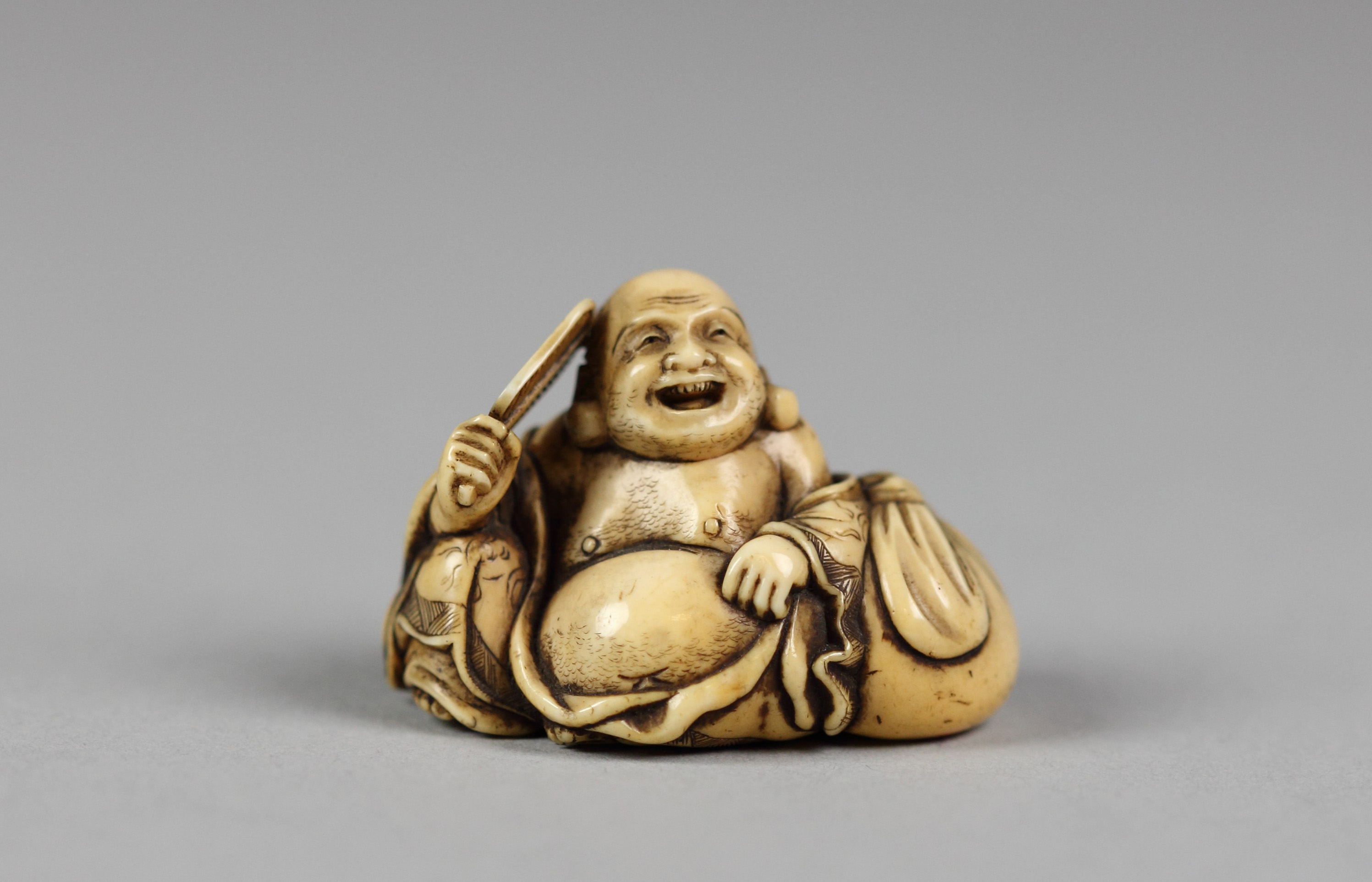
Heritage Analysis: Netsuke of Hotei — Ivory, Symbolic Capital, and the 2026 Luxury Landscape
Object Overview and Material Context
The netsuke of Hotei under examination is a compact, exquisitely carved ivory toggle originating from Edo-period Japan (1603–1868), the classical epoch of netsuke production. Measuring typically between three and five centimeters, the piece depicts Hotei — the pot-bellied, laughing figure widely venerated as the god of contentment, abundance, and good fortune. Executed in elephant or mammoth ivory, the object exhibits the fine grain, warm patina, and tactile density that defined the medium's prestige. Ivory was not a neutral material choice: it signaled access to long-distance trade networks, considerable artisan investment, and a refined aesthetic sensibility. For Katherine Fashion Lab, the object represents far more than a historical curiosity; it constitutes a concentrated vessel of symbolic, spiritual, and commercial meaning that can be strategically reactivated for the 2026 luxury market.
Historical Adornment and Functional Identity
Netsuke emerged from practical necessity. Traditional Japanese kimono lacked pockets, so men suspended small personal items — tobacco pouches, medicine cases, and purses — from a cord passed beneath the sash. The netsuke served as the counterweight, the toggle that anchored the cord at the sash's upper edge. Yet this functional origin rapidly evolved into a vehicle for artistic expression. By the mid-Edo period, netsuke had become collector's objects, commissioned from master carvers and exchanged as gifts among merchants, samurai, and the urban elite.
The Hotei motif was among the most popular subjects, appearing in ivory, boxwood, and lacquer. Its ubiquity was not accidental. Hotei offered a portable, personal talisman of good fortune — a private spiritual companion worn against the body, visible only in intimate or semi-public moments. This duality of concealment and display is critical for Katherine Fashion Lab's strategic positioning: the netsuke was simultaneously a private devotion and a public signal of taste, wealth, and cultural literacy.
Symbolic Power and Spiritual Meaning
Hotei's iconography is layered with meaning. His exposed belly signifies openness, generosity, and the absence of worldly anxiety. His laughter — often rendered as a broad, toothy grin — embodies equanimity and the transcendence of suffering. In Japanese folk religion, Hotei is one of the Seven Lucky Gods (Shichifukujin), associated specifically with abundance and the fulfillment of wishes. He is also linked to the historical Zen monk Budai, whose eccentric demeanor and simple wisdom became a parable for non-attachment.
The ivory medium amplifies these meanings. Ivory's smooth, cool surface and organic warmth when handled create a sensory experience of intimacy and permanence. The material's rarity — particularly in the context of modern conservation ethics — adds a layer of ethical complexity that luxury brands must navigate carefully. For Katherine Fashion Lab, the symbolism is threefold: contentment as a counter-narrative to aspirational anxiety, abundance as a promise of enduring value, and spiritual groundedness as a response to the digital age's disembodiment.
2026 Luxury Strategy: From Artifact to Narrative Capital
The 2026 high-end luxury landscape is defined by three converging forces: the demand for provenance and authenticity, the rise of "quiet luxury" and experiential consumption, and the ethical scrutiny of materials. A netsuke of Hotei — particularly one with documented Edo-period origin — sits at the intersection of these forces. It is not merely an object; it is a narrative asset.
First, provenance as product. Katherine Fashion Lab can deploy the netsuke as a design motif, a storytelling anchor, or a limited-edition capsule. A carved Hotei silhouette on a hand-finished leather accessory, for example, transforms a historical toggle into a modern talisman. The key is not replication but reinterpretation — preserving the symbolic grammar while adapting the scale and function.
Second, spiritual minimalism. The 2026 consumer, particularly in the Asia-Pacific and diaspora markets, seeks objects that carry meaning without ostentation. Hotei's laughter and open belly align with a post-pandemic ethos of resilience, gratitude, and anti-excess. Katherine Fashion Lab can position the netsuke-inspired line as "wearable serenity" — a luxury that soothes rather than shouts.
Third, ethical materiality. Ivory is a reputational risk. The strategic response is not avoidance but transparent substitution: mammoth ivory (legal, sustainable, and equally historic), tagua nut, or recycled resin. The narrative becomes one of continuity without complicity — honoring the craft while rejecting the ecological cost. This aligns with the 2026 luxury mandate for verifiable ESG commitments.
Fourth, collectible scarcity. The original netsuke is a one-of-one artifact. Katherine Fashion Lab can mirror this through numbered editions, artisan-signed pieces, and archival documentation. The object's small scale also supports a "jewel-box" retail strategy — intimate, appointment-only viewing rooms where clients handle the piece, learning its history before purchase.
Strategic Recommendations and Conclusion
Katherine Fashion Lab should treat the Netsuke of Hotei as a heritage IP asset, not a static collectible. Recommended actions include: commissioning a scholarly monograph on Hotei iconography for client gifting; developing a "Seven Lucky Gods" capsule series with Hotei as the anchor; partnering with Japanese artisans for a limited run of mammoth-ivory or boxwood toggles; and creating a digital provenance certificate using blockchain for each piece. The spiritual dimension — contentment, abundance, laughter — should be the emotional core of all marketing, avoiding fetishization of the original material.
In sum, the Netsuke of Hotei is a masterclass in compact symbolic power. It is portable, personal, and profound. For Katherine Fashion Lab, the 2026 opportunity lies in translating its Edo-period intimacy into a modern luxury language of meaning, ethics, and enduring value. The object does not need to be large to be monumental; it only needs to be understood.