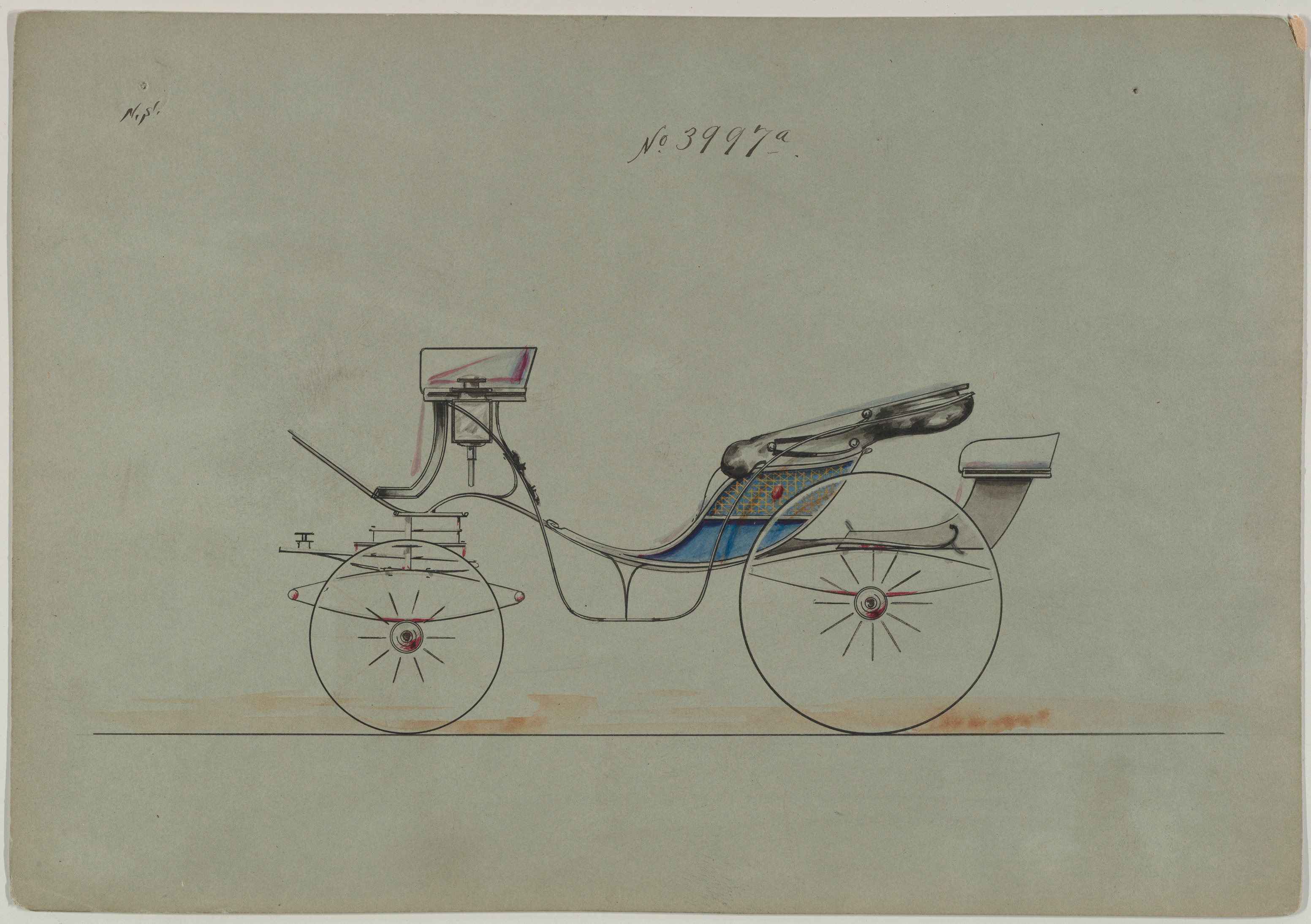
Victoria #3997a: A Study in Pen, Ink, and the Alchemy of Watercolor
Within the archival taxonomy of Katherine Fashion Lab, certain works resist easy classification. Victoria #3997a is precisely such a piece—a standalone study that operates at the fertile intersection of technical draftsmanship and painterly intuition. Executed in pen and black ink, watercolor, and gum Arabic, this work belongs to the Global Heritage designation, a curatorial category reserved for objects whose formal language transcends any single geographic or stylistic tradition. To examine Victoria #3997a is to confront a paradox central to couture itself: the tension between the discipline of the line and the freedom of the wash.
Medium as Methodology: The Dialectic of Pen and Watercolor
The choice of media in Victoria #3997a is not incidental but constitutive of its meaning. Pen and black ink supplies the architecture of the garment—the structural logic that governs silhouette, seam, and proportion. In couture practice, the pen line is the equivalent of the tailor's chalk: decisive, corrective, and unforgiving. Every stroke in this study carries the authority of a decision made. There is no erasure in ink; there is only intention.
Against this rigor, watercolor and gum Arabic introduce an element of controlled unpredictability. Gum Arabic, the traditional binder for watercolor pigments, lends the washes a particular luminosity and body. It allows the pigment to sit on the paper's surface with a subtle gloss, rather than sinking into the fiber. The result is a chromatic depth that reads almost like textile—as though the paper itself has been woven. Where the ink line delineates, the watercolor suggests. Where the pen asserts, the brush implies. This dialectic mirrors the couturier's own process: the precision of the pattern block in dialogue with the drape of the fabric on the mannequin.
Critically, the artist has not allowed the watercolor to obscure the ink. The two media remain in tension, each respecting the other's territory. This is a mark of sophisticated draftsmanship. In lesser studies, wash becomes a corrective for uncertain line work. Here, it functions as a parallel language—one that speaks to atmosphere, volume, and the sensory experience of cloth.
Global Heritage and the Question of Origin
The Global Heritage classification of Victoria #3997a invites scrutiny. What does it mean for a standalone study to claim such a designation? The term is not geographic but methodological. It signals that the work draws upon a reservoir of formal solutions that have circulated across cultures and centuries—the pleat as understood in Japanese kimono construction, the corsetry logic of European court dress, the draped volumes of South Asian and North African textiles. Victoria #3997a does not quote any single tradition; it synthesizes.
This synthesis is evident in the silhouette. The study presents a form that is at once structured and fluid—a bodice that suggests boning without depicting it, a skirt that falls in washes of graduated tone rather than explicit folds. The artist has absorbed the grammar of multiple dress histories and produced something that belongs to none of them exclusively. In an era of globalized fashion, this is not evasion but accuracy. Couture has always been a hybrid practice, and Victoria #3997a acknowledges that inheritance without nostalgia.
The Standalone Study as Curatorial Object
Victoria #3997a is not a preparatory sketch for a realized garment, nor is it a finished presentation drawing. It is a standalone study—a category that Katherine Fashion Lab treats with particular seriousness. The standalone study is where the designer's thinking is most visible, unmediated by the demands of client, atelier, or market. It is the space of pure inquiry.
In this context, the absence of a figure is significant. The garment floats on the page, unanchored to a body. This is not a failure of completion but a deliberate abstraction. By removing the wearer, the artist forces the viewer to engage with the garment as a formal object—to read its lines, its volumes, its tonal transitions as one would read a sculpture. The watercolor washes become the equivalent of light falling across a three-dimensional form. The ink lines become the edges where form turns away from the viewer.
This abstraction also protects the study from the contingencies of trend. A garment depicted on a body is dated by that body's posture, its hairstyle, its cultural markers. A garment depicted in isolation belongs to a longer durée. Victoria #3997a thus achieves a kind of timelessness that is not vague but rigorous—the timelessness of a well-resolved form.
Color, Tone, and the Discipline of Restraint
The palette of Victoria #3997a is restrained, even austere. The watercolor washes operate primarily in a narrow range of tonal values, with occasional passages of muted chroma. This restraint is strategic. In couture, color is often the first thing to be noticed and the last to be understood. By limiting the palette, the artist directs attention to structure and surface. The gum Arabic's slight sheen catches the light, animating the washes so that they seem to shift as the viewer moves. This is a kinetic quality achieved through material rather than depiction.
The black ink, meanwhile, is not uniformly black. Variations in line weight and density create a hierarchy of information. Primary contours are drawn with a heavier hand; internal details—the suggestion of a seam, the ghost of a dart—are rendered with finer, more tentative strokes. This hierarchy guides the eye through the composition, establishing a reading order that is both logical and aesthetic.
Conclusion: The Study as Manifesto
Victoria #3997a is a work that rewards slow looking. It is not a spectacle; it is an argument. The argument is that couture's foundational language—line, volume, material, restraint—can be articulated in a standalone study with as much authority as in a finished gown. The Global Heritage designation reminds us that this language is not the property of any single culture but a shared inheritance, constantly renewed by practitioners who understand that tradition is not a constraint but a resource.
At Katherine Fashion Lab, we regard Victoria #3997a as exemplary of a certain curatorial philosophy: that the study is not preliminary but primary, not a means to an end but an end in itself. In its dialogue between pen and wash, between structure and atmosphere, between heritage and invention, it offers a compact statement of what couture can be when it is practiced as a fine art. The line holds. The color breathes. The garment, though unworn, is complete.