Devotional Craftsmanship and the Dialectics of the Double-Sided Canvas
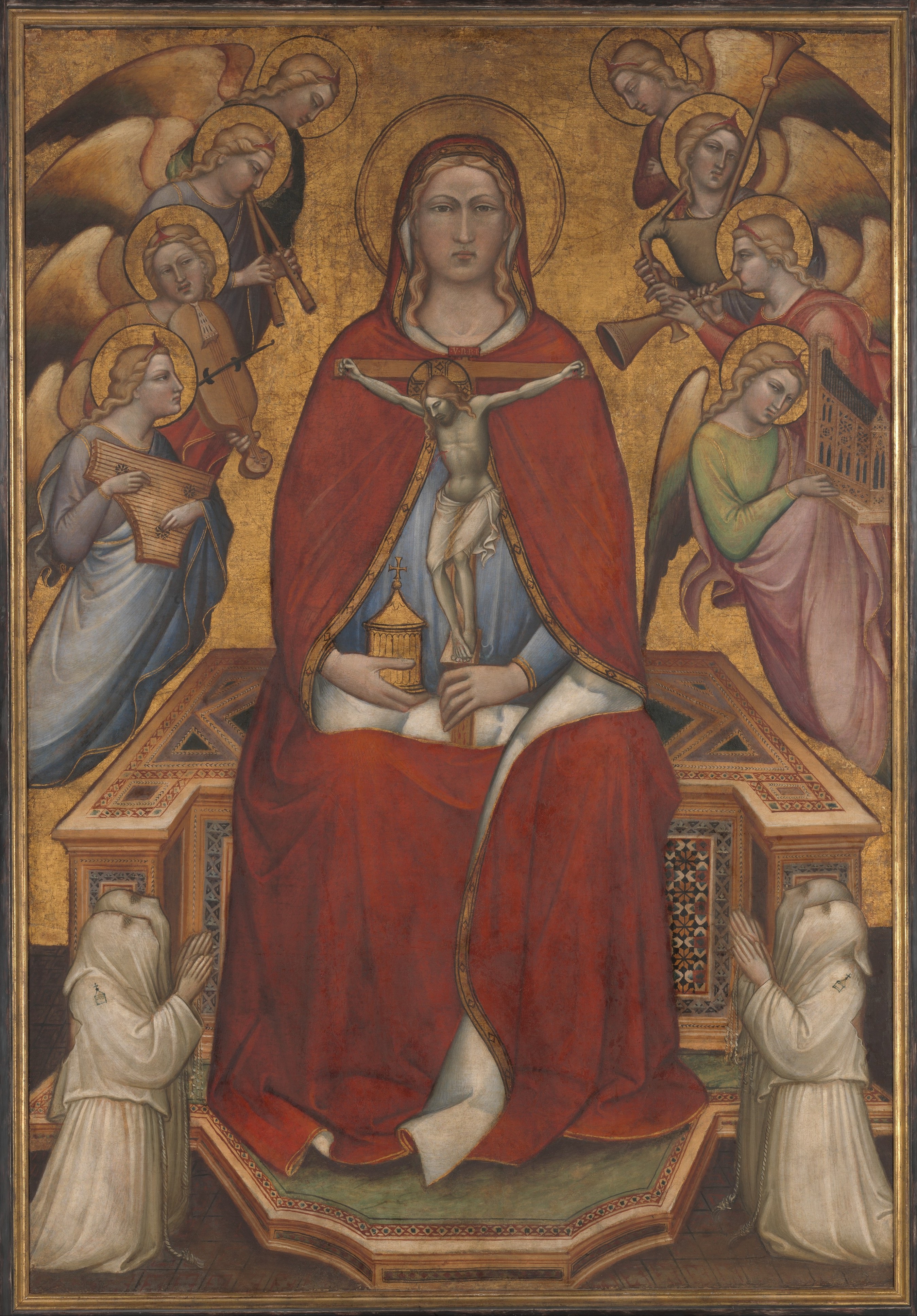
The object under examination—Saint Mary Magdalen Holding a Crucifix; (reverse) The Flagellation—presents a rare convergence of material devotion, painterly discipline, and curatorial paradox. Housed within the Global Heritage corpus and executed in tempera on canvas with a gold ground, the work is a double-sided devotional panel whose primary face depicts the penitent Magdalen, while its reverse carries a Flagellation scene augmented by a photographic facsimile of Christ’s face. As a standalone study, this piece resists easy categorization: it is neither pure painting nor pure relic, neither singular image nor simple diptych. Instead, it operates as a threshold object—a surface designed for procession, touch, and bidirectional viewing, where the economies of suffering and redemption are literally bound on opposing sides of a single support.
For the couture analyst, the vocabulary of garment construction offers an unexpectedly precise lens. A double-sided canvas is, in effect, a reversible textile: two faces, one structural logic, seams that must satisfy both an interior and an exterior audience. The Magdalen face is the public lining—gold, legible, and rhetorically elevated; the Flagellation reverse is the hidden seam—violent, chromatic, and intended for the private gaze of the officiant or the confraternity member who turns the panel to face the altar. This essay argues that the work’s significance lies not in either face alone but in the tensile relationship between them, a relationship that anticipates modern couture’s obsession with the garment as a site of doubled meaning: the visible and the concealed, the sacred and the somatic, the finished surface and the labor beneath.
The Gold Ground as Couture Surface: Materiality, Light, and the Discipline of Tempera
Tempera on canvas with a gold ground is a medium of extraordinary discipline. Unlike oil, which permits revision and blending, tempera demands rapid, decisive brushwork; the pigment dries almost immediately, and the gold leaf beneath establishes a luminous plane that refuses to be overwritten. In couture terms, this is haute construction: a foundation layer—the gold—that functions as both ground and ornament, much like a hand-stitched trame or a metallic thread woven into a bodice. The Magdalen’s drapery, rendered in tempera, achieves a crispness of fold and edge that recalls the knife-pleats of a couture skirt: each line is intentional, each shadow a decision.
The gold ground is not mere background; it is an active participant in the image’s temporality. As light shifts across the canvas, the gold recedes or flares, causing the Magdalen’s figure to oscillate between presence and dissolution. This is the same phenomenon exploited by couturiers who use lamé or metallic organza: the garment is never fully stable, never fully “finished” in the viewer’s eye. The Magdalen holds a crucifix, her gaze directed downward, her body angled in penitential torsion. The gold behind her does not illuminate her so much as suspend her—a technique that transforms a devotional portrait into a meditation on the instability of the visible world.
The Reverse Face: Flagellation, Facsimile, and the Ethics of Reproduction
The reverse of the panel introduces a different order of representation. The Flagellation is a scene of bodily violence, rendered in tempera but without the gold ground’s unifying radiance. Here, the palette is earthier, the figures more crowded, the composition more narrative than iconic. Yet the most provocative element is the photographic facsimile of Christ’s face—a modern intervention that disrupts the historical integrity of the object. This facsimile is not a restoration; it is a supplement, a technological graft onto a pre-modern surface.
From a curatorial standpoint, the facsimile raises urgent questions. Does it complete the Flagellation scene, or does it betray it? In couture, the equivalent gesture is the visible repair—the gold seam on a kimono, the contrasting patch on a denim jacket. These interventions acknowledge damage while refusing to erase it. The photographic face of Christ functions similarly: it is a confession of loss, a marker of the original paint’s disappearance, and a new layer of meaning. The viewer who turns the panel from Magdalen to Flagellation does not simply change scenes; they change epistemologies. The Magdalen face asks for contemplative identification; the Flagellation reverse, with its photographic face, asks for historical self-consciousness. One side is theology; the other is archive.
Standalone Study: The Object Without Context
As a standalone study, this work is deliberately decontextualized. We do not know its original altarpiece, its confraternity, or its precise date. This absence is productive. It forces the analyst to treat the object as a fragment—and fragments, in both couture and art history, are often more revealing than complete ensembles. A fragment shows the seams, the stitching, the raw edge. It exposes the labor that a finished work conceals.
The Magdalen/Flagellation panel, in its double-sidedness, is a fragment of a larger devotional choreography. It was likely carried in procession, turned to face the congregation, then turned again for private prayer. Its canvas support—flexible, lightweight—suggests portability, much like a couture garment designed for travel. The gold ground, however, anchors it to the altar. This tension between mobility and fixity, between public display and private meditation, is the work’s central couture problem: how to make a surface that serves two audiences without compromising either.
Conclusion: The Reversible Sacred
Saint Mary Magdalen Holding a Crucifix; (reverse) The Flagellation is not a single artwork but a dialectical object. Its tempera-on-canvas construction, gold ground, and photographic facsimile create a stratified surface where medieval devotion meets modern intervention. For Katherine Fashion Lab, the lesson is clear: the most sophisticated designs are those that acknowledge their own reversibility—their ability to be read from multiple sides, by multiple gazes, without resolving into a single truth. The Magdalen weeps; the Flagellation wounds; the facsimile remembers. Together, they form a garment of faith whose seams are never fully closed.