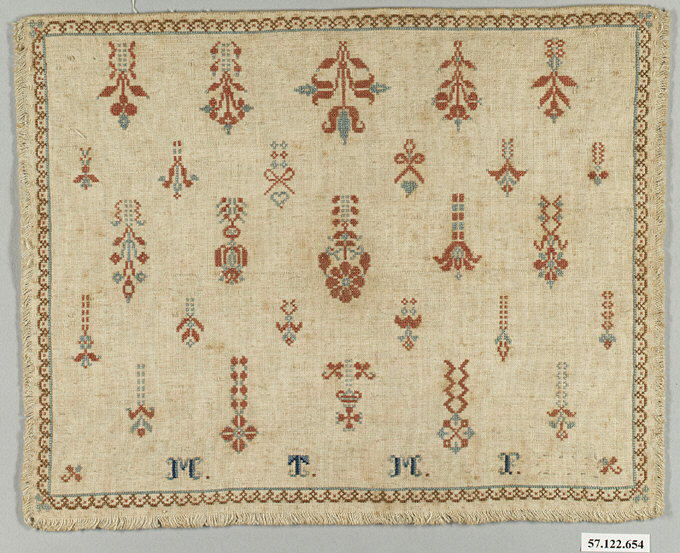
The Sampler as Autonomous Artifact: Silk on Linen in Global Heritage
The textile commonly designated as a sampler occupies an ambiguous position within the hierarchies of material culture. Historically consigned to the category of pedagogical exercise or domestic accomplishment, the sampler has rarely been granted the interpretive seriousness afforded to painting, sculpture, or even the more monumental textile arts such as tapestry. Yet when examined through the lens of connoisseurship rather than domestic history, the sampler emerges as a sophisticated site of technical experimentation, semiotic density, and cross-cultural transmission. The present study considers a standalone sampler executed in silk on linen, situating it within the broader framework of global heritage and arguing for its reconsideration as an autonomous aesthetic object rather than a mere precursor to finished work.
Material Logic: The Tension of Silk and Linen
The choice of ground and thread is never neutral. Linen, produced from the bast fibers of the flax plant, offers a rigid, open weave whose regularity imposes a grid upon the maker. This grid is simultaneously a constraint and a generative structure—a proto-pixel system that disciplines the hand while enabling precise calculation of stitch and interval. Silk, by contrast, introduces luminosity, fluidity, and a certain recalcitrance. Where linen is matte and structural, silk is reflective and responsive; it catches light along the twist of the filament and shifts in hue depending on the angle of view.
The marriage of silk on linen therefore produces a productive antagonism. The linen ground asserts order; the silk thread introduces variance. In the sampler under consideration, this dialectic is legible in the way certain motifs appear to float above the surface while others recede into the weave. The maker has exploited the differing tensile properties of the two materials—silk's elasticity against linen's relative inelasticity—to create areas of raised relief and flattened ground. Such manipulation anticipates techniques later codified in whitework, blackwork, and the raised embroidery traditions of both European and non-European courts.
Global Heritage and the Mobility of Motif
To describe the sampler as belonging to "global heritage" is not to flatten its specificities but to acknowledge the extraordinary mobility of its constituent motifs. The standalone study under examination displays a repertoire that resists singular geographic attribution. One encounters here the double-running stitch associated with Italian punto scritto, there a cross-stitch border reminiscent of Mexican otomi tenango work, and elsewhere a counted satin stitch whose density evokes the kesi silk tapestries of China. These are not citations in the postmodern sense but evidence of a longue-durée exchange along trade routes, missionary networks, and colonial circuits.
The sampler thus functions as a kind of material archive—a portable repository of techniques encountered, adapted, and recombined. Its maker may have been a young woman in a European convent school, a professional embroiderer in a South Asian workshop, or an amateur in the Americas; the object itself does not disclose. What it does disclose is a cosmopolitan visual vocabulary that predates the modern art market's categories of "Western" and "non-Western." In this sense, the sampler challenges the geographic parochialism that still lingers in histories of decorative art.
Composition and the Aesthetics of Accumulation
Unlike the tapestry, which subordinates part to whole in service of a unified iconographic program, the sampler proceeds by accumulation. Motifs are arrayed in bands, registers, or scattered fields, often without a single vanishing point or hierarchical focal area. This additive logic has been read as evidence of the sampler's status as a trial piece—a place to test stitches rather than to compose a picture. However, such a reading undervalues the aesthetic intelligence at work.
In the present object, the distribution of silk passages across the linen ground creates a rhythm of density and void that is unmistakably compositional. Dense floral clusters in the upper register give way to sparser geometric bands below, producing a visual deceleration that guides the eye downward. The use of negative space—unworked linen left exposed—is deliberate rather than incidental. It functions as a kind of silence, allowing the silk's sheen to register more forcefully when it does appear. This is not the composition of a sketchbook but of a catalogue raisonné in thread.
Conservation, Display, and the Question of Autonomy
Museums have historically displayed samplers in period rooms or domestic interiors, framed as documents of female education. Such contextualization, while informative, risks reducing the object to a biographical footnote. A more productive curatorial approach treats the sampler as a standalone study—an object whose value inheres in its material and formal properties rather than in its documentary function. This shift has precedents: the reevaluation of cartoons as independent drawings, the elevation of the modello in Renaissance studies, and the recent attention to test plates in print history.
Under raking light, the silk on linen reveals its sculptural dimension. Threads cast micro-shadows; the linen's weave becomes a legible ground rather than a neutral support. Conservation protocols must therefore balance the stabilization of silk's inherent fragility—its susceptibility to light, moisture, and abrasion—against the retention of the object's tactile presence. Over-cleaning or over-mounting can flatten the very relief that constitutes its aesthetic argument.
Conclusion: Toward a Critical Appreciation
The silk-on-linen sampler deserves to be read as a critical object—one that interrogates the boundaries between craft and art, exercise and expression, local and global. Its material logic, its compositional intelligence, and its embeddedness in networks of exchange all argue for a mode of attention that is neither antiquarian nor merely biographical. In the context of global heritage, the sampler is not a minor curiosity but a sophisticated negotiation between structure and freedom, discipline and invention. To study it closely is to recover a history of making that has too often been overlooked—and to recognize in its delicate surface a form of knowledge that is, in the fullest sense, material.