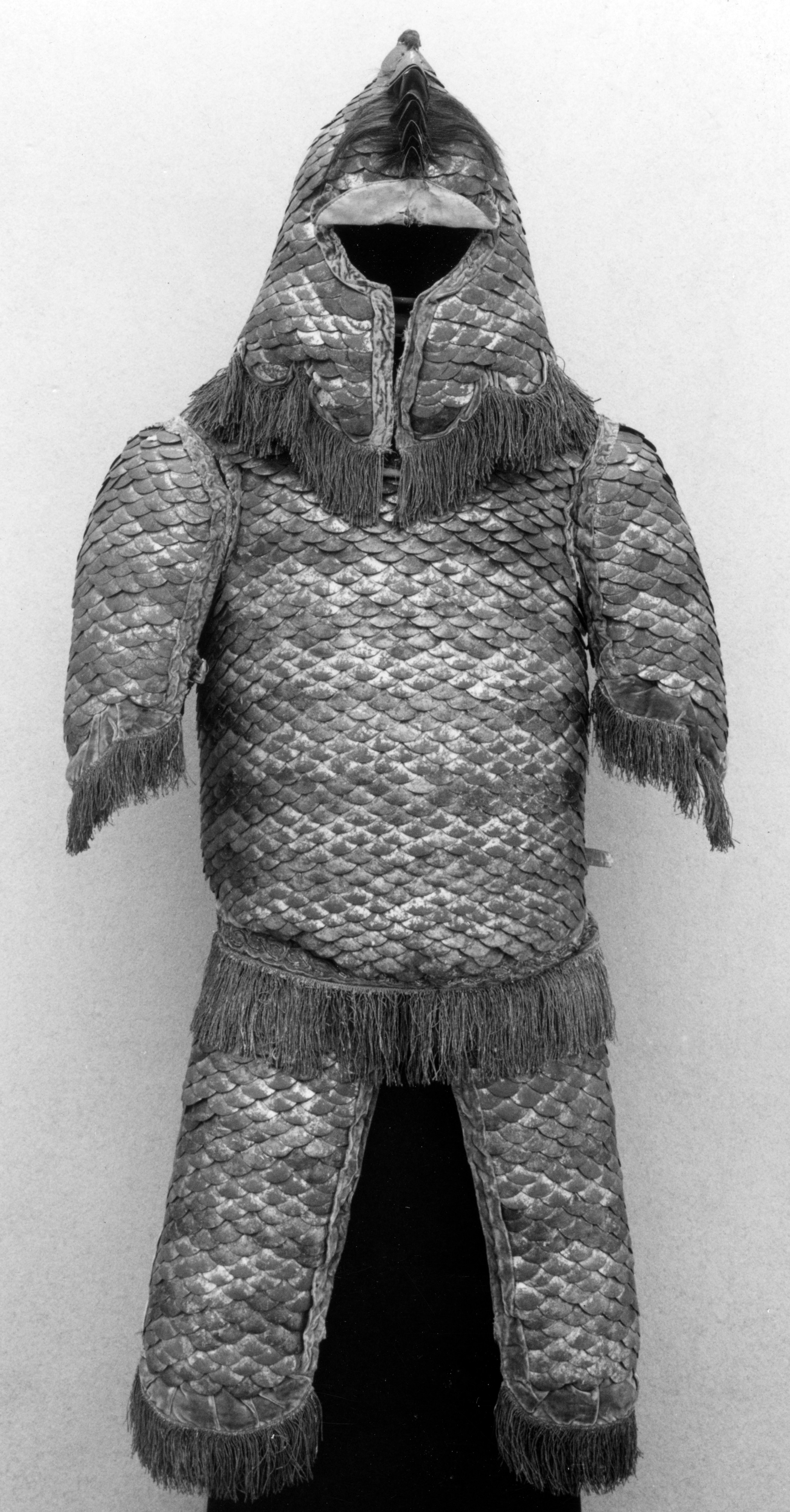
Scale Armor: A Study in Structural Elegance and Material Synthesis
Within the expansive taxonomy of global protective garments, Chinese scale armor occupies a rarefied position—not merely as a utilitarian artifact of military history, but as a sophisticated negotiation between metallurgical rigidity and textile suppleness. This standalone study examines the form through the dual lenses of couture construction and material anthropology. The object in question, composed of iron and tin scales mounted upon a substrate of hemp and velvet, embellished with pigment and gold, represents a convergence of disciplines that prefigures contemporary haute couture’s obsession with hybridized surfaces. For the modern designer, it offers an enduring lesson in how disparate materials—base and precious, rigid and fluid—can be orchestrated into a coherent visual and tactile statement.
Historical Provenance and Functional Logic
Scale armor (lin jia or yu lin jia) emerged in China during the Warring States period and matured through the Han and Tang dynasties. Unlike lamellar armor, which binds individual plates into horizontal rows, scale armor overlaps small, leaf-shaped plates in a manner analogous to fish scales or roof tiles. This overlapping configuration distributes impact force across multiple points, allowing the garment to flex with the wearer’s body while maintaining defensive integrity. The choice of iron as the primary metal provided hardness; tin, often alloyed or used as a coating, contributed corrosion resistance and a muted, silvery luster. The result was a surface that shifted from matte to reflective depending on the angle of light—an early instance of what we might now call dynamic materiality.
Yet the armor was never purely functional. The textile foundation—hemp for durability and breathability, velvet for prestige in later ceremonial iterations—elevated the object beyond the battlefield. Hemp, woven tightly, acted as a shock-absorbing cushion and a means of securing scales with silk or leather cord. Velvet, introduced through Silk Road exchanges, introduced an element of tactile luxury that would have been unthinkable in purely combat-oriented gear. This duality—protection and ornamentation—is the crux of its couture relevance.
Material Composition: A Study in Contrast and Cohesion
The constituent materials of this scale armor demand close reading. Iron supplies structural memory; it resists deformation and lends the garment a sense of gravitas. Tin, whether as an alloying element or surface treatment, softens the iron’s ferrous harshness, introducing a cool, pewter-like sheen. Together, these metals create a palette of grays that range from gunmetal to silver, a neutral foundation upon which pigment and gold can perform.
Hemp functions as the hidden architecture. Its coarse weave grips the scales, preventing slippage, while its breathability prevents the accumulation of moisture—a critical consideration for a garment worn in active contexts. Velvet, by contrast, is the visible luxury. Where hemp is structural, velvet is sensorial. Its pile absorbs light, creating depths that contrast with the metallic scales’ reflections. This interplay of absorption and reflection is a fundamental principle of couture finishing, where matte and gloss are balanced to guide the eye.
Pigment and gold complete the composition. Pigments—likely mineral-based, such as cinnabar or azurite—were applied to the textile or the scales themselves to denote rank, allegiance, or ritual function. Gold, applied as leaf or wire inlay, transformed the armor into a ceremonial object. In couture terms, gold is not merely decoration; it is a material that changes the wearer’s relationship to light and movement. A gilded scale catches the eye and holds it, creating focal points that disrupt the uniform rhythm of the armor’s surface.
Couture Techniques: Overlap, Binding, and Articulation
The construction of scale armor anticipates several techniques central to modern couture. First, overlapping—the systematic layering of scales—is a direct precursor to the overlapping sequin and paillette work seen in houses such as Paco Rabanne and Elie Saab. The principle is identical: small, individual units are linked to create a continuous, flexible surface. Second, binding: the scales are secured not with rigid rivets alone but with cord or wire that allows slight movement. This articulation is what separates armor from sculpture. The garment must move with the body, and the binder—whether silk, leather, or metal wire—is the mediator.
Third, edge finishing. The borders of each scale are often rolled or beveled to prevent chafing and to create a subtle rim of light. In couture, edge finishing is the difference between a garment that looks handmade and one that looks industrial. The Chinese armorers understood that the perimeter of each component is as important as its face. Finally, integration of textile and metal. The velvet or hemp is not a mere backing; it is a co-equal surface. In contemporary practice, this corresponds to the use of bonded fabrics, where metal foils or films are laminated to silk or wool, creating a single material with dual properties.
Symbolism and the Aesthetics of Protection
Beyond technique, scale armor carries symbolic weight. The fish-scale motif is associated with water, adaptability, and abundance in Chinese cosmology. A warrior clad in scale armor embodies fluidity within strength—a philosophical position that resonates with modern fashion’s fascination with protective yet sensual garments. The gold and pigment introduce a hierarchy of value: the armor is not merely a tool but a treasure. This tension between utility and preciousness is precisely what defines haute couture today, where a garment may be worn once yet represents hundreds of hours of labor and the finest materials available.
For Katherine Fashion Lab, this study yields actionable insights. The scale armor suggests a methodology for combining rigid and soft materials without sacrificing either’s integrity. It demonstrates that ornamentation can be structural, that binding can be expressive, and that a garment’s interior (the hemp) deserves as much consideration as its exterior (the gold). It also reminds us that protection and beauty are not opposites; they are, in the most sophisticated design, inseparable. The Chinese scale armor is not a relic. It is a template for a future couture that is at once armored and fluid, historical and radically new.