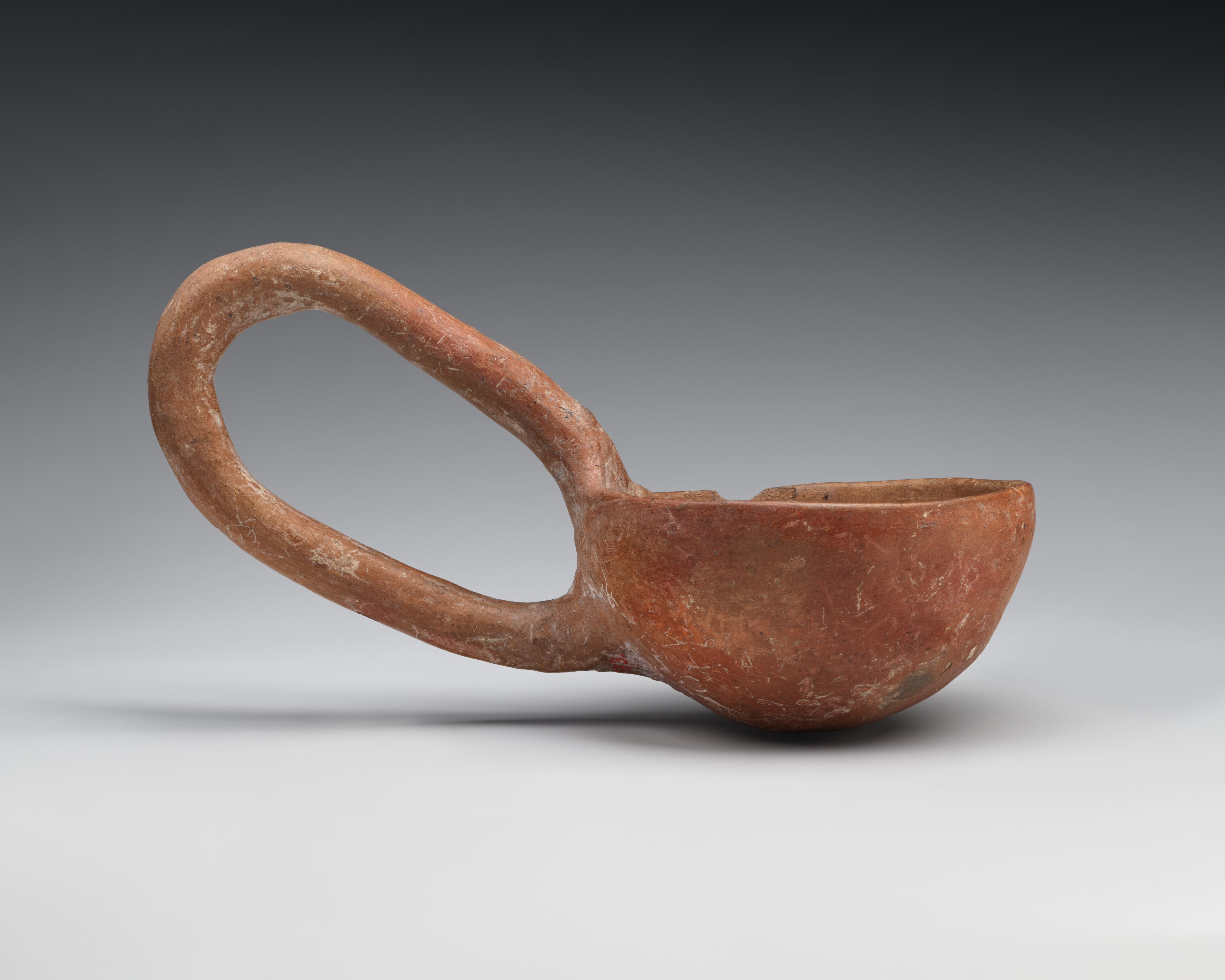
Strategic Heritage Analysis: The Cypriot Terracotta Ladle as a Foundational Object for Katherine Fashion Lab
This standalone research paper, prepared for the strategic development of Katherine Fashion Lab, conducts a deep heritage analysis of a singular artifact: a Cypriot terracotta ladle. Dated broadly within the ancient to late antique period, this object transcends its mundane functional classification to reveal a dense nexus of cultural symbolism, ritual practice, and social adornment. Our analysis deconstructs its layered meanings to extract core principles that will inform a forward-looking, high-end luxury strategy for the 2026 collection and beyond. The objective is to transform archaeological insight into brand patrimony, positioning Katherine Fashion Lab at the intersection of profound cultural narrative and avant-garde craftsmanship.
Deconstructing the Object: From Utensil to Vessel of Symbolic Power
Superficially, a terracotta ladle from Cyprus is an implement of daily life—used for serving wine, oil, or grain. However, its context within Cypriot society, a crucible of Eastern Mediterranean trade, religious syncretism, and artistic exchange, imbues it with deeper significance. The ladle’s form is inherently dualistic: a receptacle (the bowl) and an extension (the handle). This duality mirrors fundamental human actions: receiving and offering, containing and pouring. In ritual settings, linked to the cults of fertility goddesses like Aphrodite (born from Cypriot sea foam) or Demeter, the ladle was not merely a tool but a consecrated instrument for libations. The act of pouring a liquid offering was a sacred transaction, a channeling of divine favor. The terracotta medium itself, fired earth, connects the object to the chthonic and the generative powers of the land—a core Cypriot value. Thus, the ladle’s symbolic power lies in its role as a mediator: between human and divine, between the abundance of the earth and the community, between the private act and the public ritual.
Historical Adornment and the Body as Ritual Site
The concept of adornment, central to fashion, must be expanded beyond personal jewelry or garment to encompass the adornment of ritual actions and sacred spaces. The ladle, in its highly decorated iterations, often featured applied figures, painted motifs, or intricate handle terminals in the form of animals, goddesses, or floral volutes. These were not mere decoration; they were amplifiers of intent. A ladle adorned with a dove (sacred to Aphrodite) transformed the act of pouring into an invocation of love and fertility. A handle terminating in a pomegranate (symbol of Persephone and the underworld cycle) spoke of death and rebirth. The user, by wielding this object, became part of a performative chain—their body, gesture, and the adorned object were unified in a single statement of cultural and spiritual identity. For Katherine Fashion Lab, this presents a critical insight: adornment is not passive embellishment but an active semantic layer that changes the meaning of the gesture and the status of the wearer. The body becomes the site where heritage is activated, much as the priestess’s hand activated the symbolic power of the ladle.
Extracted Spiritual Meaning: Containment, Offering, and Flow
The spiritual lexicon of the Cypriot ladle offers three potent conceptual pillars for brand narrative. First, The Sanctity of the Vessel: The bowl represents containment, potential, and the sacred interior. It is a protected space holding value (liquid, offering, essence). Second, The Intention of the Offer: The handle represents direction, agency, and the graceful transfer of this contained value. It is the vector of generosity, connection, and deliberate action. Third, The Cycle of the Libation: The complete action—from dipping, to lifting, to pouring—represents a cyclical flow of energy, a reciprocal exchange between giver and receiver, mortal and immortal. This triad moves beyond the literal to inform a philosophy of design: pieces should feel like vessels for personal essence, facilitate meaningful connection (the offer), and participate in a larger cycle of cultural and aesthetic reciprocity.
Strategic Application: 2026 High-End Luxury Brand Strategy
Integrating this heritage analysis into a concrete 2026 luxury strategy requires moving from archaeology to alchemy—transforming clay into gold, metaphorically. The strategy rests on four pillars:
Pillar 1: The New Ritual Object
Position Katherine Fashion Lab creations not as mere accessories but as modern ritual objects for secular life. A clutch bag is re-framed as a "vessel" for one’s essentials (The Sanctity of the Vessel). The act of gifting a KFL piece is elevated to a ceremonial "offering" of great personal significance. Design collections around the triad of Contain, Offer, Flow, creating pieces that speak to each phase of a meaningful gesture.
Pillar 2: Material Alchemy & Terracotta Legacy
Honor the terracotta medium through advanced material innovation. Develop proprietary composite ceramics with the warmth and texture of fired clay but the durability and finish of high jewelry. Partner with avant-garde material scientists to create "liquid terracotta" resins or sintered minerals that capture the essence of the Cypriot earth. This creates a unique, defensible, and story-rich material signature for the brand.
Pillar 3: Adornment as Semiotic System
Incorporate handle, terminal, and receptacle motifs into hardware, closures, and structural elements. A buckle is not a buckle; it is a volute terminal inspired by a ladle handle. A bag’s shape echoes the generous, containing bowl. Embroideries and prints should not be random patterns but modern glyphs derived from Cypriot floral and animal symbolism, each carrying a defined narrative of connection, growth, or protection.
Pillar 4: The Cypriot Nexus Narrative
Leverage Cyprus’s historical position as a cultural nexus. This aligns perfectly with the global, interconnected luxury consumer. Brand messaging should emphasize syncretic elegance—the beautiful fusion of influences (East/West, Earth/Sea, Mortal/Divine) into a coherent, powerful whole. This positions KFL as a brand for cosmopolitan individuals who themselves are vessels of multiple cultures and experiences.
Conclusion: From Ancient Libation to Modern Legacy
The Cypriot terracotta ladle, through this strategic analysis, is revealed as a foundational metaphor for Katherine Fashion Lab. Its symbolic power, context of ritual adornment, and spiritual meaning provide a rich, untapped vein of heritage that is both specific and universally resonant. The 2026 strategy, built upon this foundation, will allow KFL to launch a distinctive narrative in the crowded luxury landscape. By championing the principles of the sacred vessel, intentional offering, and cyclical flow, the brand will cultivate an aura of depth, purpose, and timeless connection. We are not merely designing accessories; we are crafting contemporary heirlooms that carry the weight of history and the intention of a modern ritual, transforming the wearer from consumer into curator and celebrant of a newly awakened lineage.