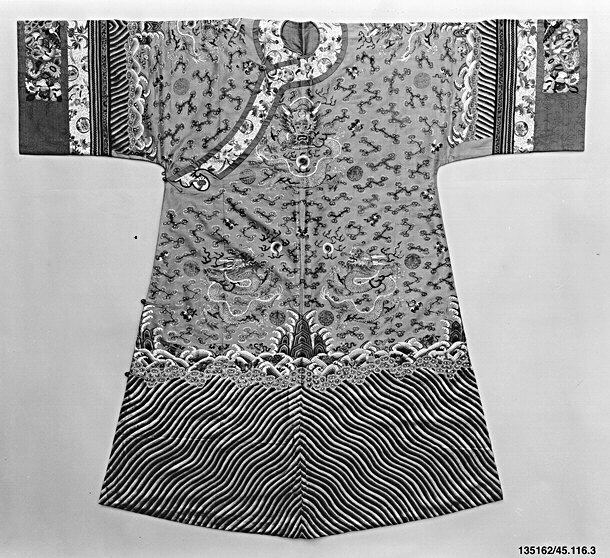
Imperial Court Robe: A Study in Silk on Silk
The Imperial Court Robe stands as one of the most technically demanding and symbolically dense artifacts in the history of global couture. Within the Qing dynasty court wardrobe—particularly from the Kangxi through the Qianlong reigns—the formal dragon robe (longpao) functioned not merely as ceremonial dress but as a portable cosmology. Every element, from the placement of the five-clawed dragon to the precise shade of the ground silk, was codified by sumptuary law. This standalone study examines the robe as a singular object of material mastery, where silk is not simply the substrate but the very medium of imperial authority.
Materiality: The Silk on Silk Construction
The phrase "silk on silk" understates the layered complexity of the object. The foundation is typically a tabby-woven silk ground—often a rich midnight blue, imperial yellow, or apricot—selected for its density and receptivity to dye. Onto this ground, the decorative program is executed through a combination of silk embroidery (using floss silk threads in satin, couching, and Peking knot stitches) and silk tapestry weave (kesi), where the pattern is woven directly into the fabric rather than applied after. In the most prestigious examples, the two techniques coexist: the dragon's scales may be embroidered in twisted silk for dimensional relief, while the surrounding cloud forms are woven in fine silk tapestry to achieve a flat, painterly gradient.
This dual application of silk—as structural ground and as decorative overlay—creates a textile that is simultaneously robust and ethereal. The embroidery threads, often untwisted for maximum sheen, catch light in ways that mimic the glint of gold, yet remain purely proteinaceous. The result is a garment that feels heavy with meaning but light in the hand, a paradox that mirrors the Confucian ideal of the ruler: outwardly commanding, inwardly refined.
Symbolic Cartography: Reading the Robe
No analysis of the Imperial Court Robe can ignore its iconographic program, which operates as a form of sartorial governance. The central motif—the five-clawed dragon (long)—is reserved exclusively for the emperor and select princes of the first rank. Positioned at the chest, back, and shoulders, the dragons are typically depicted in pursuit of a flaming pearl, a symbol of wisdom and the cosmic principle. Surrounding them are the Twelve Symbols, a set of ancient emblems that legitimize the emperor's mandate: the sun, moon, stars, mountains, dragons, pheasants, sacrificial vessels, aquatic grass, grains of millet, fire, axe, and the fu pattern.
Critically, the placement of these symbols is not decorative but hierarchical. The sun and moon are positioned on the shoulders, signifying the emperor's illumination of the world. The mountains sit at the chest, representing stability. The aquatic grass and grains are placed near the hem, grounding the sovereign in agricultural fertility. This spatial logic transforms the wearer into a living diagram of ideal governance—a mandala in silk.
Technical Mastery: The Artisan's Invisible Hand
The production of a single court robe involved dozens of specialized artisans across the Imperial Silk Manufactories in Jiangnan (Nanjing, Suzhou, and Hangzhou). The process began with the cultivation of mulberry silkworms, followed by reeling, throwing, and dyeing. The most demanding phase was the embroidery, executed on a frame that held the silk ground taut. A single dragon scale might require hundreds of tiny stitches, each angled to reflect light consistently across the motif. The Peking knot—a French-knot variant—was used for the dragons' eyes and claws, giving them a three-dimensional intensity that stares back at the viewer.
What distinguishes the Imperial Court Robe from contemporaneous European court dress is the absence of visible seams or tailoring cuts that interrupt the pattern. The robe is constructed from a single length of silk where possible, with joins concealed within the embroidery. This continuous-surface approach reflects a philosophical preference for wholeness over articulation, unity over division. The body of the wearer disappears beneath the garment; only the cosmic program remains visible.
Conservation and Contemporary Resonance
Today, surviving Imperial Court Robes present significant conservation challenges. The silk ground is often degraded by light exposure, while the embroidery threads—dyed with organic colorants like indigo, safflower, and gardenia—fade at different rates. Conservators must stabilize the textile without obscuring the original stitch tension, a task that requires both technical skill and art-historical sensitivity. The robe is no longer worn, but it continues to function as a teaching object, revealing the intersection of material science, political theology, and aesthetic refinement.
For the contemporary couturier, the Imperial Court Robe offers a masterclass in restraint and excess. Its palette is limited—often no more than five colors—yet its pattern density is extraordinary. Its silhouette is simple, yet its surface is a universe. In an era of digital printing and synthetic fibers, the robe reminds us that true luxury is not the speed of production but the depth of intention. Each stitch is a decision; each dragon is a decree. The silk on silk is not merely fabric on fabric—it is meaning on meaning, layered until the garment becomes a text.
As a standalone study, the Imperial Court Robe resists reduction to a single interpretation. It is at once a garment, a document, a ritual object, and a work of art. Its legacy in the Katherine Fashion Lab collection is not its rarity alone, but its demonstration that couture, at its highest level, is a form of governance—over materials, over symbols, and over the imagination of the viewer.