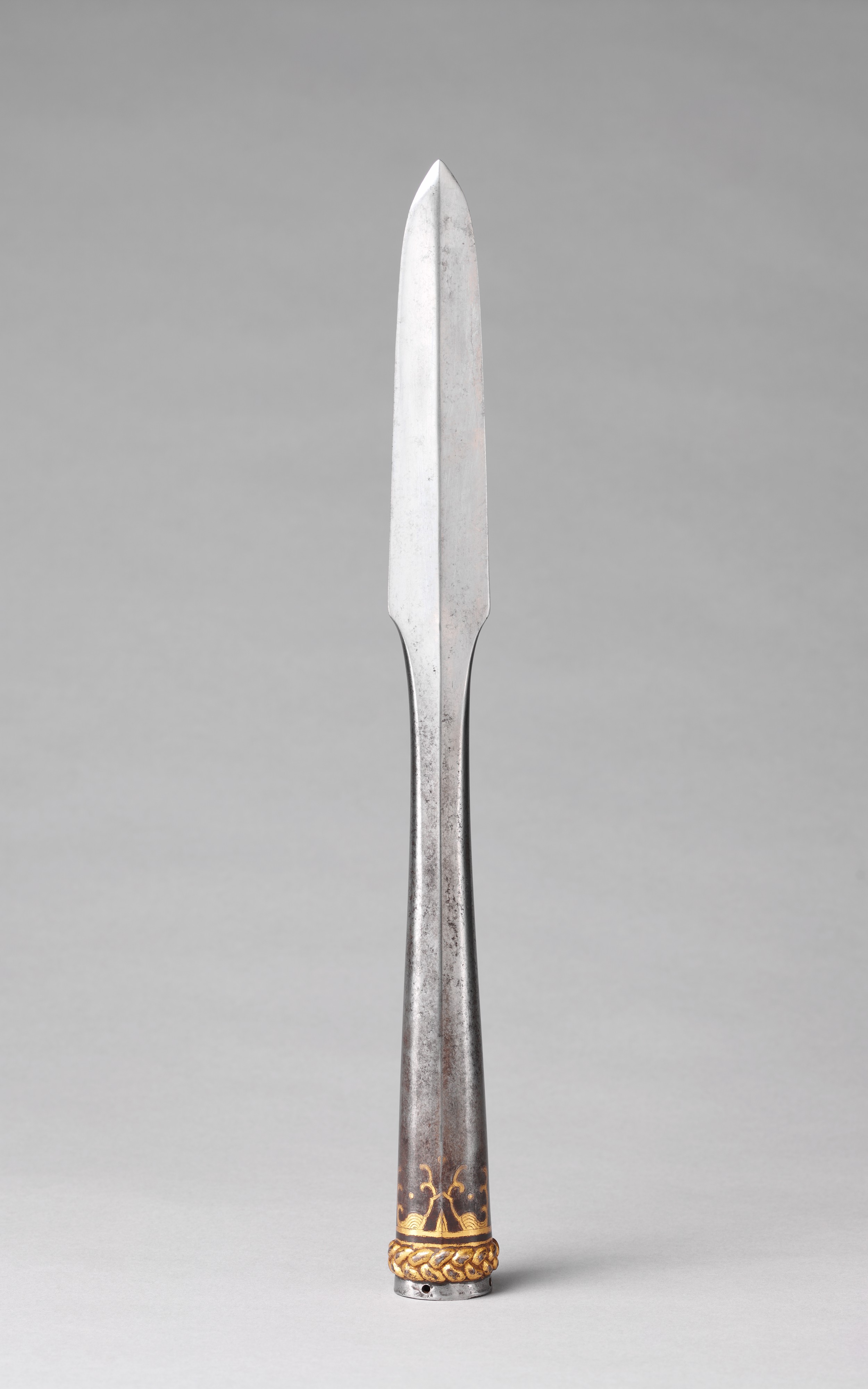
Heritage Asset Analysis: Qing Spearhead and Tibetan Storage Case
Katherine Fashion Lab — Strategic Standalone Research
Within the expanding portfolio of Katherine Fashion Lab's heritage assets, few objects present a more compelling convergence of martial symbolism, spiritual utility, and material sophistication than the Qing spearhead and its accompanying Tibetan storage case. This analysis examines the object's layered provenance, its symbolic and spiritual functions across Chinese, Mongolian, and Tibetan cultural spheres, and its strategic positioning potential within the 2026 high-end luxury market.
Material Composition and Craftsmanship
The spearhead itself is forged from steel, with gold inlay or gilding applied to select surfaces. This combination is significant: in Qing-era metallurgy, gold was not merely decorative but signaled rank. The application of gold to a weapon of war transformed it from a utilitarian implement into a marker of aristocratic or imperial association. The blade's profile—likely a willow-leaf or triangular form characteristic of Qing military regulation—embodies the dynasty's synthesis of Han Chinese, Manchu, and Mongol martial traditions.
The storage case introduces a distinct cultural layer. Attributed to Tibetan craftsmanship, it incorporates leather, copper fittings, and possibly cork or wood as structural or protective elements. Tibetan artisans were renowned for their ability to construct devotional and utilitarian containers that honored the object within. The case functions not as passive packaging but as an active agent of preservation—materially, ritually, and symbolically. Copper, associated with protection in Tibetan Buddhist material culture, reinforces this reading.
Symbolic Power and Historical Adornment
In Qing and Mongolian contexts, the spear carried meanings far beyond combat. As a weapon of the mounted warrior tradition, it embodied erke—power, authority, and the legitimate right to command. Mongolian martial culture venerated the spear as an extension of the warrior's body and spirit. When adorned with gold, the weapon entered the sphere of courtly display, functioning as an emblem of imperial favor or hereditary status. Such objects were often presented as gifts within diplomatic exchanges, binding alliances through material generosity.
The act of storing the spearhead in a dedicated case—rather than displaying it openly—introduces a contemplative dimension. In Tibetan practice, the careful enclosure of sacred or powerful objects is itself a ritual act. The case may have served to contain the spearhead's potency, protecting both the object and its environment from unmediated contact. This tension between display and concealment, between martial aggression and monastic restraint, gives the object its distinctive cultural charge.
Spiritual Meaning Across Traditions
The spearhead's spiritual resonance operates on multiple registers. In Tibetan Buddhist iconography, weapons frequently appear as attributes of protective deities—symbols not of violence but of the cutting of ignorance and the defense of the dharma. A spearhead housed in a Tibetan case may have been understood as a consecrated instrument, its martial origins subordinated to a protective, apotropaic function.
Simultaneously, in Chinese and Mongolian contexts, the spear was linked to celestial authority. The Qing imperial cult venerated martial efficacy as a manifestation of legitimate rule. The gold adornment thus participates in a cosmology in which material splendor reflects cosmic order. The object's journey from battlefield implement to enshrined relic traces a broader pattern in Inner Asian material culture: the transformation of instruments of power into objects of veneration.
Strategic Positioning for 2026 Luxury
For Katherine Fashion Lab, this object offers a rare opportunity to operate at the intersection of three luxury narratives currently converging in the high-end market: provenance-driven authenticity, spiritual-material hybridity, and cross-cultural craftsmanship.
First, the object's layered provenance—Qing or Mongolian spearhead, Tibetan case—resists simple categorization. This complexity is an asset. Contemporary luxury consumers increasingly value objects that carry unresolved histories, that invite inquiry rather than deliver instant legibility. The spearhead-case ensemble can be positioned as a "conversation object," its meaning unfolding through research and contemplation.
Second, the object's spiritual dimension aligns with the 2026 luxury market's growing appetite for objects that function as secular relics. In an era of digital saturation, tangible artifacts that embody protection, power, and contemplation command premium positioning. The case's protective function can be narratively extended to the consumer: this is not merely a collectible but a guardian object, a talisman for the modern connoisseur.
Third, the cross-cultural craftsmanship—steel and gold, leather and copper, Chinese and Tibetan—supports a strategy of heritage fusion. Katherine Fashion Lab can present the object as a case study in pre-modern globalization, demonstrating that luxury has always been transcultural. This positions the brand not as a custodian of a single tradition but as a curator of interconnected histories.
Recommendations
Katherine Fashion Lab should consider the following strategic moves. Research investment: commission metallurgical analysis and provenance tracing to establish the spearhead's specific cultural attribution and the case's date of manufacture. Narrative development: construct a curatorial narrative that foregrounds the object's dual identity—weapon and relic, aggression and protection—as a metaphor for contemporary luxury's own tensions. Product translation: explore limited-edition accessories or objets d'art that abstract the spearhead-case relationship—containment, adornment, protection—into wearable or displayable forms. Market positioning: target collectors of Asian antiquities and spiritual-material hybrid objects, emphasizing the piece's rarity as a complete ensemble.
The Qing spearhead and Tibetan case is not merely an artifact of martial history. It is a meditation on power and its containment, on the transformation of violence into veneration. For Katherine Fashion Lab, it represents a strategic asset capable of anchoring a 2026 collection around themes of protection, provenance, and the poetry of materials.