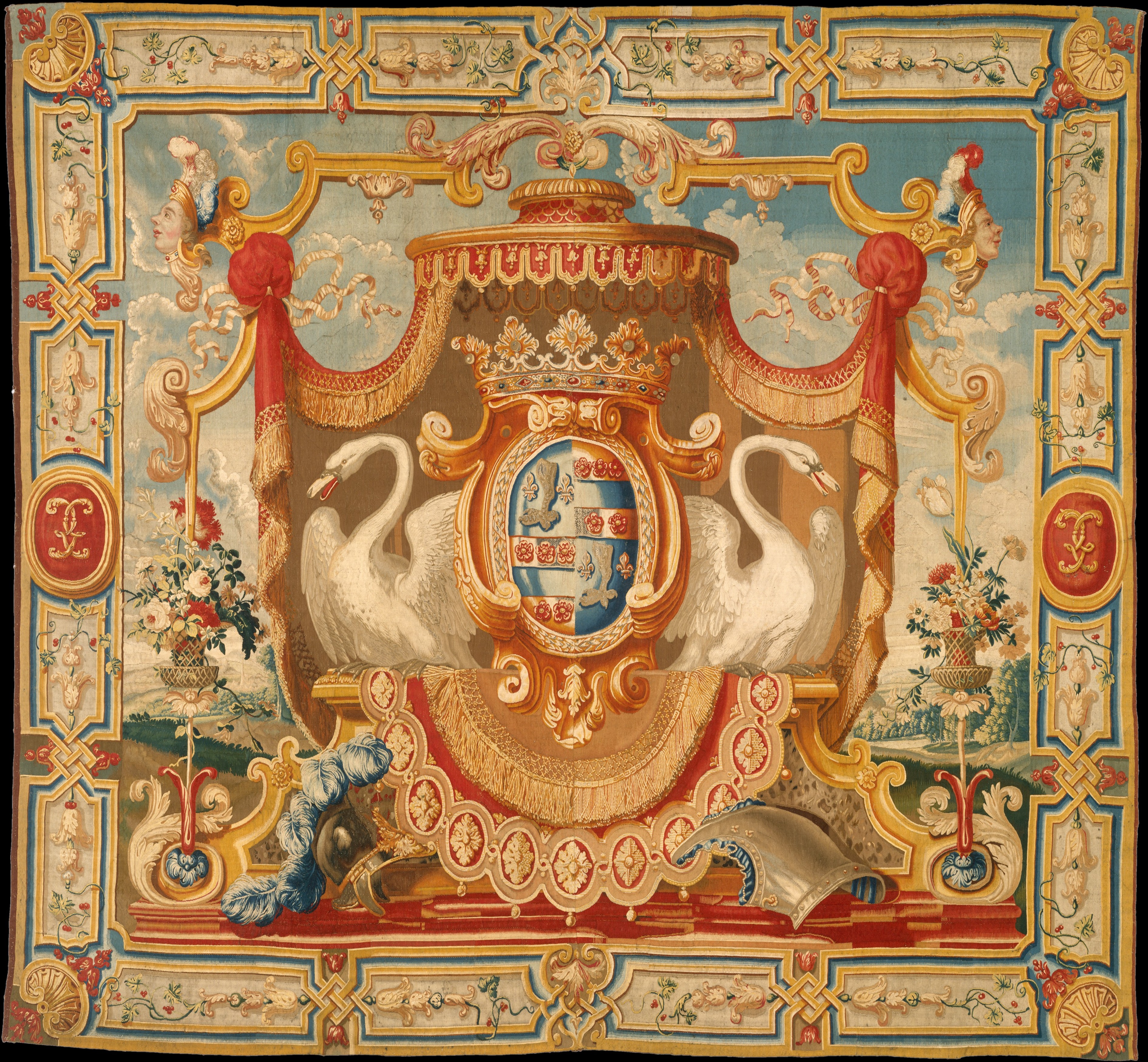
Arms of the Greder Family of Solothurn: A Study in Swiss Textile Heraldry
The Arms of the Greder Family of Solothurn represents a singular convergence of Swiss civic identity, heraldic precision, and the technical virtuosity of pre-industrial European textile production. As a standalone study within the Global Heritage collection at Katherine Fashion Lab, this piece demands close material analysis and contextual framing that situates it not merely as a decorative object but as a document of social ambition, political consolidation, and artisanal excellence. The Greder family, prominent in the canton of Solothurn from the late medieval period through the early modern era, commissioned armorial textiles that served simultaneously as genealogical markers, diplomatic instruments, and displays of wealth. This particular work—executed in wool, silk, and metal thread at a weave density of 20–22 warps per inch (8–9 per centimeter)—exemplifies the highest standards of Swiss textile heraldry.
Historical Context and the Greder Lineage
Solothurn, one of the oldest cities in Switzerland and a canton of considerable strategic importance during the Confederation's formative centuries, produced a class of patrician families whose identities were inseparable from their heraldic devices. The Greder family, whose name appears in Solothurn records from the fifteenth century onward, belonged to this governing elite. Their arms—typically featuring a shield with distinctive charges that varied across branches and generations—were not static symbols but evolving statements of alliance, inheritance, and status. In the context of Swiss confederal politics, where sovereignty was distributed among cantons and families rather than centralized in a monarchy, armorial display carried particular weight. A woven coat of arms in wool, silk, and metal thread was a costly commission, requiring the coordination of a designer, a weaver, and a metal-thread specialist. The Greder family's investment in such an object signals their participation in a pan-European culture of heraldic patronage that linked Swiss patricians to counterparts in the Low Countries, the German principalities, and the Italian city-states.
Material Analysis: Wool, Silk, and Metal Thread
The material composition of this armorial textile reveals a deliberate hierarchy of fibers, each selected for specific optical and tactile properties. The wool ground provides the structural foundation—a densely woven substrate that offers durability and a matte surface against which the more precious fibers can articulate the heraldic design. Wool's natural crimp and elasticity allow the weaver to achieve the 20–22 warps per inch (8–9 per cm) density that characterizes high-quality Swiss weaving of this period. This density is significant: it exceeds the standard for utilitarian cloth and approaches the fineness of tapestry weaving, indicating that the piece was intended for display rather than domestic use.
Silk introduces luminosity and chromatic depth. In heraldic weaving, silk was reserved for the field colors and principal charges, where its sheen could simulate the enameled surfaces of painted arms. The protein structure of silk fibroin allows it to take dye with exceptional saturation, producing the deep reds, blues, and blacks that heraldic convention demands. The contrast between silk and wool within a single weave creates a subtle relief effect, as the silk reflects light while the wool absorbs it—a technique that anticipates the haute lisse methods of later European tapestry workshops.
Metal thread—typically silver or silver-gilt wound around a silk core—provides the piece's most conspicuous marker of value. In armorial contexts, metal thread was used for the helmet, crest, and sometimes the shield's bordure or principal charge, following the heraldic convention that gold and silver represent the metals of the field. The application of metal thread at this weave density requires exceptional technical control: the metal-wrapped yarn is less pliable than silk or wool, and any irregularity in tension produces visible distortion in the woven surface. The presence of intact metal thread in this piece suggests that it was either carefully preserved or produced by a workshop with specialized expertise in precious-metal weaving—likely one associated with the textile centers of Basel, Zurich, or the Rhine corridor.
Heraldic Composition and Visual Grammar
The arms themselves follow the standardized visual grammar of Swiss heraldry, which by the sixteenth century had codified the relationship between shield, helmet, mantling, and crest. The Greder arms, as rendered in this textile, likely feature a shield divided by a bend or chevron, with charges that reference the family's historical identity—perhaps a star, a crescent, or a stylized animal. The helmet above the shield, positioned in profile or affronté, carries a crest that repeats or extends the shield's charges. The mantling—the stylized cloth that drapes from the helmet—is rendered in silk and metal thread, its foliate forms providing a counterpoint to the geometric rigor of the shield.
What distinguishes this piece within the Global Heritage collection is its material translation of heraldic language. Where a painted armorial achieves its effects through pigment and brushwork, this textile achieves them through the interaction of fiber, dye, and light. The metal thread does not merely represent gold or silver; it is metal, and its reflective properties change with the viewer's position, introducing a temporal dimension to the heraldic image. Similarly, the silk's sheen varies with the angle of illumination, so that the arms appear differently in morning light than in candlelight—a quality that would have been particularly meaningful in the context of Solothurn's town halls and guild chambers, where such textiles were displayed during civic ceremonies.
Conservation and Material Integrity
The survival of this piece at its original weave density is remarkable. Wool is susceptible to moth damage and moisture-induced degradation; silk is vulnerable to light and handling; metal thread corrodes when exposed to atmospheric sulfur compounds. That the arms remain legible suggests either a controlled provenance—perhaps preservation within a family archive or a church treasury—or early intervention by a conservator trained in textile stabilization. At Katherine Fashion Lab, the study of such objects proceeds from the principle that material integrity is inseparable from historical meaning. The 20–22 warps per inch density is not merely a technical specification; it is a measure of the weaver's intent to create an object that would endure, that would carry the Greder name across generations, and that would assert the family's place within the fabric of Swiss civic life.
Conclusion: The Armorial Textile as Cultural Document
The Arms of the Greder Family of Solothurn occupies a liminal space between fine art, decorative art, and documentary artifact. It is not a painting, though it employs color and composition; it is not a garment, though it shares the weaver's craft with clothing; it is not a legal document, though it asserts identity and status with the force of a sealed charter. In the context of Global Heritage, it serves as a reminder that the history of fashion and textiles is inseparable from the history of power—that the same looms and fibers that produced liturgical vestments and aristocratic dress also produced the armorial symbols by which families claimed their place in the social order. For the contemporary viewer, the piece offers a lesson in material literacy: to understand it, one must read not only its heraldic charges but also its warp count, its fiber hierarchy, and the invisible labor of the metal-thread specialist whose work has survived the centuries.