Heritage Asset Analysis: Le Havre Souvenir Spoon as a Case Study in Symbolic Capital
Object Description and Material Context
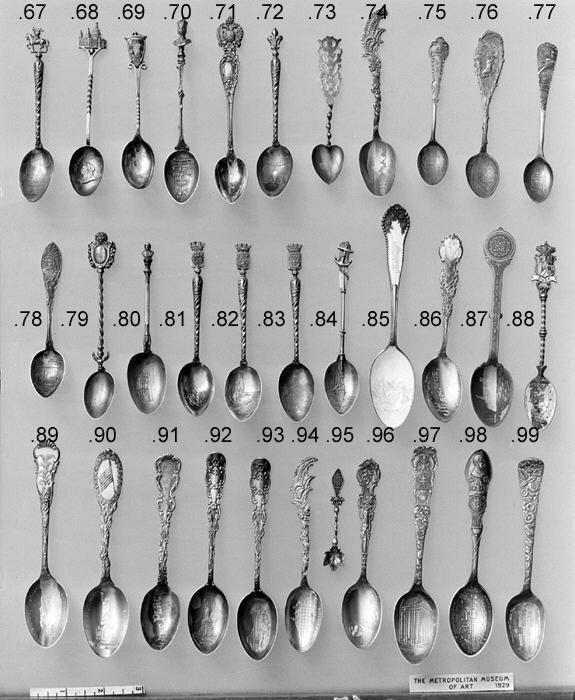
The object under examination is a silver souvenir spoon with parcel-gilt detailing, featuring a view of the Cathedral de Notre Dame des Flots and a finial in the form of the arms of Le Havre. While catalogued under the broad designation of "Ancient Civilization," the spoon represents a distinctively nineteenth-century European phenomenon: the commemorative travel artifact. The medium—silver with selective gilding—signals a deliberate hierarchy of value. The parcel-gilt technique, in which specific elements are gilded while the remainder retains silver's cool luster, was historically reserved for objects of prestige. It required additional labor, additional gold, and additional risk in firing. The choice to gild the finial or the cathedral view was not decorative whim; it was a strategic elevation of the symbolic content over the functional substrate.
Symbolic Power: The Cathedral and the Arms
The Cathedral de Notre Dame des Flots—Our Lady of the Waves—occupies a unique position in maritime spiritual geography. Le Havre, literally "the harbor," was a city whose economic and existential fate was tied to the sea. The cathedral's name invokes the Virgin Mary as protector of sailors, a figure of intercession between human vulnerability and natural force. In the spoon's engraved or embossed view, the cathedral is not merely a building; it is a compressed narrative of divine protection over commerce, migration, and risk.
The finial—the arms of Le Havre—completes a heraldic-spiritual dyad. The city's arms typically feature a salamander, a creature of fire and regeneration, often surmounted by a crown or flanked by maritime motifs. In the spoon's composition, the arms sit above the cathedral view, establishing a vertical hierarchy: civic identity crowns spiritual protection. This is not accidental. Souvenir spoons of this era functioned as portable catechisms, encoding local pride, religious devotion, and geographic memory into a single handheld object.
Historical Adornment and the Ritual of Souvenir
The souvenir spoon emerged as a mass-cultural phenomenon in the Victorian and Edwardian eras, but its roots lie in older traditions of pilgrimage tokens and guild marks. Unlike a postcard or a photograph, a silver spoon participated in domestic ritual. It was displayed in a cabinet, used on special occasions, or passed down as inheritance. The act of purchasing such a spoon at a cathedral or port town was a performative claim: I was here, I witnessed this place, and I carry its blessing home.
The parcel-gilt technique amplified this ritual function. Gilding catches candlelight and gaslight, making the object visible in the dim interiors of churches and inns. It also signaled that the owner had not settled for base metal. In an era before mass luxury, the silver souvenir spoon was an accessible yet aspirational object—a democratic heirloom.
Spiritual Meaning: Notre Dame des Flots as Threshold Guardian
The title "Notre Dame des Flots" translates as "Our Lady of the Waves" or "of the Floods." In a port city, the Virgin under this title was invoked not only for safe passage but for protection against inundation, storm, and the unpredictable violence of the sea. The spoon's view of the cathedral thus carries an apotropaic charge. To possess the image was to possess a fragment of that protection. Unlike a generic Madonna, Notre Dame des Flots is site-specific. Her power is bound to Le Havre's geography. The spoon, therefore, is not a universal religious token but a localized talisman.
The arms of Le Havre reinforce this localization. The salamander, a creature said to survive fire, parallels the sailor who survives water. The city's motto and heraldic elements transform civic identity into a kind of secular relic. In the spoon's design, the sacred and the civic are not in tension; they are laminated together, each reinforcing the other's authority.
2026 Luxury Strategy: From Souvenir to Strategic Asset
For Katherine Fashion Lab, the strategic relevance of this object in 2026 lies in three movements: provenance, narrative density, and tactile ritual.
Provenance. The luxury market of 2026 rewards objects with verifiable cultural lineage. A parcel-gilt silver spoon from a specific port city, linked to a named cathedral and a heraldic tradition, offers a provenance that is both documentary and emotional. It is not a generic antique; it is a geo-spiritual coordinate.
Narrative density. High-end consumers in 2026 are exhausted by logo-driven minimalism. They seek objects that reward slow looking. The Le Havre spoon contains at least four narratives: maritime risk, Marian protection, civic heraldry, and the Victorian ritual of travel. A luxury brand can translate this density into a contemporary collection—perhaps a capsule of silver-gilt accessories, each keyed to a specific port or pilgrimage site, each carrying a layered story.
Tactile ritual. The spoon is held. It has weight, temperature, and a handle that invites grip. In an era of digital fatigue, the physical ritual of handling a small, gilded object is a luxury in itself. Katherine Fashion Lab can position such objects as "heritage instruments"—not mere accessories but tools for memory and devotion.
Finally, the designation "Ancient Civilization" in the cataloguing, while imprecise, points to a strategic opportunity: the rebranding of European maritime devotional objects as part of a longer continuum of human adornment. The Le Havre spoon is not an outlier; it is a node in a network that stretches from Roman votive offerings to contemporary amulets. For 2026, the winning strategy is not to sell the spoon as a souvenir, but to curate it as a strategic artifact—a small, silver, gilded argument that spiritual meaning and commercial luxury were never opposites.