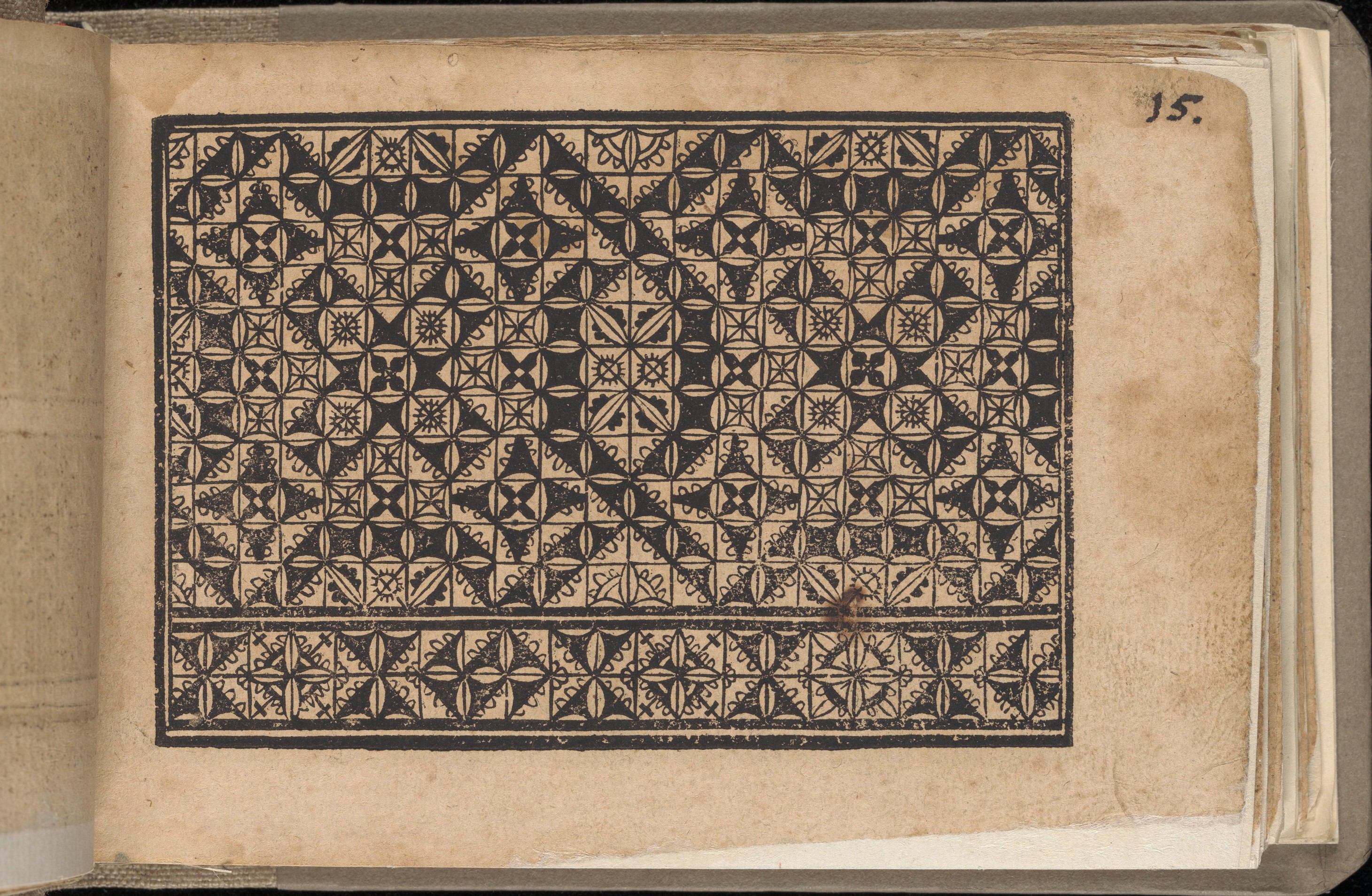
Schön newes Modelbuch, Page 15r: A Woodcut Grammar of Early Modern Design
The Schön newes Modelbuch occupies a singular position in the historiography of European decorative arts. Published in the early seventeenth century—most likely in Frankfurt am Main, the nerve centre of the German printing trade—this pattern book assembled a compendium of ornamental motifs intended for the working artisan: the embroiderer, the lacemaker, the cabinetmaker, the goldsmith. Page 15r, the recto of the fifteenth leaf, presents a dense orchestration of scrolling foliage, geometric interlacing, and stylised florals executed in woodcut. Its significance for the contemporary couture atelier lies not in nostalgia but in methodology: the page encodes a reproducible system of ornament, and reproducibility is the operative logic shared between early modern print and modern luxury production.
Material Logic: The Woodcut as Democratic Medium
The woodcut was the workhorse of early modern visual culture. Unlike engraving on copper, which demanded expensive metal plates and a rolling press, the woodblock could be carved from pear or boxwood, inked with relative economy, and pulled by the hundred on a common screw press. This material accessibility determined the Modelbuch's social reach. A pattern book was not a princely manuscript; it was a working tool, priced for the professional workshop. Page 15r must therefore be read as a utilitarian object, its lines worn by repeated impression, its margins perhaps annotated by a Nuremberg embroiderer or a Flemish lacemaker.
For couture analysis, this matters profoundly. The woodcut line is a line of translation: the carver interprets a drawn design, the printer reproduces it, and the artisan reinterprets it again in thread, wire, or veneer. Each transfer introduces variation. No two impressions of Page 15r are identical, and no two embroideries derived from it would be either. This is the ancestral logic of the toile and the sample—the intermediate object through which a design migrates from concept to garment. The Modelbuch anticipates the modern fashion system's dependence on the reproducible pattern, from the paper block of the nineteenth-century petite main to the digital CAD file of the contemporary atelier.
Compositional Analysis: Structure Beneath Ornament
Page 15r is organised around a central vertical axis, from which symmetrical foliate scrolls unfurl in mirrored pairs. The design operates on at least three registers. First, a structural armature of interlocking C-scrolls provides the compositional skeleton—a continuous line that never terminates abruptly but instead loops back into itself, creating the illusion of infinite extension. Second, within the negative spaces of these scrolls, the carver has inserted discrete motifs: stylised carnations, tulips, and pomegranates, each rendered with the characteristic angularity of the knife-cut line. Third, a fine cross-hatching supplies tonal modulation, suggesting volume without abandoning the flatness of the printed sheet.
This tripartite organisation—armature, motif, tone—corresponds precisely to the hierarchy of concerns in couture embellishment. The armature is the seam line or the structural boning; the motif is the embroidery or appliqué; the tone is the shading achieved through thread direction, bead density, or fabric layering. A couture embroiderer reading Page 15r today would recognise the logic immediately: the scrolls indicate a continuous line of punto lancato or chain stitch, while the florals invite satin-stitch infill or goldwork padding. The page is not merely a picture of ornament; it is a set of instructions.
Global Heritage and the Question of Origin
The Modelbuch tradition sits at a crossroads of cultural exchange that complicates any simple narrative of European invention. The scrolling foliage of Page 15r descends from the arabesque—a form that travelled from Hellenistic Alexandria through Islamic Spain and Sicily into the Italian Renaissance workshop. The pomegranate motif, ubiquitous in sixteenth-century German pattern books, arrived via Venetian trade with the Ottoman Empire. The geometric interlacing at the page's margins echoes Celtic knotwork, Coptic textile borders, and even the girih tessellations of Persian tilework. To classify this page as "Global Heritage" is not a curatorial evasion but an accurate description of its lineage.
For Katherine Fashion Lab, this recognition carries an ethical dimension. The luxury industry has historically extracted ornamental vocabularies from non-European cultures while erasing their sources—a practice that continues in the uncredited appropriation of kente, huipil, and ao dai motifs on Western runways. Page 15r demonstrates that the European pattern book was itself an act of synthesis, not pure invention. A responsible couture practice begins by acknowledging that every ornament has a route, and every route has a history.
Standalone Study: The Page as Autonomous Object
Approached as a standalone study, Page 15r resists the impulse to treat it merely as a source for finished textiles. The woodcut has its own aesthetic integrity: the crispness of the knife-cut line, the slight irregularity of hand-inking, the fibrous texture of laid paper visible in raking light. These are properties that contemporary textile designers increasingly seek to recover through digital means—scanned textures, distressed overlays, algorithmically generated irregularities.
Yet the page also exposes the limits of that recovery. The woodcut's irregularities are indexical; they record the physical gestures of a carver whose name is lost. A digital simulation can imitate the appearance of that gesture but not its causality. The couture atelier that understands this distinction will use Page 15r not as a clip-art library but as a provocation: a reminder that ornament is always embodied, that design is always labour, and that the most sophisticated technology is often the one that preserves the trace of the hand.
Conclusion: From Modelbuch to Maison
Page 15r of the Schön newes Modelbuch is a document of transitional modernity. It belongs to a moment when ornament became reproducible, when design separated from execution, and when the pattern book made the artisan's skill portable across borders. For Katherine Fashion Lab, it offers a working model: the page as a site of negotiation between structure and surface, between local gesture and global circulation, between the authority of the archive and the agency of the maker. To study it is to recognise that couture has always been a print culture—and that the woodblock, four centuries on, still holds the line.