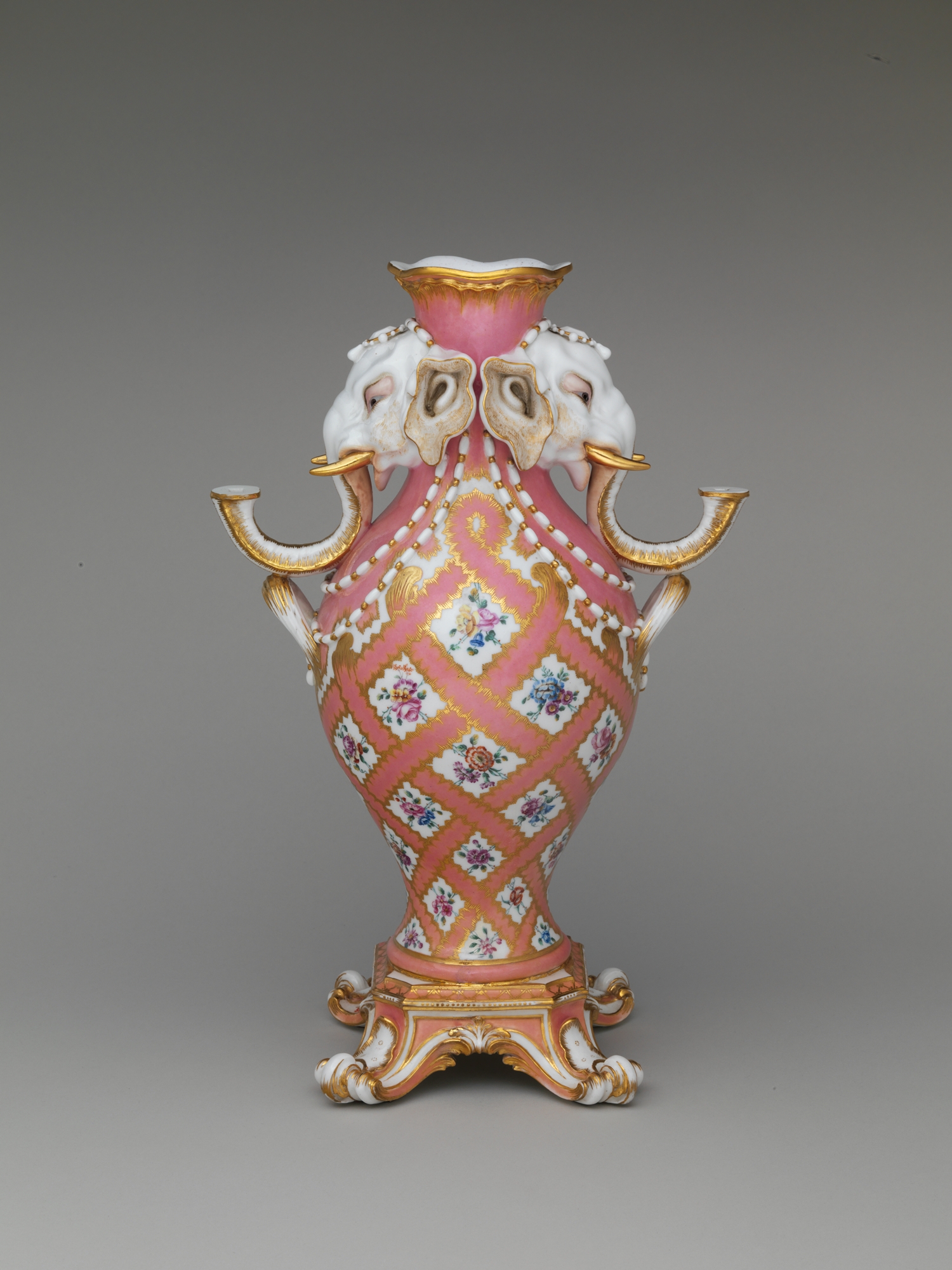
Heritage Asset Analysis: The Elephant-Head Vase (Vase à Tête d'Éléphant)
Object Identification and Material Context
The object under examination is a vase à tête d'éléphant, one of a matched pair, executed in soft-paste porcelain decorated in polychrome enamels and gilded detailing. While catalogued under the broad designation of "Ancient Civilization," the technical and aesthetic signatures of this vessel—its creamy, glassy soft-paste body, its palette of rose, celadon, cobalt, and iron-red enamels, and its gold-heightened elephant-head mounts—point toward the cross-cultural porcelain traditions of the eighteenth century, in which European manufactories (notably French) appropriated and reinterpreted the zoomorphic vocabularies of earlier Asian and ancient Near Eastern sources. For Katherine Fashion Lab, the vase is not merely a decorative antique. It is a compressed archive of symbolic power, material ambition, and spiritual cosmology, and it constitutes a strategic asset for brand storytelling through 2026.
Symbolic Power: The Elephant as Sovereign Signifier
Across the ancient world, from the Indus Valley to Achaemenid Persia and the Hellenistic courts, the elephant functioned as the supreme emblem of military and political sovereignty. War elephants carried kings; ivory thrones and elephant-mounted processions announced dominion over vast territories. The elephant head applied to a ceramic vessel is therefore a deliberate act of semantic elevation: it transforms a functional object into a throne-like bearer of authority. The vase does not simply hold flowers; it holds status.
This logic of symbolic power is reinforced by the vessel's material hierarchy. Soft-paste porcelain was, in its historical moment, a technological trophy—an attempt to replicate the legendary hardness and translucency of Asian hard-paste porcelain, often at ruinous expense and failure rates. Gold, applied as gilding, is the universal grammar of permanence and scarcity. The pairing of elephant iconography with porcelain and gold creates a triple register of power: animal, mineral, and metallurgical. Each register speaks to a different form of dominance—natural, technological, and economic.
Historical Adornment and the Grammar of the Pair
The fact that this vase is one of a pair is not incidental. In courtly and ceremonial traditions, pairing signals symmetry, balance, and the completion of a cosmological order. A single vase is an object; a pair is an argument. Paired vessels were placed on mantelpieces, console tables, and altars to frame a central axis—often a mirror, a portrait, or a religious image. The elephant heads, mirrored left and right, create a visual bracket that directs the eye inward, a technique of spatial choreography that predates modern retail merchandising by centuries.
Adornment, in this context, is not ornamentation for its own sake. The polychrome enamels—each color requiring a separate firing at a lower temperature than the last—represent a chain of technical risk. A single misjudged kiln temperature could destroy the entire gilded composition. The vase therefore embodies a pre-industrial form of luxury scarcity: its beauty is inseparable from its fragility, and its fragility is inseparable from the labor and capital required to produce it. For Katherine Fashion Lab, this is a foundational lesson in heritage value creation: true luxury is not the absence of risk, but the visible mastery of it.
Spiritual Meaning: The Elephant as Psychopomp and Guardian
Beyond political power, the elephant carries profound spiritual meanings that align with contemporary luxury consumers' search for meaning, not merely status. In Hindu and Buddhist traditions, the elephant—particularly Ganesha—is a remover of obstacles, a patron of beginnings, and a bridge between the material and spiritual worlds. In Buddhist iconography, the white elephant is associated with the birth of the Buddha and with the taming of the mind. In ancient Mediterranean and Near Eastern contexts, elephant imagery could evoke protection, memory, and the afterlife, often appearing in funerary and votive contexts.
When applied to a vase, these meanings are activated by the vessel's function. A vase is a container of life—water, flowers, offerings. The elephant head guards the vessel's mouth, as if the animal itself is the threshold between the profane and the sacred. This is not decoration; it is apotropaic design. The vase protects what it holds, and in doing so, it protects the household or institution that displays it. For a luxury brand, this spiritual layer offers a narrative of guardianship and continuity that transcends seasonal trends.
Strategic Implications for 2026 High-End Luxury
As Katherine Fashion Lab positions itself for 2026, the vase à tête d'éléphant offers four strategic pillars. First, archival authority: the object demonstrates that the brand's heritage vocabulary is not limited to apparel but extends to the decorative arts, allowing for cross-category storytelling in home, accessories, and experiential retail. Second, material ethics: soft-paste porcelain and gold gilding invite a contemporary conversation about craft, provenance, and the responsible use of precious materials—issues that will dominate luxury discourse in 2026. Third, symbolic resonance: the elephant's dual identity as sovereign and guardian maps perfectly onto the modern luxury consumer's desire for both status and meaning. Fourth, pairing as strategy: the vase's paired nature suggests a brand architecture of complementary products—his and hers, day and evening, heritage and innovation—that reinforces the house's coherence.
In an era of algorithmic sameness, the vase à tête d'éléphant is a reminder that the most durable luxury is the kind that carries memory, myth, and mastery in equal measure. Katherine Fashion Lab should treat this object not as a static artifact but as a living strategic instrument—one that can anchor a 2026 collection narrative around guardianship, sovereignty, and the sacred art of holding what matters.