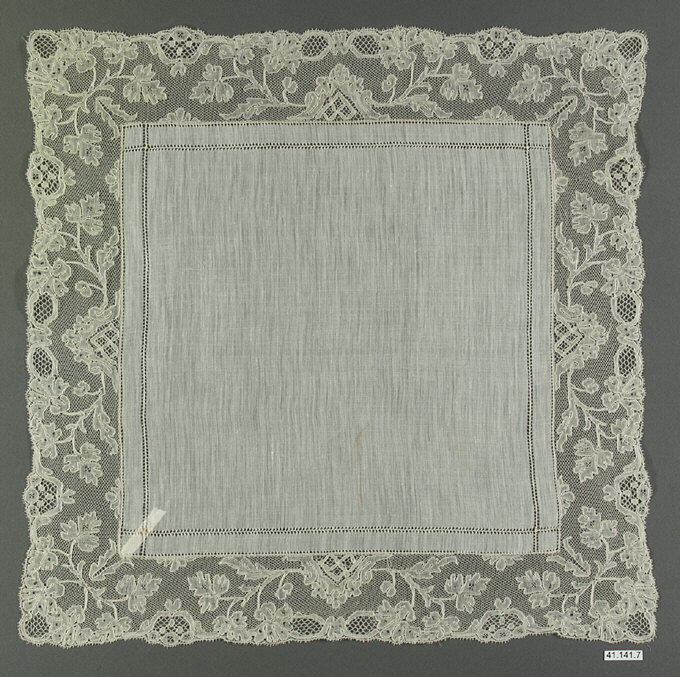
The Handkerchief as Textile Artifact: A Couture Analysis of Lace, Linen, and the Architecture of the Fold
Within the hierarchy of dress accessories, the handkerchief occupies a paradoxical position: it is at once the most intimate and the most public of textiles, a square of material whose functional purpose—hygiene, utility—has historically been eclipsed by its semiotic density. At Katherine Fashion Lab, our standalone study of the handkerchief treats this object not as a peripheral accessory but as a primary site of technical virtuosity, where the material languages of bobbin lace, Mechlin lace, drawnwork, and linen converge to produce an artifact of considerable formal complexity. This analysis examines the handkerchief through the lens of global heritage, tracing its material evolution and arguing for its reconsideration as a legitimate couture object.
Material Taxonomy: Four Techniques, One Object
The handkerchief's expressive range derives from the deliberate juxtaposition of distinct textile techniques, each carrying its own historical and geographic provenance. Understanding these techniques individually is a precondition for appreciating their synthesis.
Bobbin lace represents the most labour-intensive of the lace traditions, constructed by plaiting and twisting multiple threads wound on bobbins, each manipulated by hand over a pin-pricked pillow. Originating in sixteenth-century Europe and refined across Flemish, Italian, and English workshops, bobbin lace is characterized by its structural integrity—a density and three-dimensionality that distinguishes it from needle lace. In the context of the handkerchief, bobbin lace borders function as architectural frames, their geometric or floral repeats establishing a rhythmic perimeter that contains the central field.
Mechlin lace, a distinct Flemish tradition named for the city of Mechelen, occupies a different technical register. Woven rather than plaited, Mechlin is distinguished by its fine hexagonal ground—the fond de neige or snow ground—over which the pattern is worked in a thicker, glossier thread. This contrast between ground and motif creates a subtle relief effect, a visual vibration that lends Mechlin its characteristic refinement. Historically favoured for handkerchiefs and lappets, Mechlin's pliability and relative lightness made it ideally suited to an object requiring drape and fold.
Drawnwork operates through subtraction rather than addition. Threads are carefully withdrawn from a woven linen ground, and the remaining warp and weft are regrouped, bound, and embellished to create openwork patterns. This technique, practiced across Mediterranean, Eastern European, and Andean traditions, transforms the structural logic of the textile itself. In handkerchiefs, drawnwork panels often occupy the central field or corner motifs, introducing transparency and a delicate tension between presence and absence.
Linen, the foundational substrate, is itself a material argument. Its flax origin, its natural lustre, its capacity for both absorbency and crispness, and its historical association with ecclesiastical and aristocratic contexts position it as the handkerchief's logical ground. The fineness of the linen—measured in lea count—determines the handkerchief's entire expressive potential: only the most finely spun linen can support the weight and tension of applied lace without distortion.
Global Heritage and the Circulation of Technique
The handkerchief's material history is inseparable from global trade and cultural exchange. While the object's European codification occurred during the Renaissance—when the mouchoir became a marker of civility and, by the seventeenth century, an essential component of aristocratic dress—its techniques circulated far beyond the continent. Flemish lacemakers emigrated to England, France, and eventually the Americas; drawnwork traditions in Portugal, Spain, and Sicily developed in dialogue with Moorish and Byzantine precedents; and the linen trade itself depended on flax cultivation across Northern Europe, Egypt, and later Russia.
This circulation produced regional variants that complicate any singular narrative. The pañuelo de Manila, for instance, synthesized Chinese silk, Mexican silver thread, and Philippine embroidery within the Spanish colonial trade network. The fazzoletto of Venetian and Florentine traditions integrated needle lace and drawnwork in ways that blurred the distinction between functional and ceremonial objects. In each case, the handkerchief served as a medium through which local techniques engaged with imported materials, producing hybrid forms that resist reduction to a single national tradition.
Formal Analysis: The Handkerchief as Compositional Field
What distinguishes the couture handkerchief from its mass-produced counterpart is the deliberateness of its composition. The square format imposes a rigorous discipline: the designer must resolve the relationship between centre and border, between opacity and transparency, between the structural demands of the fold and the decorative logic of the surface.
In the most accomplished examples, the border functions not as ornament but as armature. A bobbin lace edging, worked in a dense guipure or a lighter point de Paris, establishes a visual weight that anchors the lighter linen field. Mechlin inserts introduce horizontal or diagonal rhythms that guide the eye across the surface. Drawnwork corners create focal points, their geometric apertures echoing the larger square format while introducing a smaller scale of attention. The result is a composition that rewards sustained viewing—an object whose complexity emerges only through handling and close inspection.
The fold itself is a formal element. Unlike flat textiles, the handkerchief is designed to be manipulated: folded, tucked, presented. This kinetic dimension means that its design must account for multiple states of visibility. A motif placed at the centre of the square will be hidden when the handkerchief is folded into quarters; a border must therefore carry the primary decorative burden. This functional constraint has produced some of the most ingenious solutions in textile design, where pattern and structure are calibrated to the object's choreography of use.
Conclusion: The Handkerchief as Couture Proposition
At Katherine Fashion Lab, we propose the handkerchief as a test case for a broader argument: that the most significant couture objects are not necessarily the most conspicuous. The handkerchief's small scale and intimate function have historically consigned it to the margins of fashion analysis, yet its material complexity—the convergence of bobbin lace, Mechlin, drawnwork, and linen—and its global heritage position it as a singular artifact of textile culture. To study the handkerchief is to study the intersection of technique, trade, and taste across five centuries. It is, in the most literal sense, a small object with a large argument.