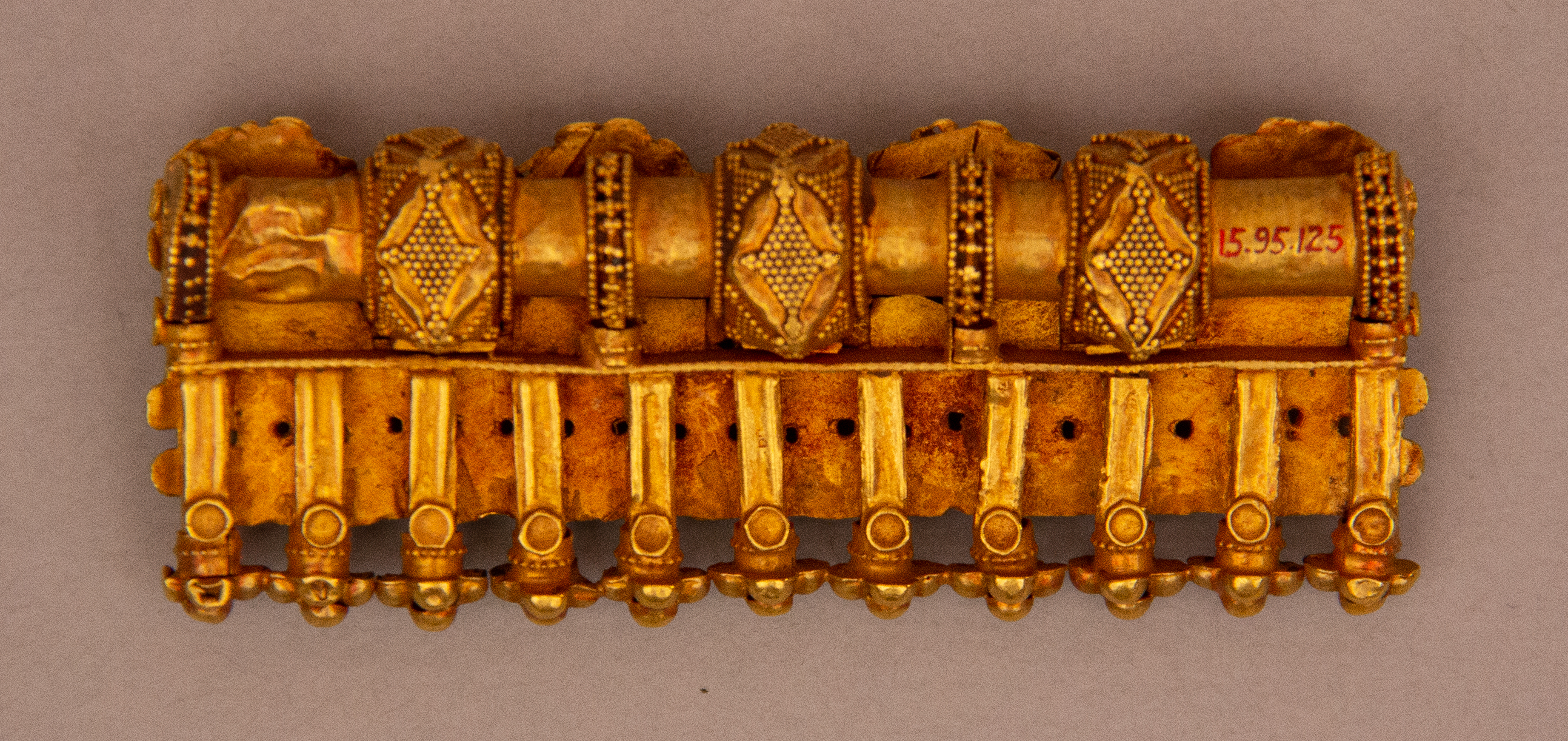
Heritage Analysis: The Ancient Gold Pendant as a Vessel of Symbolic Power
Introduction: A Study in Material Memory
At Katherine Fashion Lab, our research into ancient adornment is driven by a singular conviction: that the most enduring luxury objects are those that encode a civilization's deepest spiritual and symbolic investments. The subject of this analysis—a gold pendant originating from the crucible of an ancient civilization—stands as a paragon of this principle. Far from a mere decorative accessory, this artifact functions as a compressed archive of belief, status, and metaphysical intent. Its resonance with our prior study, Mirror with Split-Leaf—which juxtaposed the luminous silver mirror with its gold-inlaid palm fronds against the funerary stone sarcophagus—offers a critical interpretive lens. Where the mirror captured the living world's reflection and the sarcophagus narrated the journey of the dead, the gold pendant operates at the intersection of both: it is a portable altar, worn upon the body, that mediates between the temporal and the eternal.
Symbolic Power: The Pendant as Condensed Cosmology
In the context of ancient civilizations, gold was never merely a metal of economic value. Its incorruptibility, solar luminosity, and rarity positioned it as the preferred medium for objects intended to channel divine authority. A pendant, suspended near the heart or throat, occupied a uniquely intimate zone of the body—the seat of breath, voice, and life force. The symbolic power of this gold pendant therefore derived from its dual function: it was both a public declaration of rank and a private talisman.
Drawing a parallel to the Mirror with Split-Leaf, we observe a shared grammar of botanical and geometric motifs. The palm frond—a recurring emblem in ancient Near Eastern and Mediterranean iconography—symbolized victory, fertility, and eternal renewal. When rendered in gold upon a pendant, these motifs were not ornamental flourishes but condensed cosmological statements. The pendant's wearer carried a microcosm of ordered nature upon their person, a visual assertion that they were aligned with the regenerative forces of the universe. In this sense, the pendant functioned as a wearable myth, a narrative of creation and continuity compressed into a few square centimeters of precious metal.
Historical Adornment: Techniques of Power and Permanence
The technical execution of such a pendant reveals as much about its cultural context as its iconography. Ancient goldsmiths employed techniques—granulation, repoussé, filigree, and cloisonné inlay—that demanded not only extraordinary skill but also a theological patience. Each hammer strike and each applied granule was an act of ritual precision. The pendant was not mass-produced; it was a singular commission, often destined for a temple treasury, a royal burial, or a diplomatic gift between elites.
This artisanal exclusivity prefigured the logic of modern high jewelry. The ancient pendant's value was inseparable from the hours of skilled labor and the scarcity of its materials. More importantly, its design was site-specific and person-specific: it was made to be worn by a particular individual, in a particular ritual or civic context. This embeddedness in a singular life narrative is precisely what distinguishes heritage adornment from contemporary commercial jewelry. The pendant was an heirloom in its own time, a transgenerational object that accumulated meaning with each successive wearer.
Spiritual Meaning: The Threshold Between Worlds
The most profound dimension of the gold pendant is its role as a spiritual instrument. In many ancient civilizations, the pendant served as a psychopomp—a guide for the soul. Its placement on the body, often over the heart or at the throat, marked it as a guardian of the vital centers. The gold itself was believed to possess apotropaic qualities, repelling malevolent forces and attracting divine favor.
Here, the resonance with the Mirror with Split-Leaf becomes explicit. The mirror's silver surface, polished to reflect, was a tool for seeing the self and, by extension, for navigating the boundary between the visible and the invisible. The sarcophagus, carved in stone, was a permanent vessel for the transformed dead. The pendant, worn in life and often buried with the deceased, participated in both economies: it reflected the wearer's status in the living world while also serving as a passport for the afterlife. Its gold, immune to tarnish, symbolized the soul's incorruptible essence. Thus, the pendant was not a static ornament but a dynamic spiritual technology, operational across the threshold of death.
Strategic Resonance for 2026 High-End Luxury
As Katherine Fashion Lab develops its 2026 high-end luxury strategy, the ancient gold pendant offers a blueprint for value creation that transcends trend cycles. Three strategic imperatives emerge:
1. Narrative Density over Logo Visibility. The pendant's power lay in its layered symbolism—botanical, solar, funerary, and personal. For 2026, luxury objects must similarly encode multiple narratives that reward sustained contemplation. A single pendant should function as a conversation between the wearer's biography and a broader cultural inheritance.
2. Material Integrity as Spiritual Proposition. Ancient gold was chosen for its incorruptibility, not its resale value. Our strategy must reposition precious materials as carriers of metaphysical permanence. The 2026 client seeks not just rarity but resonance—an object that feels like a guardian, not an asset.
3. The Body as Ritual Site. The pendant's intimacy—its placement near the heart—created a ritual relationship between object and wearer. High-end luxury in 2026 must reclaim this embodied dimension. Adornment should be designed for daily ritual, for moments of personal significance, and for the quiet assertion of one's place within a longer human story.
In conclusion, the ancient gold pendant is not a relic to be admired from a distance. It is a strategic template. Its symbolic power, historical adornment techniques, and spiritual depth offer Katherine Fashion Lab a coherent framework for creating objects that are simultaneously luxurious and meaningful. The mirror reflected; the sarcophagus narrated; the pendant accompanied. In 2026, our clients will seek companions for their own journeys—objects of gold that carry the weight of eternity.