Oscar Wilde: The Dandy as Living Couture
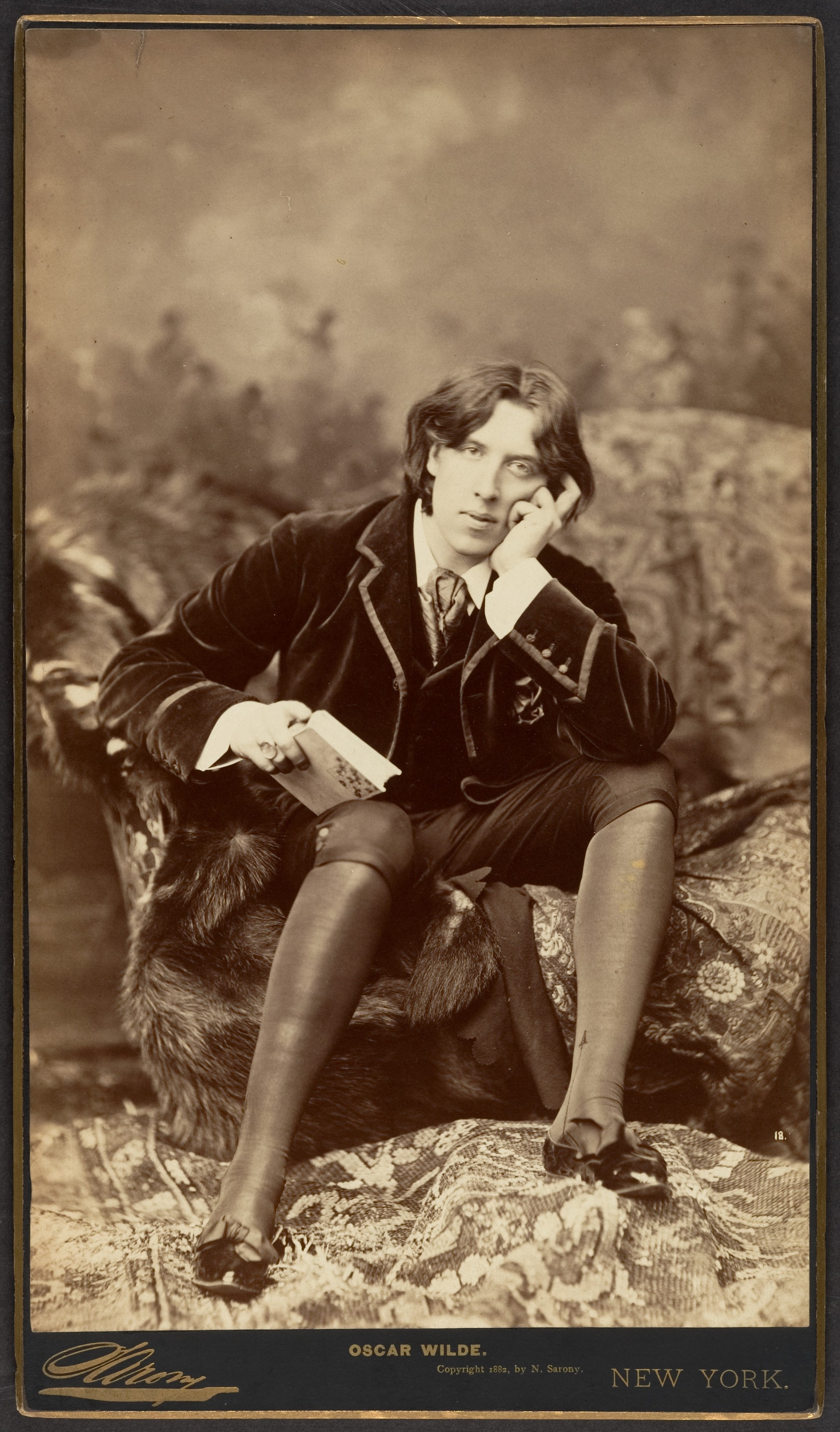
In the historiography of fashion, few figures compel the couturier's attention quite like Oscar Wilde. He was not a designer, nor a tailor, nor a maison in any conventional sense. Yet the Anglo-Irish poet, playwright, and provocateur manufactured one of the most enduring and legible silhouettes in the Western visual canon—a silhouette so deliberate, so self-aware, and so ruthlessly maintained that it deserves to be read as couture rather than mere personal style. This study examines Wilde through a single material witness: an albumen silver print, the dominant photographic medium of the late Victorian era, whose tonal range and surface character render his sartorial programme with unusual fidelity.
The Albumen Print as Material Evidence
The albumen silver print, prevalent from roughly 1850 to 1900, was produced by coating paper with egg white and salt before sensitizing it with silver nitrate. The result was a glossy, warm-toned surface capable of extraordinary detail—precisely the qualities demanded by a subject whose entire aesthetic project depended on finish, lustre, and the precise fall of fabric. Unlike the matte papers that succeeded it, the albumen process captured the sheen of silk, the nap of velvet, and the disciplined knot of a cravat with almost forensic clarity.
For the fashion historian, this matters enormously. Wilde's wardrobe was an argument conducted in textiles, and the albumen print preserves the evidence of that argument. We can read the weight of his coat cloth, the contrast between a pale glove and a dark sleeve, the calculated disarray of a collar. The medium is not neutral; it flatters the very qualities Wilde cultivated. In this sense, the photograph and the man were collaborators.
The Architecture of the Dandy
Wilde's sartorial philosophy crystallised in the 1880s, when he emerged as the self-appointed apostle of Aestheticism. His uniform was deceptively simple: a velvet or broadcloth coat, often in deep greens, browns, or plum; knee breeches or loose trousers; silk stockings; and the notorious lily or sunflower worn as a boutonnière. This was not eccentricity for its own sake. It was a coherent design language that rejected the black-and-white severity of Victorian bourgeois dress in favour of colour, texture, and historical allusion.
Consider the construction. Wilde favoured soft, unstructured tailoring that allowed the body to move—a radical departure from the rigid, padded shoulders and corseted torsos of conventional gentleman's attire. His coats draped rather than moulded. His collars were turned down, his ties loosely knotted, his hair worn long and waved. Every element signalled a refusal of the industrial-age uniform. In couture terms, he was designing for the wearer's interior life rather than the observer's expectations.
The dandy, in Wilde's hands, became a wearable manifesto: the body as canvas, the garment as thesis.
Colour, Texture, and the Rejection of Convention
Where his contemporaries dressed in charcoal and oxblood, Wilde assembled palettes that read like Pre-Raphaelite paintings. The albumen print's warm tonal bias amplifies this chromatic intelligence, translating deep greens into luminous mid-tones and rendering velvet's light-absorbing depth as a rich, almost liquid black. His fabric choices—velvet, silk, fine wool, occasionally fur—were tactile propositions. He understood that couture is experienced first through the hand and the eye, not the label.
This tactile sensibility aligned him with the Arts and Crafts movement's reverence for material honesty. A garment should reveal its making, not disguise it. Wilde's coats showed their seams; his cravats showed their folds. The honesty was both ethical and aesthetic, and it anticipated by decades the modernist principle that form should follow material.
Global Heritage and the Politics of Dress
Wilde's aesthetic drew from a deliberately global vocabulary. He admired Japanese kimono construction for its planar simplicity and its respect for the body's natural line. He referenced Renaissance portraiture, eighteenth-century macaroni dress, and the flowing drapery of classical sculpture. This was heritage appropriation in the service of a new masculinity—one that permitted ornament, softness, and beauty without apology.
For Katherine Fashion Lab, Wilde's global sourcing is instructive. He treated the world's dress traditions as a living archive, not a costume shop. The kimono's influence on his silhouette was structural, not decorative; it changed how his clothes hung. That distinction separates couture from fancy dress, and it remains the discipline's central test.
A Standalone Study in Enduring Influence
Wilde died in 1900, the same year the albumen print fell out of commercial favour. The coincidence is poetic. Both belonged to an era of surface and sheen, of image carefully composed. Yet his influence on fashion has proven remarkably durable. The velvet jacket, the dramatic lapel, the floral boutonnière, the long hair as accessory—these recur season after season on runways from Gucci to Saint Laurent. Designers return to Wilde because he solved a problem that still preoccupies couture: how to make the interior life visible on the exterior body.
His legacy is not a garment but a method: the deliberate construction of a self through cloth, colour, and gesture. The albumen print preserves that method at its most articulate. To study it is to study couture before couture had a name—and to recognise that the most influential designer of the Victorian age never cut a single pattern.
Katherine Fashion Lab regards Oscar Wilde as a foundational case in the Global Heritage canon: a reminder that couture begins not with the atelier but with the imagination, and that a single photograph, properly read, can contain an entire wardrobe philosophy.