Katherine Fashion Lab — Heritage Research Division
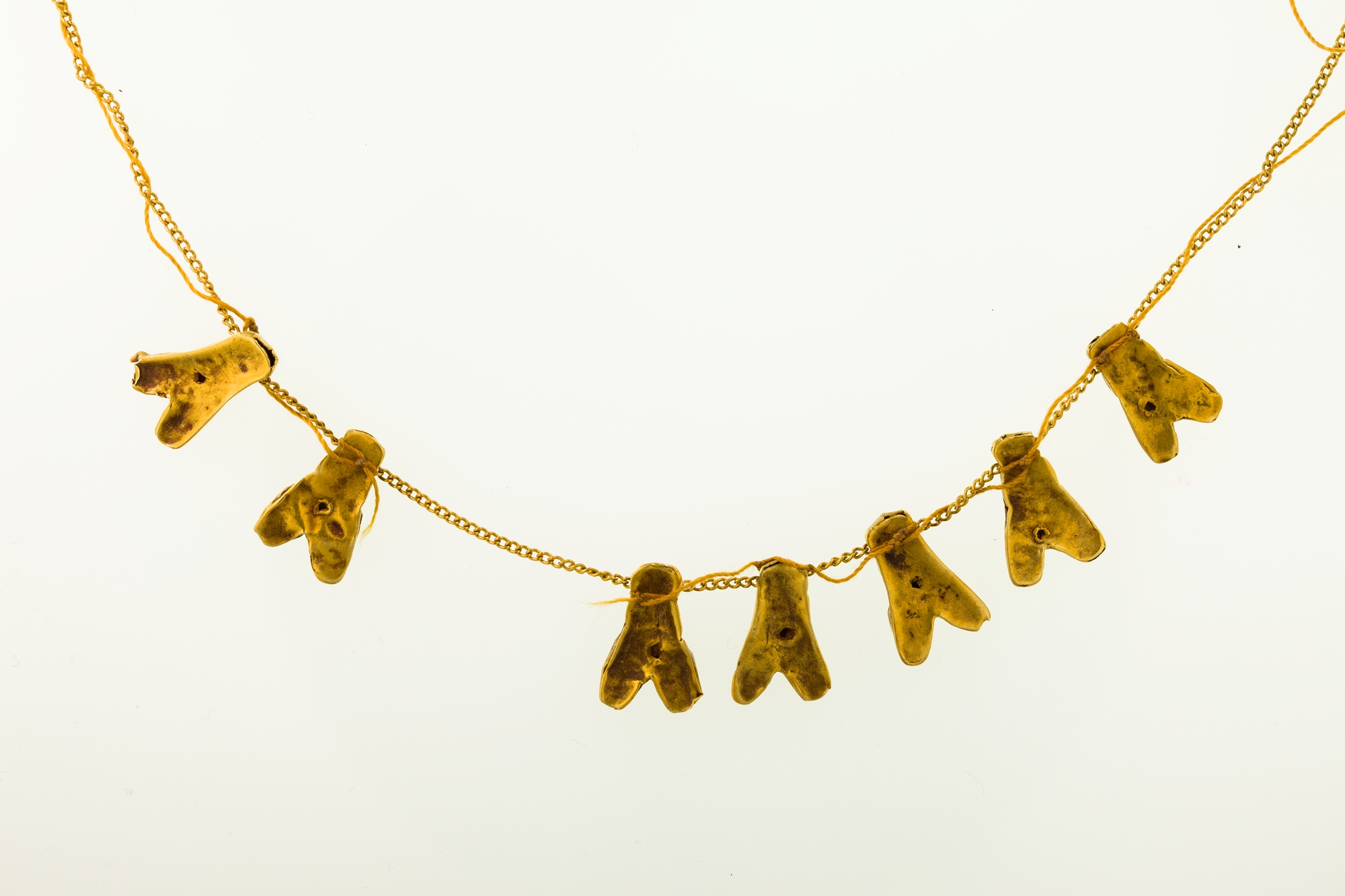
Object File: String of Seven Fly Amulets | Ancient Egyptian | Gold | New Kingdom, c. 1550–1070 BCE
I. Object Description and Material Authority
The artifact under examination is a string of seven fly amulets rendered in solid gold, each cast in the characteristic elongated form of the common housefly (Musca domestica), with segmented body, incised wings, and a suspension loop integrated into the thorax. The amulets are strung in sequence, a configuration consistent with New Kingdom Egyptian jewelry conventions in which repeated motifs accumulate protective force through numerical density. Gold, in the Egyptian material lexicon, was not merely a precious metal but the flesh of the gods — imperishable, solar, and incorruptible. Its selection for a protective amulet of this type signals an object intended for the highest tiers of society: military commanders, royal consorts, and court officials whose bodies were prepared for eternity with the same care as their earthly status demanded.
Fly amulets are among the most distinctive yet under-theorized categories of Egyptian personal adornment. Unlike the scarab, the wedjat eye, or the djed pillar, the fly does not belong to the canonical solar or funerary repertoire. Its presence in gold, in series, and in a wearable string indicates a specific and targeted symbolic program — one that Katherine Fashion Lab identifies as a critical case study in the translation of martial and apotropaic meaning into luxury form.
II. Symbolic Power: The Fly as Valorous Citation
The fly in ancient Egyptian culture operated on two registers simultaneously. The first is apotropaic: the fly's persistence, its resistance to being swatted, and its association with the boundary between life and decay made it a natural vehicle for protective magic. Fly amulets were placed on the body to repel harm, much as the insect itself is difficult to drive away. The second register is martial and honorific. The most celebrated historical anchor is the Gold of Valor (nebu en qenbet), the ceremonial award of golden fly pendants granted by New Kingdom pharaohs to soldiers who had distinguished themselves in battle. The fly, in this context, was not vermin but a citation of relentless pursuit — the warrior who would not be shaken off, who returned to the field, who persisted against the enemy.
This dual semantics — protection and prowess — is precisely what makes the string of seven amulets a sophisticated luxury object. It does not choose between the sacred and the martial; it fuses them. The wearer is simultaneously defended and declared. In the funerary context, the same string accompanies the deceased into the afterlife, where the fly's persistence becomes a metaphor for the soul's endurance through the trials of the Duat.
III. Historical Adornment and the Logic of the Series
The decision to string seven amulets rather than one is not incidental. Egyptian numerology invested the number seven with completion and cosmic order — seven is the sum of the four cardinal directions and the three planes of existence, and it recurs in funerary and magical texts as a number of fullness. A single fly amulet is an ornament; a string of seven is a system. The wearer does not simply carry protection; they carry a complete protective architecture, articulated in gold, calibrated to the body.
Formally, the amulets also demonstrate the Egyptian genius for abstraction. The fly is reduced to its essential geometry — head, thorax, abdomen, wings — without anatomical excess. This is not a naturalistic study but a heraldic compression, closer in spirit to a modern monogram than to a zoological illustration. For a contemporary luxury house, this is the decisive lesson: the amulet is legible at a glance, memorable at a distance, and endlessly repeatable without loss of authority.
IV. DNA Correlation: The Mirror with Split-Leaf Inlay and the Fly String
Katherine Fashion Lab's comparative study of the Mirror with Split-Leaf — one face a polished silver mirror inlaid with gold palm frond motifs, the reverse a cold stone sarcophagus panel narrating life in relief — establishes a governing principle of ancient luxury: the object must hold two truths at once. The mirror presents beauty and reflection on one surface, mortality and narrative on the other. The fly string operates by the same DNA. On one hand, it is a jewel of gold, worn close to the skin, radiant and intimate. On the other, it is a memento of war, decay, and the persistence of the dead.
This split-surface logic — splendor and mortality in a single artifact — is the heritage thread that connects the mirror and the fly string across object categories. Both refuse the modern luxury assumption that beauty and gravity must be separated into different products. The ancient object insists that the most valuable thing is the one that can carry both.
V. 2026 High-End Luxury Strategy: From Amulet to Authorized Icon
For Katherine Fashion Lab's 2026 positioning, the string of seven fly amulets offers a disciplined strategic platform. Three directives follow.
First, codify the series. The seven-fly configuration should be treated as a protected house signature — a repeatable module that can scale from a single fine-jewelry pendant to a limited high-jewelry necklace, each iteration maintaining the seven-unit integrity. Repetition is the mechanism by which the motif acquires authority; the house should resist the temptation to vary the count.
Second, honor the dual register. Marketing and design language must hold protection and valor together. Positioning the piece solely as a talisman reduces it to superstition; positioning it solely as a military citation reduces it to costume. The 2026 consumer — particularly in the art-literate, collectible tier — responds to objects that carry legitimate historical density. The fly string's documented association with the Gold of Valor provides a verifiable narrative that no competitor can appropriate.
Third, translate material honesty. The original is solid gold, not gilded, not plated. Any 2026 interpretation should preserve this material integrity at the top of the range, with a secondary line in vermeil or recycled gold for accessibility. The fly's abstraction makes it unusually well-suited to contemporary minimalism — it reads as a glyph, not a novelty, and it will not date.
In sum, the string of seven fly amulets is not a curiosity. It is a compact, gold-cast argument that luxury at its highest level is the fusion of beauty, protection, memory, and persistence. Katherine Fashion Lab's inheritance of this argument — through the DNA shared with the Mirror with Split-Leaf — is both an obligation and a competitive advantage. The house that can wear the fly without flinching owns a category no one else has claimed.