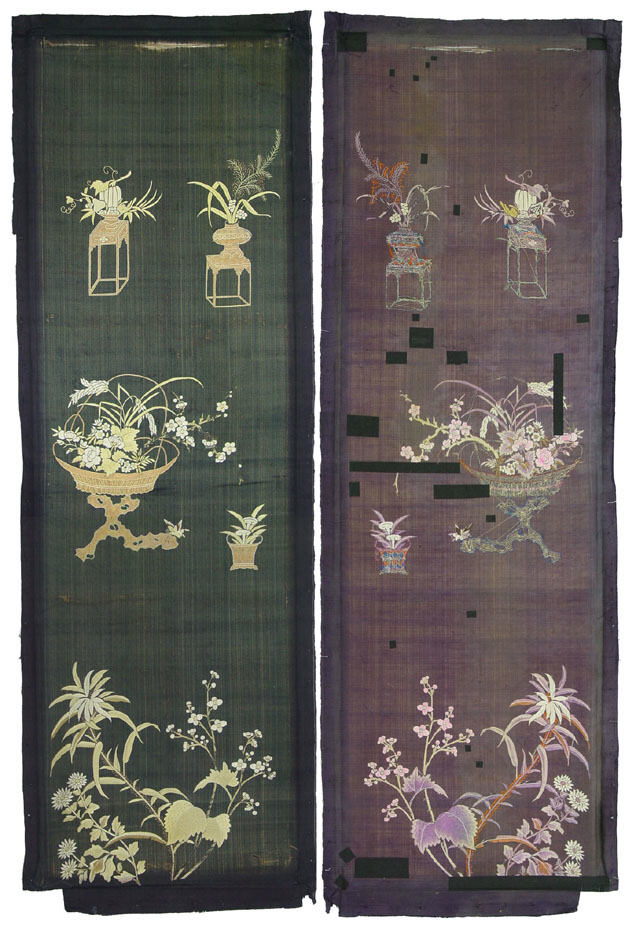
Introduction: The Embroidered Panel as a Self-Contained Artwork
Within the broader historiography of Chinese textile arts, the embroidered panel occupies a singular position. Unlike garments designed for bodily adornment or ceremonial hangings created for specific architectural contexts, the standalone embroidered panel functions as a deliberate, self-sufficient aesthetic statement. The object under examination here—one panel from a set of four, originating from China and executed in silk with metallic thread—invites a rigorous interrogation of materiality, technique, and the shifting boundaries between ornament and fine art. At Katherine Fashion Lab, we approach such objects not merely as historical artifacts but as case studies in the enduring dialogue between craftsmanship and conceptual ambition.
Materiality and the Semiotics of Silk and Metal
The Foundation: Silk as Cultural Substrate
Silk in the Chinese context is never merely a fabric. It is a material with deep cosmological associations, linked historically to the silkworm's life cycle, imperial monopoly, and the Silk Road's complex networks of exchange. The choice of a silk ground for this panel is therefore not neutral. Silk's natural luster and tensile strength allow for exceptionally fine needlework, but more importantly, it establishes a surface that interacts dynamically with light. The ground itself becomes an active participant in the visual experience, shifting in tone and depth as ambient conditions change.
Metallic Thread and the Politics of Radiance
The introduction of metallic thread—likely gold- or silver-wrapped silk or paper core—elevates the panel beyond mere pictorial representation. Metallic embroidery in Chinese tradition carries associations with status, ritual efficacy, and even apotropaic function. The metal does not simply add shine; it introduces a discontinuous, reflective element that disrupts the uniformity of the silk ground. Under raking light, the metallic passages appear to hover above the surface, creating an optical tension between flatness and relief. This is a deliberate aesthetic strategy, one that anticipates by centuries the concerns of modernist collage and mixed-media installation.
Key observation: The panel's visual power derives not from the complexity of its imagery alone, but from the calculated interplay between the matte depth of silk and the specular volatility of metal.
Technique as Epistemology: Reading the Stitch
Stitch Vocabulary and Spatial Logic
Chinese embroidery encompasses a vast repertoire of stitches—satin, seed, couching, Peking knot, and countless regional variants. Each stitch produces a distinct surface texture and carries its own historical and geographic associations. In this panel, the use of couched metallic thread suggests a concern with linear clarity and structural definition. Couching allows the embroiderer to lay metallic thread along a predetermined path and secure it with tiny silk stitches, effectively drawing with metal. This technique prioritizes contour and rhythm over seamless tonal blending.
Labor, Time, and the Invisible Hand
Every square centimeter of an embroidered panel represents hours of concentrated labor. The anonymity of the embroiderer—rarely recorded in historical documents—stands in stark contrast to the enduring visibility of the work itself. This asymmetry raises important questions for the contemporary curator and collector. To appreciate the panel solely for its visual splendor is to risk erasing the human labor that produced it. At Katherine Fashion Lab, we argue for a dual reading: the panel as aesthetic object and as document of skilled, often gendered, and frequently invisible labor.
Standalone Status: From Fragment to Autonomous Work
The Set of Four and the Logic of Seriality
The fact that this panel belongs to a set of four is significant. Serial production in Chinese decorative arts often follows cosmological or seasonal logic—four directions, four seasons, four virtues. Yet the panel's standalone presentation in a modern collection context invites us to consider it as an autonomous work. This tension between original seriality and contemporary singularity is productive rather than problematic. It allows the viewer to appreciate both the panel's internal coherence and its relational identity as part of a larger program.
Framing, Display, and the Museum Effect
When an embroidered panel is removed from its original context—whether a garment, a room screen, or a ceremonial hanging—and placed in a frame or on a wall, it undergoes what art historians call the "museum effect." It becomes a picture. This transformation is not innocent. It changes how we read scale, function, and intention. The panel's metallic threads, once designed to catch the flickering light of oil lamps or candles, now contend with the cool, even illumination of gallery spaces. Curators must therefore be attentive to lighting design, as the panel's meaning is inseparable from its material response to light.
Comparative Contexts: Chinese Embroidery and Global Textile Modernism
It is tempting to view Chinese embroidered panels solely through the lens of tradition. However, a more nuanced analysis situates them within global textile modernism. The early twentieth-century fascination with Chinese embroidery among European modernists—from the Bauhaus textile workshops to couture houses in Paris—was not merely orientalist appropriation. It was a recognition that Chinese embroiderers had long ago resolved problems of surface, pattern, and material hierarchy that Western art was only beginning to address. The panel's simultaneous embrace of figuration and abstraction, of flatness and optical depth, prefigures debates that would occupy Western artists for decades.
Conclusion: The Panel as Critical Object
The embroidered panel from China, executed in silk and metallic thread, is far more than a decorative survivor from a distant past. It is a sophisticated meditation on material, technique, and the politics of display. Its standalone status—however historically contingent—invites us to treat it with the same critical rigor we apply to painting or sculpture. At Katherine Fashion Lab, we contend that such objects deserve not only preservation but sustained theoretical attention. They challenge us to rethink the hierarchy of fine art versus craft, to acknowledge the labor embedded in beauty, and to recognize that a single panel, viewed attentively, can open onto entire worlds of meaning.