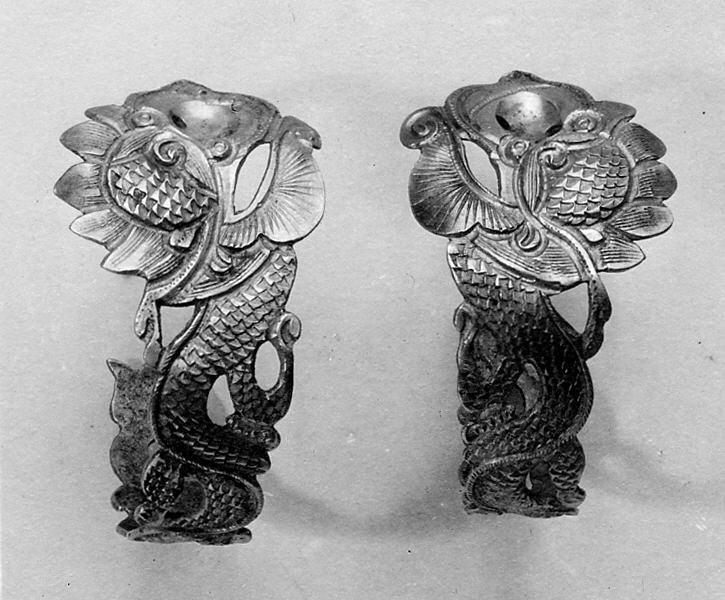
Earrings in Chinese Gold: Symbolic Power, Historical Adornment, and the 2026 Luxury Horizon
At Katherine Fashion Lab, our ongoing inquiry into adornment as a carrier of civilizational memory has repeatedly surfaced a central insight: the most enduring luxury objects are those in which material, ritual, and narrative converge. Our study of the Mirror with Split-Leaf motif — one face a polished silver surface inlaid with gold palm fronds, the other a cold sarcophagus panel narrating life in relief — established a methodological DNA for reading objects as dual-natured: reflective surface and buried story, ornament and elegy. That same DNA is legible in one of China's most persistent and underestimated forms: the gold earring. This analysis examines the Chinese gold earring across symbolic power, historical adornment, and spiritual meaning, and translates that heritage into a defensible 2026 high-end luxury strategy.
Historical Adornment: From Rites to Refinement
Gold in China was never merely decorative. Its association with immortality, incorruptibility, and the yang principle made it a material of consequence from the Warring States period onward. Ear ornaments appear in Chinese archaeological contexts with notable restraint and precision: gold earrings and ear pendants recovered from Han and Tang tombs, often paired with jade, pearl, or glass beads, indicate that the ear was understood as a site of deliberate, not casual, adornment. Unlike the heavy torque or the layered necklace, the earring occupies a liminal zone — close to the face, moving with the body, audible in its faint percussion against the skin.
By the Tang dynasty, cosmopolitan exchange along the Silk Road introduced Central Asian and Sogdian goldsmithing techniques, including granulation and filigree, which Chinese artisans absorbed and re-inflected. The resulting earrings — sometimes simple hoops, sometimes elaborate floral or phoenix forms — functioned as portable sumptuary statements. In the Ming and Qing periods, gold earrings became codified within dress regulations, with forms and weights signaling rank, marital status, and regional identity. The earring, in other words, was a document worn on the body.
Symbolic Power: The Ear as Threshold
Chinese cosmology treats the body as a microcosm, and the ear as an aperture through which sound, spirit, and social meaning enter. To adorn the ear is to govern that threshold. Gold earrings in Chinese tradition frequently deploy motifs with apotropaic force: the ruyi cloud for auspiciousness, the double fish for abundance, the gourd for protection and longevity, and the phoenix for renewal and feminine sovereignty. Each motif is a compressed prayer.
This is where the DNA of the Mirror with Split-Leaf becomes analytically productive. The mirror's two faces — reflective surface and funerary relief — encode the same duality found in the earring: an outward, luminous face presented to the world, and an inward, narrative face pressed against the wearer. The gold palm fronds inlaid on silver speak to cultivated beauty; the sarcophagus relief speaks to mortality and lineage. A Chinese gold earring performs identically. Its polished exterior catches light and announces status; its inner surface, often unseen, carries inscriptions, maker's marks, or hidden motifs intended for the wearer alone or for the afterlife. The object is simultaneously social armor and private testament.
Spiritual Meaning: Gold, Permanence, and the Afterlife
In Daoist and later Buddhist frameworks, gold's resistance to corrosion made it a metaphor for the indestructible nature of the soul and the continuity of ancestral lines. Earrings were included in tomb inventories not as vanity but as equipment for the journey — a logic consistent with the sarcophagus reliefs of our mirror study, where the narrative of a life is carved to accompany the deceased. The gold earring thus participates in a broader Chinese aesthetic of ji — entrusting — in which precious objects are deposited with the body as evidence of a life properly lived and a family properly honored.
For the living, the spiritual function is subtler. The weight of gold against the earlobe is a constant, almost subliminal reminder of obligation and belonging. It is a tactile mantra.
2026 Luxury Strategy: From Heritage to Horizon
Katherine Fashion Lab's 2026 positioning should treat the Chinese gold earring not as a folkloric reference but as a high-conviction luxury archetype. Three strategic moves follow.
First, dual-face design as brand signature. The Mirror with Split-Leaf DNA suggests a product architecture in which every earring presents a public face and a private face — one polished and declarative, one engraved, textured, or inlaid with a personal narrative. This creates a proprietary collectible logic and supports personalization at the highest tier.
Second, material authority through provenance. Positioning 24K and 22K gold with documented craft lineage — granulation, filigree, repoussé — allows the house to compete on connoisseurship rather than trend. The earring becomes an heirloom asset class, not a seasonal accessory.
Third, spiritual semantics as emotional luxury. In a market saturated with logos, the earring's threshold symbolism offers a differentiated narrative: protection, continuity, and ancestral memory. Marketing should foreground ritual occasions — marriage, coming of age, memorial — where the object functions as a vessel of meaning rather than a display of wealth.
The Chinese gold earring is, in the end, a mirror with two faces: the luminous self and the buried story. Our task at Katherine Fashion Lab is to keep both faces legible — and to build a 2026 collection in which the wearer, like the object, is understood as both surface and depth.