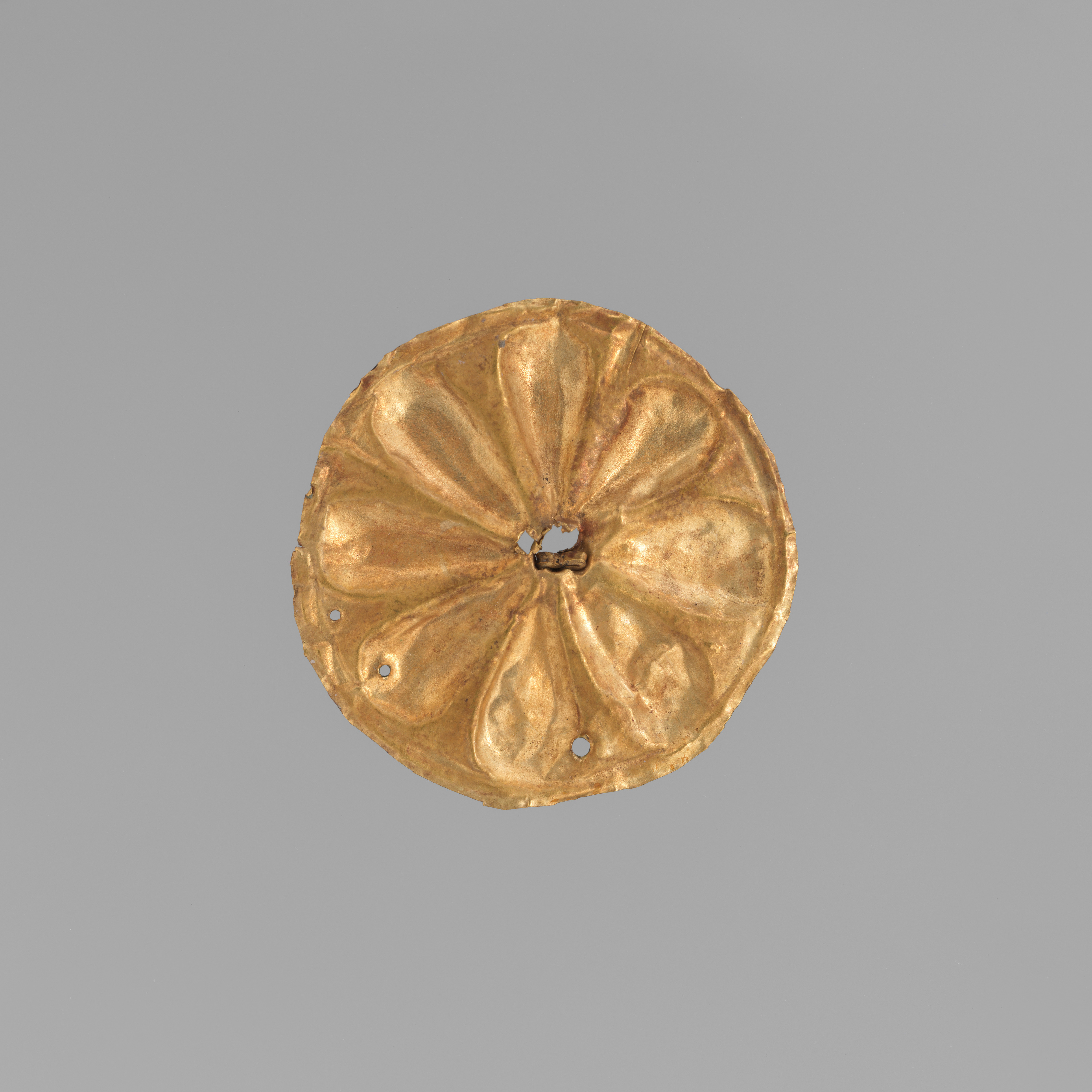
Heritage Asset Analysis: Cypriot Gold Roundel with Stamped Designs
Object Overview and Material Authority
The Cypriot gold roundel with stamped designs represents a singular convergence of material scarcity, technical mastery, and symbolic density. Hammered from high-karat gold sheet and impressed with repeated motifs via a die-stamping technique, such objects emerged from the Late Bronze Age Cypriot metallurgical tradition—an era when the island served as the eastern Mediterranean's principal copper and precious-metal entrepôt. Gold, imported and carefully husbanded, was never merely decorative on Cyprus. It functioned as a statement of cosmological authority: the metal's incorruptibility made it the preferred medium for binding human devotion to divine favor. The roundel's circular format is not incidental. In Cypriot and broader Near Eastern visual grammar, the circle encoded the sun, the cyclical year, and the enclosing boundary of the sacred. To wear or display a gold roundel was to carry a compressed universe against the body.
Stamped Design as Ritual Technology
The stamped designs—typically radiating rosettes, concentric guilloche bands, or stylized palmettes—were not applied for ornament alone. Repetition through stamping was a deliberate ritual technology. Each impression replicated a protective sign, multiplying its efficacy in the manner of a mantra made visible. The rosette, ubiquitous in Cypriot goldwork, carried dual valences: it evoked the fertilizing sun and the opening of the lotus, a symbol of rebirth shared across Egyptian, Levantine, and Aegean trade networks. The guilloche, an interlocking twisted band, represented continuity and the binding of oaths. When these motifs were struck into gold, they were understood to activate the material—transforming inert metal into an amuletic instrument. This is the core of the roundel's spiritual meaning: it was a wearable prayer, a contract with the unseen, and a marker of elite status simultaneously.
Historical Adornment and the Body as Archive
In Cypriot burial contexts, gold roundels appear in association with the head, chest, and hands of the deceased. Their placement reveals a sophisticated theory of adornment: the body was treated as an archive of identity and a vessel requiring protection during transition. The roundel did not simply decorate the living or the dead; it repositioned them within a sacred economy. For the living elite, the roundel signaled access to imported gold and foreign artisans, a cosmopolitan fluency that distinguished Cypriot courts from mainland contemporaries. For the deceased, it served as a passport—a material argument for favorable treatment in the afterlife. This dual function—status marker and spiritual insurance—is precisely the tension that makes the object so potent for contemporary luxury strategy.
DNA Correlation: From Split-Leaf Mirror to Cypriot Roundel
Our prior study, Mirror with Split-Leaf, examined a silver mirror whose obverse bore gold-inlaid palm fronds and whose reverse carried a stone sarcophagus relief narrating life's passage. That object taught us that luxury heritage operates through two-sidedness: the reflective, polished surface of aspiration and the carved, narrative surface of mortality. The Cypriot gold roundel is the DNA sibling of that mirror. Where the mirror split light and story across two faces, the roundel compresses both into a single stamped surface. The stamped rosette is the mirror's polished side—radiant, solar, presentational. The guilloche and palmette are the mirror's carved side—cyclical, funerary, mnemonic. The roundel is, in effect, a portable mirror that refuses to separate its functions. This correlation is not academic. It is a strategic blueprint.
2026 Luxury Strategy: The Roundel as Brand Architecture
For Katherine Fashion Lab, the Cypriot gold roundel offers a 2026 roadmap built on three pillars. First, material integrity as narrative. The roundel's power derives from gold's refusal to corrode. Our 2026 collections should treat material choice as a spiritual statement, not a cost line. Recycled high-karat gold, responsibly sourced, becomes the modern equivalent of Cypriot metallurgical authority—luxury that carries ethical incorruptibility.
Second, repetition as ritual. The stamped design's multiplicative logic translates directly into brand signatures. A single motif—a rosette, a guilloche knot—repeated across a collection creates the same amuletic effect: the consumer is not buying one object but entering a protective system. Limited editions should be framed as activated series, each piece carrying the same stamped sign, each impression reinforcing the last.
Third, two-sidedness as experience. Following the Split-Leaf DNA, our 2026 high-end strategy should design objects that reward both public display and private contemplation. A garment, a jewel, a fragrance vessel should have a radiant exterior and a narrative interior—a stamped surface for the world and an engraved meaning for the wearer. The Cypriot roundel did not choose between adornment and devotion. Neither should we.
Conclusion: The Roundel as Strategic Ancestor
The Cypriot gold roundel is not a relic to be admired from a distance. It is a working model for how luxury objects generate meaning across millennia. Its symbolic power lies in compression: cosmos, protection, status, and memory stamped into a disc of incorruptible metal. Its historical adornment practice teaches us that the body is the first gallery. Its spiritual meaning reminds us that consumers in 2026, like Cypriot elites in 1200 BCE, seek objects that do more than decorate—they seek objects that bind them to something enduring. Katherine Fashion Lab's opportunity is to become the modern die-stamp: to impress a consistent, protective, radiant sign onto every surface we touch.