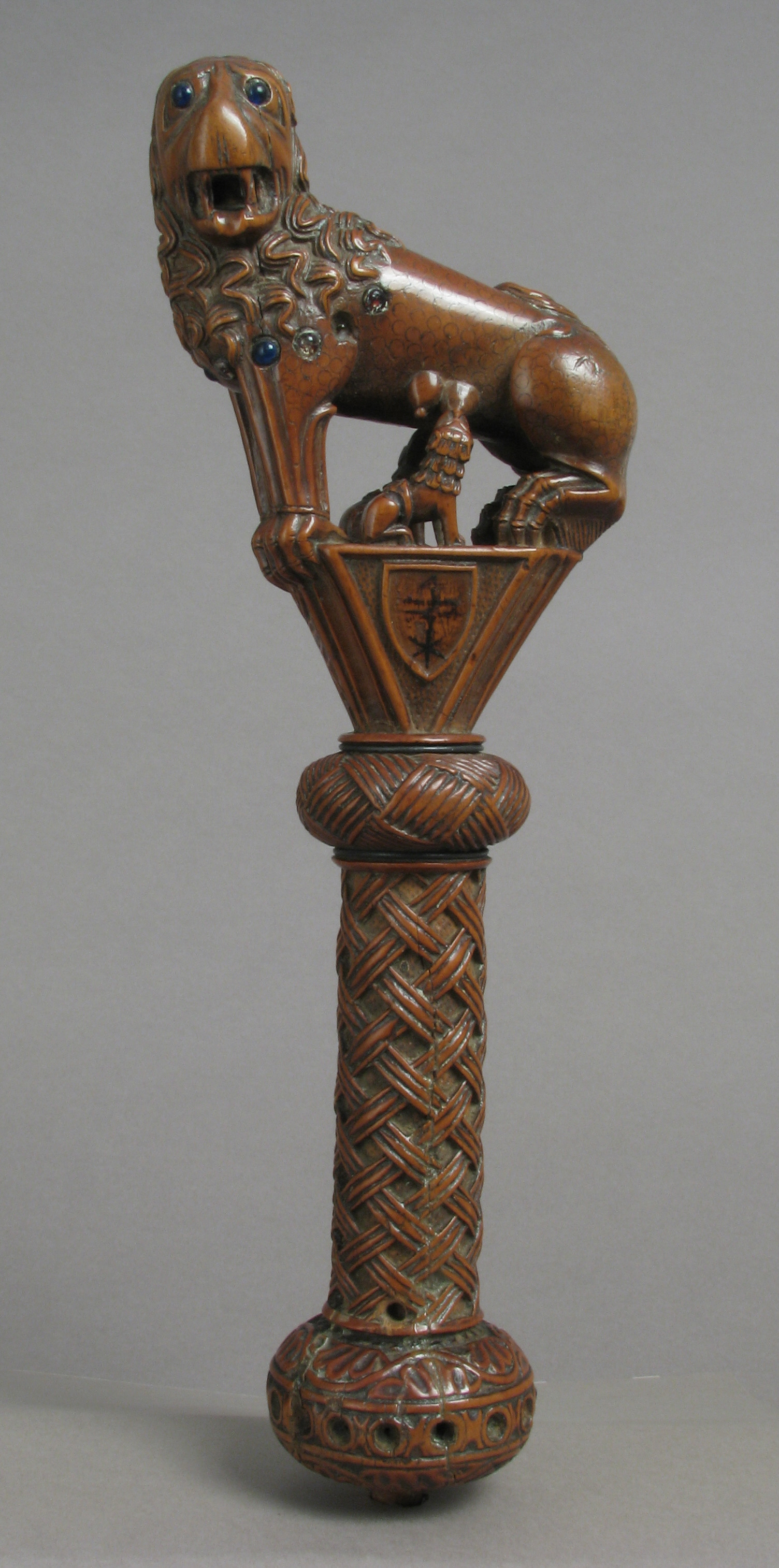
Heritage Analysis: The Italian Head of Staff
Object Overview and Material Composition
The artifact under examination is an Italian ceremonial Head of Staff, a composite ornamental finial designed to crown a wooden shaft of office. Its material assembly—carved and stained wood, a glass cabochon, hand-formed metal wire, and copper alloy settings—positions it within a distinct lineage of Italian decorative metalwork and devotional object-making. Unlike the mass-produced regalia of later industrial periods, this object reflects the atelier logic of pre-unification and post-unification Italian craft workshops, where the integration of disparate materials into a single symbolic unit was both an aesthetic discipline and a statement of hierarchical authority.
The wood core, stained rather than painted, suggests a deliberate restraint: the substrate is honored, not concealed. The glass cabochon—likely a colored paste or low-lead glass rather than a precious stone—occupies the visual apex, while the copper alloy settings and wirework provide structural tension and decorative filigree. This hierarchy of materials is itself a symbolic grammar, one that Katherine Fashion Lab must decode before it can be translated into contemporary luxury strategy.
Symbolic Power and Historical Adornment
In Italian civic and ecclesiastical tradition, the staff—bastone—functions as an extension of the bearer's personhood. It is not a tool but a portable monument. The Head of Staff, as the terminal ornament, concentrates meaning at the point of contact between hand, wood, and air. Historically, such finials in Italy appear in three overlapping contexts: the ceremonial mace of communal magistrates, the pastoral staff of clerical office, and the guild staff of master artisans. Each context shares a common semiotic function: the object materializes legitimacy.
The glass cabochon is particularly instructive. In Italian folk and devotional practice, glass was often used as a substitute for gemstones in votive objects, a practice that democratized symbolic power without diluting it. A red or amber cabochon could evoke coral—long associated with protection against the evil eye in southern Italian tradition—or it could stand in for the ruby of civic authority. The copper alloy settings, likely brass or a low-carat bronze, carry their own associations: copper is the metal of Venus, of craft, of the forge. Its presence here binds the object to the artisan's body of knowledge, not merely to the patron's purse.
The wirework deserves separate attention. Hand-formed metal wire in Italian decorative arts often mimics botanical or filigree forms, but on a staff head it also serves a structural purpose: it holds the cabochon in tension, creating a visible armature of care. This is adornment as engineering, and it signals a worldview in which beauty and function are not opposed but mutually constitutive.
Spiritual Meaning and Ritual Function
The spiritual dimension of the Head of Staff operates on two levels. First, there is the apotropaic function: the finial guards the bearer, much as a finial guards a roof peak or a bedpost. In Italian folk Catholicism, objects that crown a vertical axis are understood to attract and redirect spiritual forces. The cabochon acts as a focal point for blessing or, in protective contexts, for deflection.
Second, there is the investiture function. To receive a staff is to receive a mandate. The Head of Staff is the visible seal of that mandate, and its materials—wood from the earth, glass from fire, copper from the forge—narrate a cosmology of transformation. The bearer does not merely hold an object; the bearer holds a compressed history of human making. This is why such objects survive in museum collections and family archives alike: they are biographical anchors, not decorative accessories.
2026 High-End Luxury Strategy: Translation and Positioning
For Katherine Fashion Lab, the strategic question is not how to reproduce this object but how to translate its symbolic architecture into a 2026 luxury context. Three vectors are immediately actionable.
First, material narrative. The original's hierarchy—wood, glass, copper—offers a counter-narrative to the diamond-and-gold default of legacy luxury. A 2026 collection could foreground stained wood as a precious substrate, paired with hand-formed wire settings and laboratory-grown or recycled glass cabochons. This is not minimalism; it is material intelligence, and it aligns with the growing collector demand for provenance-rich, low-extraction luxury.
Second, object-as-investiture. The Head of Staff is inherently ceremonial. Katherine Fashion Lab can develop a modern staff of office—a walking stick, a handbag finial, a lapel pin—that functions as a portable seal of belonging. In an era of digital identity, the physical object that marks membership becomes more, not less, valuable. The 2026 luxury consumer seeks ritual objects for secular life.
Third, Italian craft diplomacy. The artifact's Italian origin is not a footnote; it is a strategic asset. Italy's luxury sector retains unmatched credibility in composite material storytelling—the ability to make wood, glass, and copper feel inevitable together. Katherine Fashion Lab should position any derivative collection within an Italian workshop narrative, emphasizing hand-assembly, regional material sourcing, and the continuity of the finial as a form.
Conclusion and Curatorial Recommendation
The Italian Head of Staff is a compact treatise on authority, protection, and craft. Its symbolic power resides not in precious materials but in the disciplined relationship between them. For Katherine Fashion Lab, the 2026 opportunity is to reclaim this logic: to design objects that concentrate meaning at a single point, that use material hierarchy as a language of value, and that treat adornment as a form of legitimate power. The recommendation is to commission a capsule collection—working title Capo del Bastone—that translates the finial's material grammar into wearable and collectible forms, supported by archival research and Italian artisan partnership. The object is not a relic. It is a strategy in material form.