Bobbin Lace as Couture Infrastructure: A Standalone Material Study
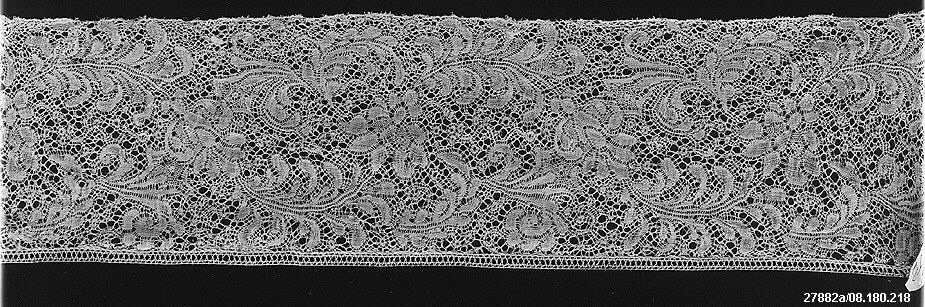
Within the architecture of haute couture, certain materials function less as ornament and more as structural philosophy. Bobbin lace belongs to this rarefied category. Unlike needle lace, which is built stitch upon stitch from a single thread, bobbin lace is a braided, tension-driven textile — a lattice formed by the systematic crossing and twisting of multiple thread pairs wound onto bobbins and pinned over a pricked pattern. The result is not merely a fabric but a record of choreography: every motif preserves the movement of the maker's hands, the rhythm of the pillow, the discipline of the pins. For Katherine Fashion Lab, this standalone study treats bobbin lace as a subject in its own right — a global heritage technology whose logic continues to inform the highest tiers of couture construction.
Global Heritage and the Cartography of a Craft
Bobbin lace's origin story resists singular attribution, and that ambiguity is precisely its strength. Scholarly consensus traces its emergence to sixteenth-century Europe — with strong traditions in Flanders, Italy, and later France, Spain, and England — yet the technique's deeper genealogy intersects with braiding and knotting systems across the globe. Japanese kumihimo, Andean cord techniques, and various Middle Eastern passementerie traditions all demonstrate the same fundamental insight: tension applied to multiple strands produces structure. Bobbin lace is therefore best understood not as a single national product but as a convergent global heritage — a craft that multiple cultures arrived at through different routes, each imprinting its own aesthetic grammar.
This matters commercially and critically. In an era of heritage-brand storytelling, bobbin lace offers something rarer than provenance: legitimacy through complexity. A machine can imitate its appearance, but it cannot replicate the decision density of hand-worked lace — the thousands of micro-adjustments in tension, the deliberate irregularity that signals human authorship. For a fashion lab operating at the intersection of craft and commerce, bobbin lace is a case study in how intangible cultural knowledge becomes tangible luxury value.
Material Properties: Why Bobbin Lace Behaves Like Engineering
To analyze bobbin lace is to analyze a textile system. Its defining characteristics are structural rather than decorative:
1. Openwork Geometry. The fabric is defined by negative space. Grounds such as tulle, net, and fond de neige establish the base grid, while motifs — flowers, scrolls, geometric repeats — are worked into or onto that grid. The interplay of solid and void creates visual porosity, allowing bobbin lace to read as weightless even when technically dense.
2. Tension as Design Variable. Because the lace is built under tension, slight variations produce measurable changes in drape, recovery, and hand-feel. A tightly worked lace behaves almost like a semi-rigid composite; a loosely worked lace becomes fluid and compliant. Couture ateliers exploit this by selecting or commissioning lace with specific mechanical profiles for specific silhouettes.
3. Thread Hierarchy. Bobbin lace typically employs finer threads for grounds and heavier threads for outlining motifs — a graded thread architecture that creates internal contrast and structural reinforcement. This is engineering logic expressed in linen, silk, or cotton.
4. Edge Integrity. Many bobbin laces feature picots and footsides — integral edge treatments that allow the lace to be joined, applied, or left raw without fraying. This self-finishing property is a significant advantage in couture, where seams must disappear and edges must behave.
Couture Application: From Flounce to Framework
Historically, bobbin lace entered couture as trim — collars, cuffs, flounces, veils. Its fineness and cost made it a marker of status, and its openwork made it ideal for layering and transparency effects. But the more interesting couture application is structural. In the hands of designers who understand its engineering, bobbin lace becomes a primary fabric: bonded to silk organza for body, appliquéd onto tulle for volume, or used as standalone panels in gowns where the lace itself carries the silhouette.
Consider the technical demands. Bobbin lace is anisotropic — its strength and stretch vary by direction. A couturier must therefore map the lace's grain before cutting, much as one would with a bias-cut woven. Motifs must be mirrored at seams to preserve visual continuity. Heavier motifs may need to be removed and reapplied to avoid bulk at stress points. These are not decorative decisions; they are structural interventions that determine whether a garment moves with the body or fights it.
The Sustainability and Value Argument
Bobbin lace also answers a contemporary market question: how does couture justify its price in an age of mechanical reproduction? The answer lies in irreplicable labor. A single meter of fine bobbin lace can require dozens of hours of handwork. That time is not a cost to be minimized; it is the product's core value proposition. Moreover, bobbin lace is inherently low-waste and repairable. Its openwork uses less fiber per square centimeter than a solid weave, and its construction allows for localized repair — a damaged motif can be reworked without discarding the whole panel. In a luxury landscape increasingly defined by traceability and longevity, bobbin lace is not nostalgia; it is infrastructure for a slower, more defensible fashion economy.
Conclusion: The Case for Material Literacy
Bobbin lace is a global heritage technology that rewards material literacy — the ability to read a textile's structure, behavior, and cultural memory. For Katherine Fashion Lab, this standalone study affirms a working principle: the most advanced couture is often the most elemental. Before silhouette, before embellishment, there is the logic of the cloth itself. Bobbin lace, with its tension, its geometry, and its centuries of cross-cultural refinement, remains one of the most eloquent arguments for craft as competitive advantage.