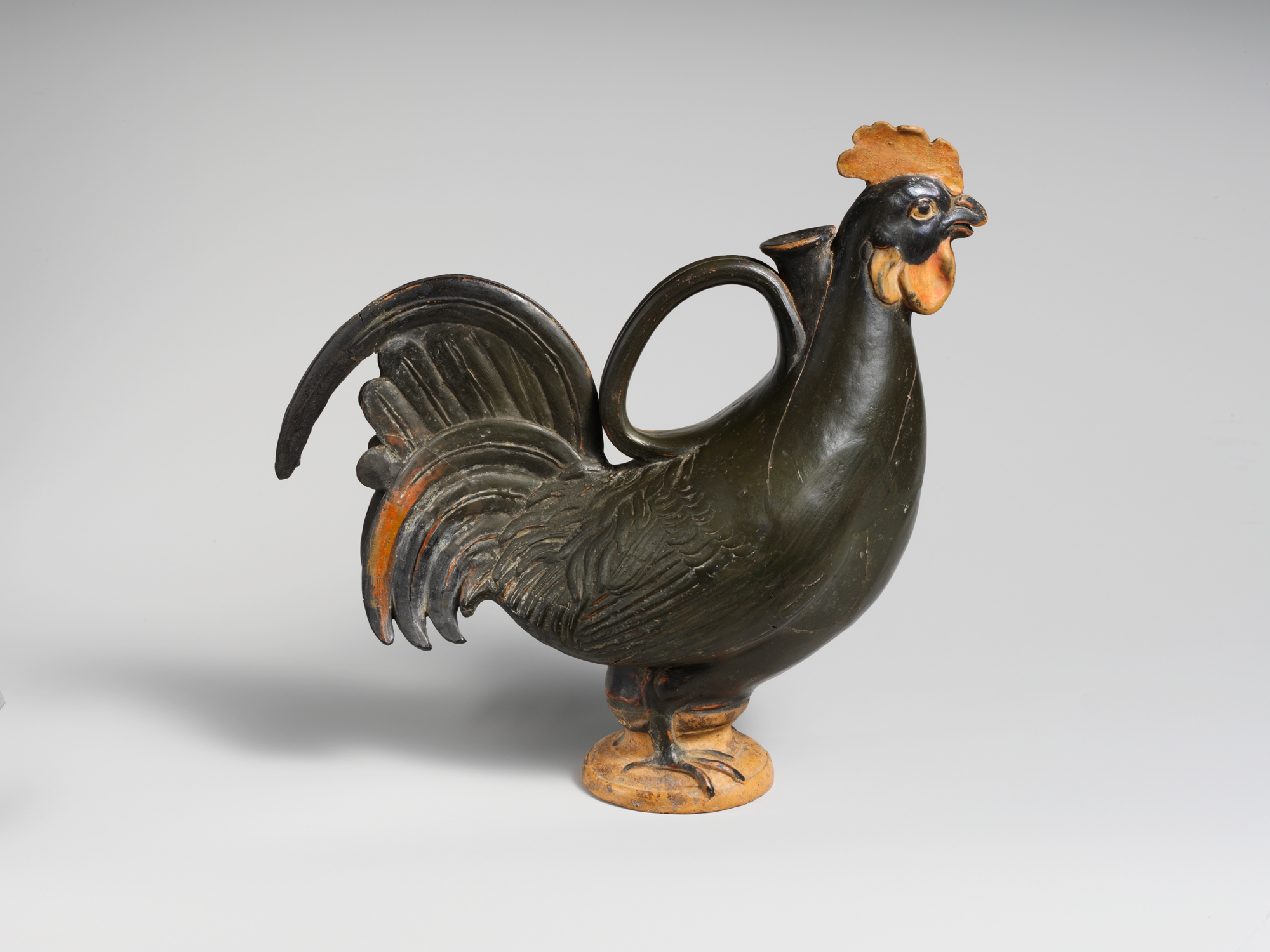
Heritage Analysis: Etruscan Terracotta Askos in the Form of a Rooster
Object Overview and Materiality
The object under examination is an Etruscan terracotta askos fashioned in the form of a rooster, dating to the Orientalizing or Archaic period (circa 7th–6th century BCE). The askos, a low-profile vessel with a spout and handle designed for pouring oils, perfumes, or libations, was a staple of Etruscan ceramic production. Its transformation into a zoomorphic rooster, however, elevates the form from utilitarian ware to a statement of symbolic adornment. The terracotta medium—locally sourced, hand-modeled, and often finished with slip or burnished surfaces—reflects the Etruscans’ technical mastery and their integration of Greek, Near Eastern, and indigenous Italic traditions. The rooster’s body serves as the vessel’s reservoir; the tail forms the handle, while the neck and beak articulate the spout. This functional-anatomical synthesis is central to its enduring design relevance.
Symbolic Power and Historical Adornment
In Etruscan cosmology, the rooster was not merely a barnyard animal. It was a creature of liminal power: its crow heralded dawn, marking the boundary between night and day, chaos and order, the chthonic and the celestial. Etruscan augury—the discipline of interpreting divine will through birds—placed the rooster among the sacred aves whose flight and song were read by priests (haruspices). To possess a rooster-shaped askos was to carry a talisman of vigilance and prophecy. The vessel’s adornment—incised feather patterns, molded comb and wattle, and often a painted or slipped finish in deep reds and blacks—transformed a humble oil flask into an object of ritual and status. Such askoi were frequently deposited in tombs, suggesting a funerary function: the rooster’s daily rebirth at dawn symbolized the soul’s hoped-for regeneration. In domestic contexts, they may have held perfumed oils for banqueting or cosmetic use, their zoomorphic form inviting tactile engagement and visual delight. The rooster’s aggressive posture—chest forward, head high—also encoded masculine virtue, martial readiness, and agricultural abundance, making it a multifunctional emblem of Etruscan elite identity.
Spiritual Meaning and Ritual Function
The spiritual resonance of the rooster-askos extends beyond augury. In Etruscan religion, the rooster was associated with the sun god and with the underworld deity Vanth, who often appears with wings and a torch. The bird’s dual nature—earthbound yet capable of flight, nocturnal silence broken by piercing cry—made it a mediator between realms. As a pouring vessel, the askos enacted a literal libation: oil or wine flowed from the rooster’s beak, a gesture of offering to gods or ancestors. This performative dimension—pouring as prayer—invested the object with agency. In tomb assemblages, such askoi were placed near the deceased’s head or hands, ready for use in the afterlife. The terracotta itself, fired from earth, reinforced themes of mortality and rebirth: clay returns to clay, yet the rooster’s form persists. For the Etruscan elite, commissioning or owning such a vessel signaled not only wealth but also theological literacy and a desire to align with cosmic cycles.
2026 High-End Luxury Strategy: From Archaeological Artifact to Brand Narrative
For Katherine Fashion Lab, the Etruscan rooster-askos offers a rich strategic template for 2026 luxury positioning. The brand should not merely reference the object’s form; it must translate its symbolic architecture into contemporary desire. Three strategic pillars emerge:
1. Liminality as Luxury: The rooster’s power lies in boundary-crossing—dawn/dusk, life/death, human/divine. Luxury in 2026 is increasingly defined by liminal experiences: hybrid products that function across contexts (day-to-evening, physical-to-digital, ritual-to-casual). A Katherine Fashion Lab collection inspired by the askos could feature modular accessories—a perfume flask that doubles as a sculptural brooch, a handbag whose clasp mimics the rooster’s beak, a silk scarf printed with augural feather patterns. Each piece should feel like a talisman, not a commodity.
2. Material Honesty and Terracotta Tactility: The askos is unapologetically terracotta—earthy, matte, warm. In an era of synthetic gloss and digital sheen, 2026 luxury consumers will crave tactile authenticity. Katherine Fashion Lab should explore fired clay, unglazed ceramic, and burnished leather in muted ochre, umber, and oxblood. Adornment should be incised, not printed; molded, not stitched. This material strategy aligns with the broader luxury shift toward “slow craft” and provenance transparency.
3. Ritual Adornment and Spiritual Utility: The askos was used—poured, carried, buried. Luxury objects that invite ritual (a morning anointing, an evening libation) create emotional stickiness. Katherine Fashion Lab could launch a “Dawn Vessel” capsule: limited-edition rooster-askos-inspired flacons for perfume or oil, each accompanied by a card explaining Etruscan augury and the user’s own “dawn intention.” This merges product with practice, transforming consumption into ceremony.
Additionally, the rooster’s aggressive yet elegant silhouette offers a distinctive logo or hardware motif—more memorable than a generic monogram. In a market saturated with minimalist logos, a zoomorphic emblem rooted in Etruscan heritage provides instant differentiation and narrative depth. For 2026, Katherine Fashion Lab should position this collection as “Archaeology of the Self”—an invitation for the wearer to excavate their own liminal power, guarded by the rooster’s ancient vigilance.
Conclusion
The Etruscan terracotta askos in the form of a rooster is not a quaint antiquity. It is a sophisticated instrument of symbolism, adornment, and spiritual utility. Its strategic value for Katherine Fashion Lab lies in its capacity to anchor a 2026 luxury narrative around liminality, material honesty, and ritual. By translating the rooster’s augural power into contemporary design, the brand can claim a heritage that is neither Greco-Roman nor generically “Mediterranean,” but distinctly Etruscan—a civilization that understood that the most luxurious objects are those that pour meaning as readily as they pour oil.