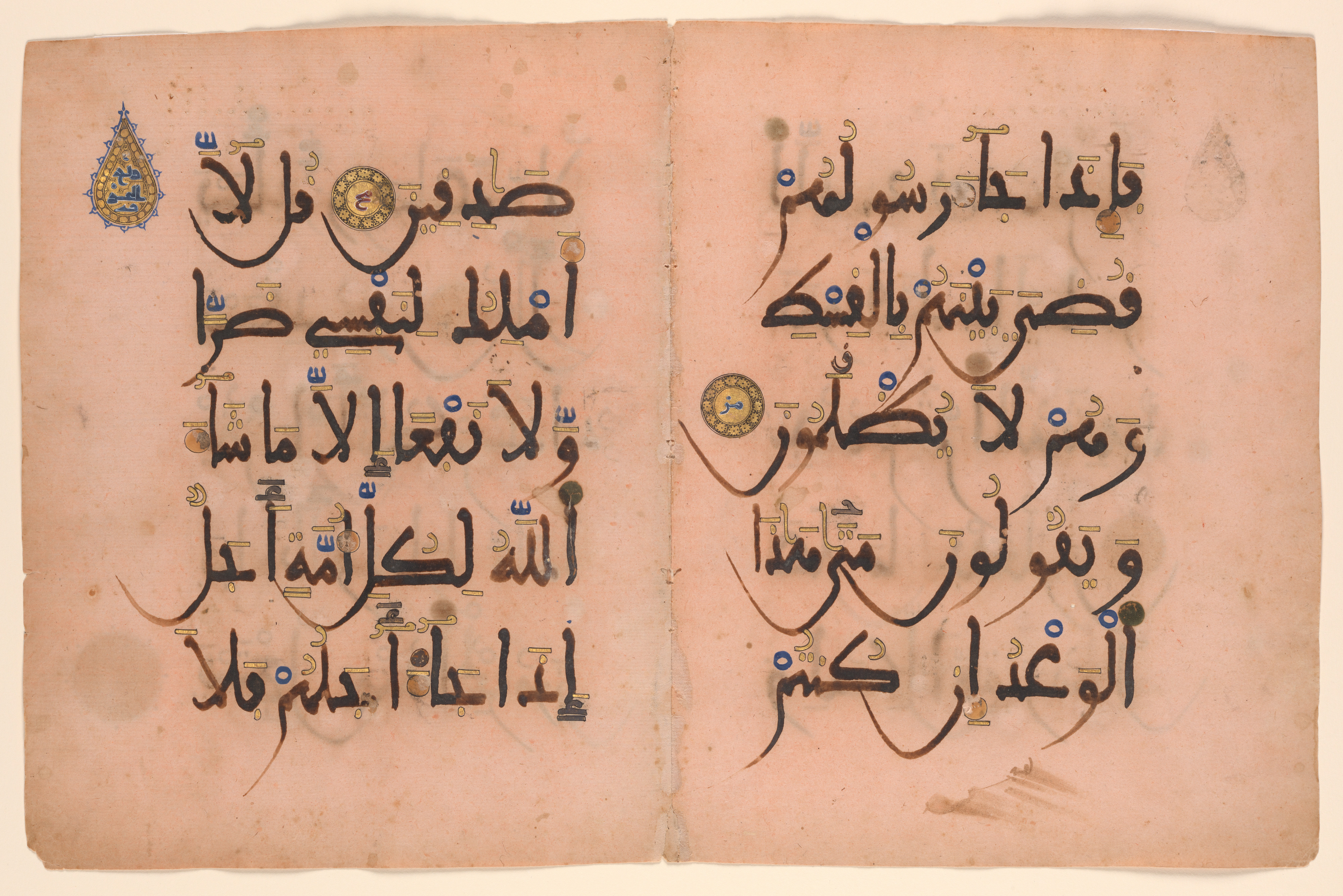
Heritage Asset Analysis: Bifolium from the Andalusian Pink Qur'an
Object Identification and Material Significance
The bifolium under examination originates from the celebrated Andalusian Pink Qur'an, a manuscript tradition attributed to the Iberian Peninsula during the Almohad and subsequent Nasrid periods (circa 12th–14th centuries CE). Executed in ink, gold, silver, and opaque watercolor on paper, this double-page spread represents a pinnacle of Andalusian manuscript illumination. The distinctive rose-toned paper—from which the manuscript derives its modern appellation—was likely achieved through dyeing or tinting processes, a technical refinement that signals both material scarcity and artisanal sophistication. For Katherine Fashion Lab, this object constitutes a strategic heritage asset whose material composition alone offers a narrative of cross-cultural exchange, imperial patronage, and spiritual devotion.
Historical Context: Adornment as Devotional Practice
The Pink Qur'an emerged within a cultural milieu where the visual adornment of sacred text was not merely decorative but theological. In Andalusian Islam, the act of illuminating the Qur'an was understood as an act of worship—a material manifestation of reverence for the divine word. The use of gold and silver in the marginalia and sura headings was not ornamental excess; rather, it invoked the concept of nur (light), a Qur'anic motif associated with divine guidance. The geometric and vegetal motifs that frame the text served as visual meditations, guiding the reader's eye toward the sacred script while simultaneously signaling the manuscript's elevated status.
The pink ground itself is significant. While blue and gold were common in Qur'anic illumination, the rose-tinted paper of this manuscript suggests a deliberate aesthetic choice—one that may have evoked the hues of dawn, a time of prayer, or the floral abundance of Andalusian gardens. This chromatic identity distinguishes the Pink Qur'an within the broader corpus of Islamic manuscripts and positions it as a unique heritage asset with strong visual branding potential.
Symbolic Power and Spiritual Meaning
The bifolium format—two facing pages—creates a unified visual field that mirrors the dual nature of revelation: the outward text and the inward meaning. The gold and silver illumination operates on multiple symbolic levels. Gold, incorruptible and luminous, traditionally signifies divine sovereignty and eternity. Silver, associated with purity and the moon, complements gold's solar symbolism, creating a balanced cosmology. Together, they frame the black ink of the sacred script, establishing a hierarchy of materials that mirrors the hierarchy of meaning: the divine word at the center, surrounded by the radiance of creation.
The opaque watercolor elements—likely in lapis lazuli, verdigris, and other mineral pigments—introduce a spectrum of color that would have been costly and technically demanding. In a luxury context, this material complexity translates directly into value: the Pink Qur'an is not merely a religious object but a demonstration of imperial wealth, cross-cultural trade networks (lapis from Afghanistan, gold from West Africa), and the highest levels of artistic specialization.
2026 Luxury Strategy: Heritage as Narrative Capital
For Katherine Fashion Lab, the strategic relevance of the Pink Qur'an bifolium lies in its capacity to anchor a luxury narrative that is both historically grounded and spiritually resonant. The 2026 luxury consumer—particularly in the Middle East, North Africa, and diaspora markets—increasingly seeks products that embody authenticity, provenance, and meaning. The Pink Qur'an offers a template for this: it is a heritage object that combines material rarity, spiritual significance, and a distinctive chromatic identity.
Three strategic applications emerge:
1. Chromatic Branding: The rose-toned paper and gold-silver illumination provide a proprietary color palette. Katherine Fashion Lab can develop a signature "Andalusian Rose" hue across textiles, leather goods, and packaging, linking the brand to a specific historical artifact and its aura of sacred luxury.
2. Narrative-Led Product Development: The bifolium's structure—paired pages, symmetrical illumination—inspires design motifs for accessories, jewelry, and even architectural retail spaces. The geometric interlace and vegetal arabesque can be reinterpreted in modern silhouettes, creating a dialogue between 12th-century Andalusian craft and 21st-century minimalism.
3. Spiritual Positioning: In an era of secular luxury, the Pink Qur'an offers a counter-narrative: adornment as devotion. Katherine Fashion Lab can position select collections as "objects of contemplation," appealing to consumers who value mindfulness, heritage, and the intersection of beauty and meaning.
Conclusion: From Bifolium to Brand Asset
The Andalusian Pink Qur'an bifolium is more than a historical artifact; it is a strategic heritage asset. Its material composition—gold, silver, opaque watercolor on rose-tinted paper—encodes centuries of trade, devotion, and artistic excellence. Its symbolic power—light, purity, and the sacred word—resonates with contemporary desires for authenticity and spiritual connection. For Katherine Fashion Lab, the path forward lies in translating this bifolium's visual and conceptual language into a luxury strategy that honors its origins while addressing the aspirations of the 2026 market. The result is not merely a collection but a continuation: the Pink Qur'an's legacy, reimagined for a new era of adornment.