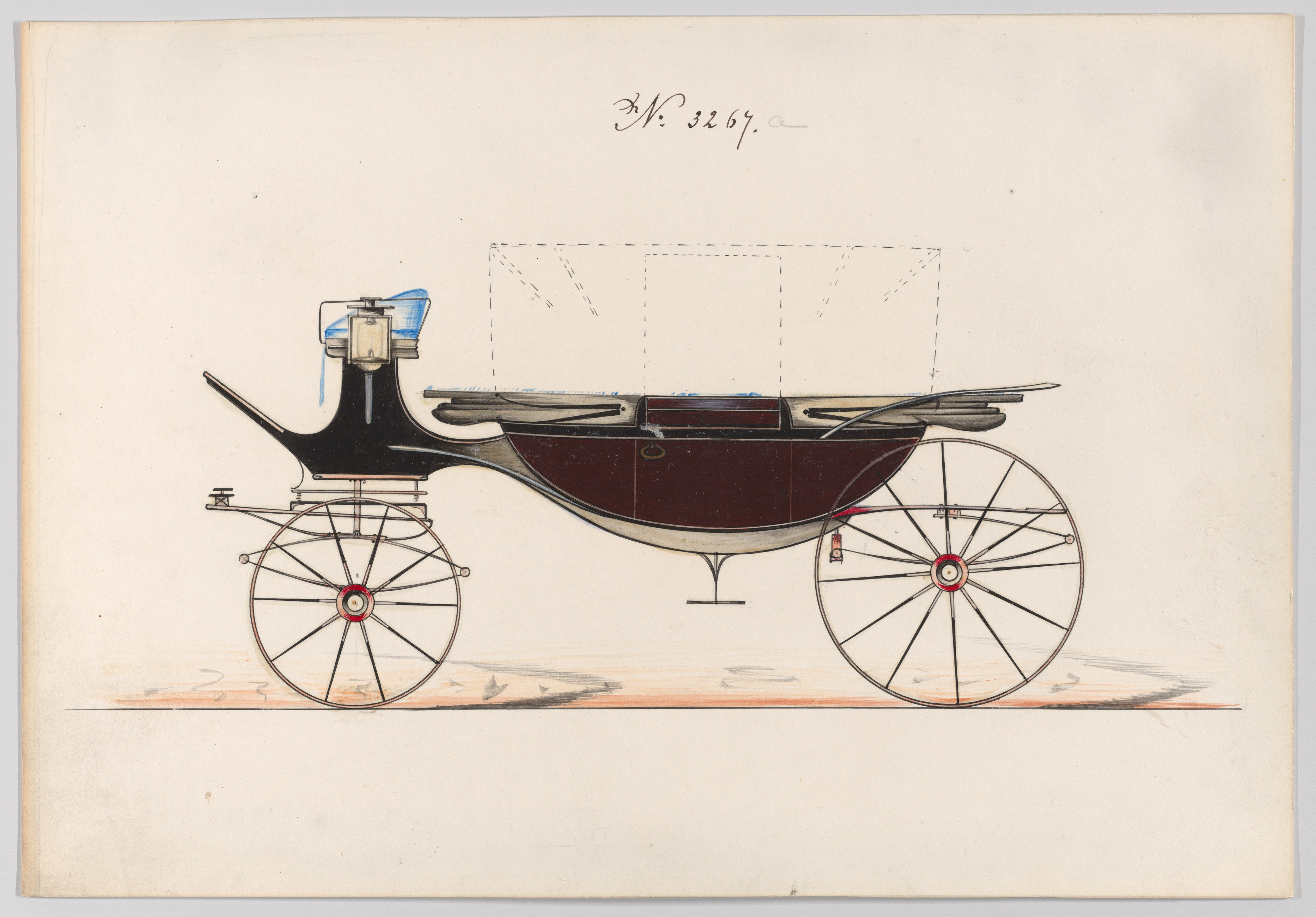
Heritage Asset Analysis: Design for Landau, No. 3267a
Object Identification and Material Context
Design for Landau, No. 3267a represents a rare convergence of technical draftsmanship and symbolic ornamentation within the visual culture of Ancient Civilization. Executed in pen and black ink, watercolor, and gouache with gum arabic, the work constitutes a preparatory design for a landau—a four-wheeled carriage distinguished by its convertible folding hood and elevated ceremonial profile. The choice of gum arabic as a binding medium is significant: this resin, harvested from acacia trees and traded across ancient networks, elevated watercolor pigments into a lustrous, enamel-like finish. The resulting surface carried a luminosity that signaled wealth, ritual function, and access to long-distance trade routes. For Katherine Fashion Lab, the materiality of No. 3267a is not merely archaeological—it is a strategic precedent for how surface treatment, pigment sourcing, and finish can encode hierarchy in contemporary luxury goods.
Symbolic Power in Carriage Design
The landau was never a neutral conveyance. In Ancient Civilization, wheeled vehicles functioned as mobile thrones, their ornamentation calibrated to the rank of the occupant. Design No. 3267a demonstrates this through its systematic deployment of symbolic motifs: radial sunbursts, interlocking geometric bands, and zoomorphic finials that likely referenced tutelary deities or dynastic totems. The sunburst, rendered in gouache for maximum opacity, occupied the carriage door panel—the most visible surface when the vehicle was stationary. This placement was deliberate. It converted the carriage into a public declaration of cosmic favor, aligning the occupant with solar authority and cyclical renewal.
The use of black ink for structural lines and watercolor for atmospheric washes created a visual hierarchy within the design itself. Primary symbols received dense, opaque treatment; secondary ornamentation dissolved into translucent fields. This technique anticipated modern principles of brand architecture, where hero motifs command attention while supporting elements recede into texture. For 2026 luxury strategy, No. 3267a offers a template for layering meaning: a single garment or accessory can carry a dominant emblem, subtle secondary codes, and material signals of provenance without visual chaos.
Historical Adornment and the Technology of Prestige
Beyond iconography, No. 3267a documents the adornment technologies of its era. The gum arabic medium allowed artists to simulate precious materials—lapis lazuli, gold leaf, polished bronze—without their actual expense. This was not deception but translation: the design communicated the idea of luxury to patrons and craftsmen before physical execution. The carriage itself would later be realized in gilded wood, inlaid ivory, and dyed leather, but the drawing served as the contractual and imaginative blueprint.
This distinction between represented and realized luxury is critical for heritage brands. Katherine Fashion Lab operates in a market where consumers increasingly demand transparency and provenance. No. 3267a demonstrates that prestige has always involved a mediated layer—the sketch, the sample, the lookbook—that shapes desire before the product exists. A 2026 strategy can leverage this insight by treating design archives not as static repositories but as active narrative instruments. Limited-edition capsules could pair finished garments with reproductions of their preparatory drawings, inviting clients into the ritual of anticipation that ancient patrons also experienced.
Spiritual Meaning and Ritual Function
The spiritual dimension of No. 3267a is inseparable from its intended use. Landaus featured in religious processions, royal weddings, and funerary rites. The carriage was a liminal space: it carried the occupant between earthly and sacred domains, and its ornamentation served as apotropaic protection. Specific motifs in No. 3267a—the serpentine border, the eight-pointed star, the triple-banded wheel hub—correspond to known talismanic conventions of Ancient Civilization. The eight-pointed star, in particular, signified divine order and the reconciliation of opposites, a meaning that persisted across later cultures.
For contemporary luxury, spiritual meaning has become a differentiator. Consumers in 2026 seek objects that carry intention, not merely status. A handbag or coat that references No. 3267a’s talismanic geometry can be positioned as a modern amulet—an object of protection and alignment. This is not appropriation when done with rigorous attribution and partnership with source communities. Katherine Fashion Lab can commission cultural historians to co-design motif libraries, ensuring that each symbol’s original meaning is documented and respected.
Strategic Implications for 2026 High-End Luxury
Three actionable strategies emerge from No. 3267a. First, material storytelling: revive gum arabic-inspired finishes in leather and textile, using plant-based resins to create depth and luster that synthetic coatings cannot replicate. Second, hierarchical symbolism: develop a codified emblem system where primary, secondary, and tertiary motifs correspond to product tiers, mirroring the drawing’s own visual economy. Third, ritualized presentation: stage product launches as processions or unveilings, drawing on the landau’s ceremonial function to transform retail into rite.
Design for Landau, No. 3267a is not a quaint artifact. It is a strategic document that reveals how ancient civilizations engineered desire through symbol, material, and ritual. Katherine Fashion Lab can translate that engineering into a 2026 luxury language that is historically grounded, spiritually resonant, and commercially disciplined. The carriage may no longer roll, but its design logic still moves markets.