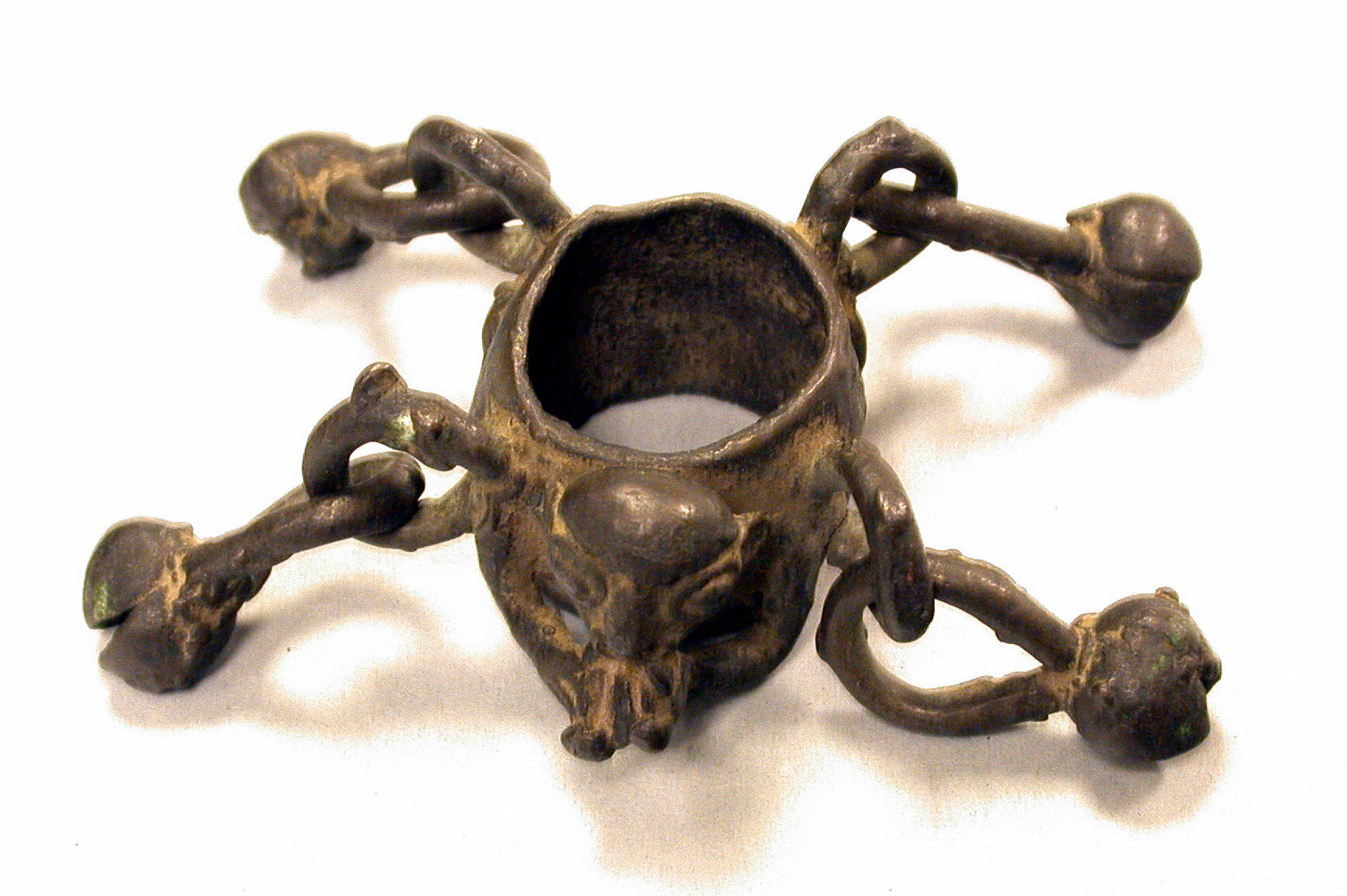
Object Biography: Cast Bronze Staff Finial, Peru (North or Central Coast)
Formal Description and Materiality
The object under consideration is a cast bronze staff finial attributed to the pre-Columbian cultures of Peru's north or central coast. Executed in copper-arsenic bronze through the lost-wax casting method, the finial would have crowned a wooden staff—now lost to time—transforming a utilitarian shaft into an instrument of authority. The alloy itself signals sophistication: Andean metalsmiths were among the most advanced in the ancient Americas, mastering alloying, gilding, and depletion techniques centuries before European contact. The surface likely carries a patina of malachite and cuprite, a chromatic signature that contemporary luxury consumers increasingly associate with authenticity and time-depth.
Symbolic Power and the Staff as Instrument of Authority
In Andean visual culture, the staff was never merely a walking aid. It was a condensed statement of legitimate power. Rulers, priests, and lineage heads carried staffs whose finials encoded rank, office, and cosmological alignment. The finial—the visible apex—functioned as a heraldic device in three dimensions, legible to any observer within the plaza or processional route. To hold the staff was to hold jurisdiction; to lose it was to forfeit standing. This logic resonates with global traditions, from the Egyptian was-scepter to the Roman fasces, yet the Andean iteration carries a distinct emphasis on verticality and cosmic mediation.
Adornment, Body, and the Extended Self
Archaeological and iconographic evidence from the Moche, Recuay, and later Chimú and Inca traditions demonstrates that adornment was a technology of personhood. Elaborate headdresses, ear spools, labrets, and staffs did not decorate a pre-existing self; they constituted it. The staff finial extended the body upward, creating a silhouette of command visible at distance. In high-end luxury terms, this is the logic of the statement accessory: an object that alters the wearer's presence before a word is spoken. The finial's casting—requiring specialized labor, controlled fire, and esoteric knowledge—further concentrated value, making the object a store of both material and ritual capital.
Spiritual Meaning and Cosmological Function
Andean cosmology organized the world into complementary realms—hanan (upper) and hurin (lower), sky and earth, mountain and sea. The staff finial occupied a mediating position: planted in the ground but reaching skyward, carried by a human body that itself bridged the two. Many finials depict avian, feline, or anthropomorphic figures, suggesting the staff served as a conduit for ancestral or deity presence. In ritual procession, the finial became a focal point for collective attention, a material anchor for invisible forces. This is not decoration; it is operational metaphysics. The object did spiritual work in the world, and its power was understood to be contingent on correct material, correct form, and correct handling.
Provenance Ambiguity as Interpretive Constraint
The attribution "north or central coast (?)" is itself analytically significant. The absence of secure archaeological context—tomb, cache, or settlement—limits our ability to assign the finial to a specific polity, workshop, or date range. North coast traditions (Moche, Lambayeque, Chimú) favored certain iconographic programs and casting conventions; central coast cultures (including the Chancay and earlier Lima traditions) developed distinct stylistic signatures. Without context, the object must be read through typological comparison and material analysis. For Katherine Fashion Lab, this ambiguity is not a weakness but a strategic asset: it positions the object within a broader Andean narrative while preserving interpretive openness, a quality that resonates with luxury consumers who value narrative depth over fixed provenance.
2026 Luxury Strategy: Heritage as Intellectual Property
The 2026 high-end market is defined by three converging forces: radical transparency, narrative scarcity, and the premiumization of cultural knowledge. Consumers at the top of the pyramid no longer purchase objects alone; they acquire access to systems of meaning. The Cast Bronze Staff Finial offers Katherine Fashion Lab a multi-layered strategic platform.
First, material authenticity. Bronze—an alloy, a product of human ingenuity rather than a single mined substance—speaks to the luxury value of transformation. The 2026 consumer rewards materials with a story of skilled intervention. A heritage capsule referencing Andean metallurgy can foreground alloy science, lost-wax casting, and the alchemy of fire, positioning the brand at the intersection of craft and technology.
Second, symbolic authority. The staff finial is a ready-made emblem of leadership. In a market saturated with logo-driven status signals, the finial offers a subtler proposition: power expressed through form, proportion, and historical literacy. A modern accessory line—whether a bag clasp, a jewelry pendant, or a limited-edition objet—can borrow the finial's vertical logic and avian or feline motifs without resorting to literal reproduction. The strategy is translation, not appropriation: cite the source, credit the culture, and collaborate with Andean artisans or institutions where possible.
Third, spiritual capital. Luxury in 2026 increasingly trades in meaning, ritual, and slowness. The finial's cosmological function—mediating between realms—maps onto contemporary desires for objects that ground the wearer in something larger than trend. Campaign narratives can explore the staff as a tool of alignment, a physical anchor for intention. This is not New Age pastiche; it is a historically grounded reading of how Andean peoples used adornment to organize their relationship with the sacred.
Fourth, provenance ethics. Any engagement with pre-Columbian material culture must confront the legacies of looting and colonial extraction. Katherine Fashion Lab should adopt a rigorous provenance policy: prioritize objects with documented collection histories, support source-community heritage initiatives, and frame research as restitution-adjacent scholarship. In 2026, ethical provenance is not a compliance cost; it is a brand differentiator.
Conclusion
The Cast Bronze Staff Finial is a compact archive of Andean political theology, metallurgical mastery, and embodied authority. Its formal ambiguity—north or central coast—invites scholarly humility and narrative breadth. For Katherine Fashion Lab, the object is less a relic than a strategic template: a lesson in how power is cast, carried, and communicated. The 2026 luxury landscape rewards brands that can move fluently between museum-grade research and consumer-facing storytelling. This finial, with its vertical ambition and spiritual charge, offers precisely that bridge.