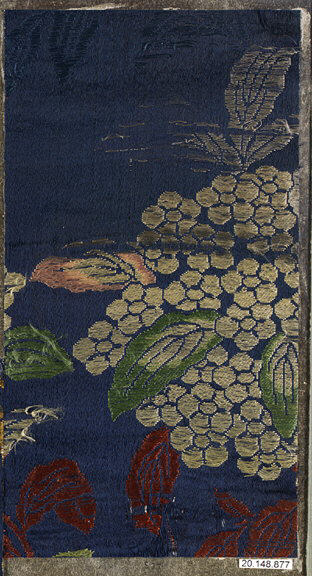
Deconstructing the Silken Architecture: A Standalone Study of a Chinese Compound Weave
In the rarefied air of haute couture, where narrative often precedes form, a standalone study possesses a unique, potent clarity. It is an exercise in pure material intelligence, a forensic appreciation of technique divorced from the distractions of a full collection's thematic arc. This analysis focuses on such a piece: a textile artifact of Chinese origin, crafted from silk via a sophisticated compound weave. For Katherine Fashion Lab, this is not merely a swatch of fabric but a complete architectural thesis—a microcosm of cultural memory, technical mastery, and avant-garde potential waiting to be activated by the designer's hand.
The Foundation: Silk as Cultural and Technical Substrate
To engage with this piece is first to acknowledge its foundational material: silk. Synonymous with China for millennia, silk is far more than a luxurious filament; it is a historical protagonist. Its cultivation, a secret guarded for centuries, established trade routes and became a global currency of prestige. In a couture context, silk represents the ultimate paradox: formidable strength born from delicate, continuous protein threads. This inherent duality—strength and suppleness, luminosity and depth—makes it the perfect canvas for technical experimentation. The silk used here is not a passive substrate but an active participant, its natural sheen and dye affinity destined to interact dynamically with the structural complexities of the weave to come.
The choice of a compound weave is the critical differentiator, elevating the fabric from a simple, elegant ground to a multidimensional textile engineering feat. Unlike basic weaves (plain, twill, satin) that operate with a single set of warps and wefts, a compound weave incorporates multiple series of warp or weft threads, often of different colors or materials, to create intricate patterns that are integral to the cloth itself, not merely applied to its surface. This is architecture at the thread level. The result is a fabric with a pronounced structural identity—a topographical landscape of raised motifs, subtle color shifts, and a compelling interplay of matte and gloss within a unified plane.
Anatomy of a Compound: Structural Analysis and Aesthetic Implications
Examining the piece closely, the Lab's analysis must dissect its woven anatomy. A compound structure, such as a damask or a brocade, typically involves a ground weave and a pattern weave operating simultaneously. The genius lies in their interdependence; the pattern is not printed or embroidered but born from the strategic interlacing of these additional thread systems. This creates a fabric with two distinct faces, often reversible, each telling a different part of the same visual story. The tactile result is a rich, substantial hand-feel—a weight and density that belies the fineness of the individual silk threads. This inherent body gives the textile a self-supporting quality, crucial for couture applications where fabric must often hold a shape with minimal internal infrastructure.
The aesthetic implications are profound. The pattern emerges with a subtle, authoritative clarity, its edges defined by light and shadow catching the divergent angles of the threads rather than by a stark color contrast. This yields a sophistication that is restrained yet deeply complex. For the couturier, this presents both a directive and an invitation. The fabric’s own narrative—perhaps a traditional Chinese motif like a cloud collar (yun jian), a scrolling vine, or a geometric lattice—is already encoded in its structure. The designer’s task becomes one of dialogue or juxtaposition: to cut and drape in a way that honors this intrinsic pattern language or to deliberately subvert it through modernist slicing and seaming, allowing the ancient geometry to collide with contemporary silhouette.
From Artifact to Avant-Garde: Couture Translation and Future Iterations
As a standalone study, this piece’s value for Katherine Fashion Lab is its predictive potential. Its properties dictate specific couture applications. Its structural integrity makes it ideal for sculptural, minimal-seam construction. Imagine a bodice where the darts are eliminated, the shape molded solely by the interaction of the woven pattern’s tension and the curve of the body. The reversible nature of many compound weaves offers built-in design solutions—a flash of a contrasting pattern at a cuff, lapel, or hem, achieved not by adding a facing but by simply turning the fabric on itself.
The material intelligence of this silk compound weave also lights a path for future innovation. The Lab must ask: How can this ancient technique be pushed into the future? Could one of the thread systems be replaced with a high-tech filament—a conductive thread, a photochromic yarn, or a biodegradable polymer—creating a "smart" compound weave that responds to its environment? Could the density of the weave be made variable across the piece, engineered to be rigid at the shoulders and fluid at the skirt, creating a garment of a single, morphing fabric? The standalone study proves the concept; the avant-garde iteration lies in hybridizing its material matrix.
Conclusion: The Autonomous Textile as Couture Catalyst
This Chinese silk compound weave, in its standalone purity, stands as a testament to the principle that in high couture, the fabric is the first draft of the design. It is an autonomous object brimming with embedded intelligence—cultural, technical, and aesthetic. For Katherine Fashion Lab, such a piece is a cornerstone resource. It provides a masterclass in textile-led design thinking, where the silhouette is not imposed upon a passive cloth but emerges in concert with the fabric’s own will and memory. It challenges the designer to act as both architect and archaeologist, building new forms while excavating the deep meaning and peerless skill woven into every thread. In this silent dialogue between past and future, material and maker, lies the perpetual, groundbreaking mission of true couture.