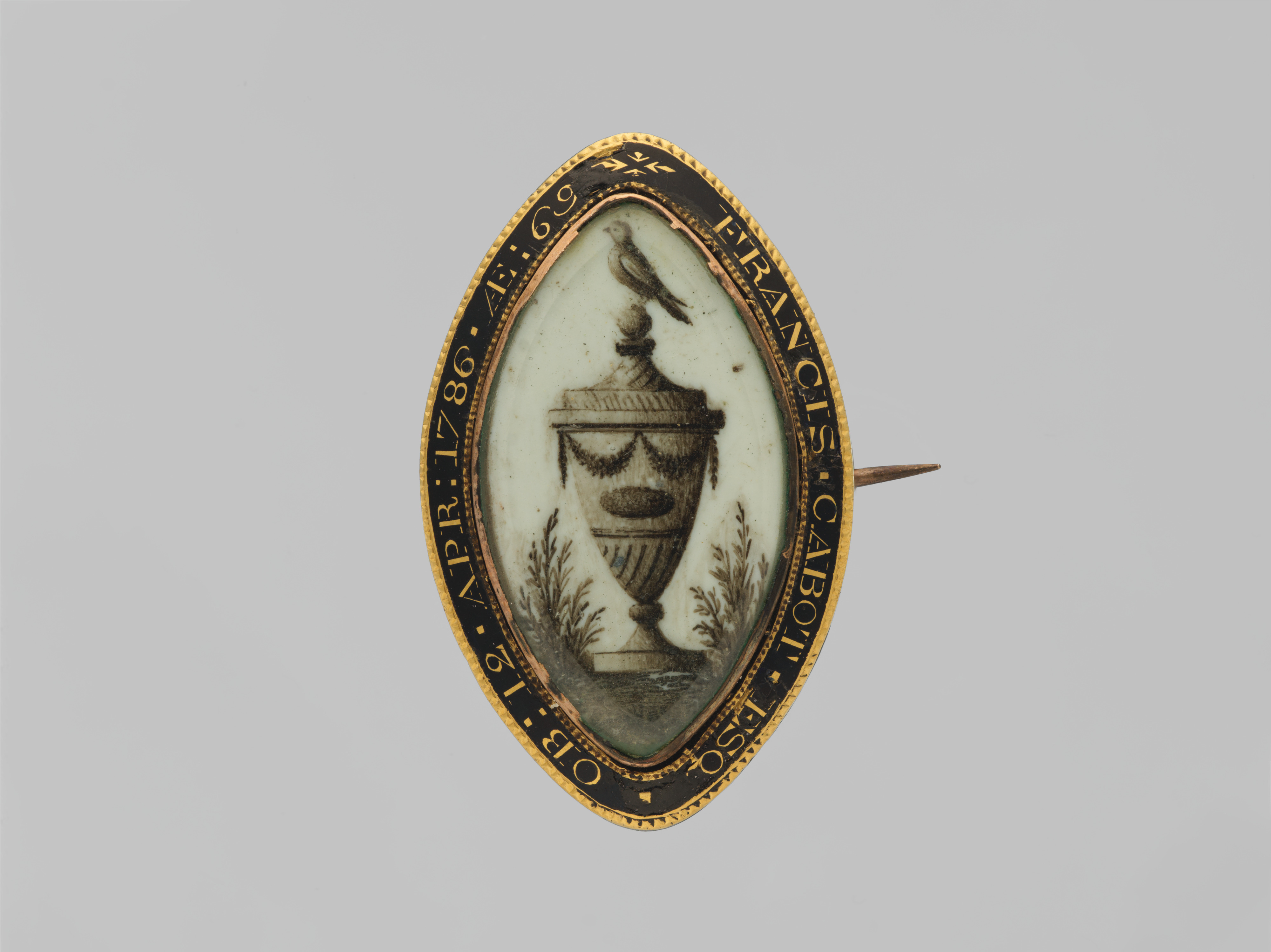
Executive Summary: The Memorial Brooch as a Foundational Luxury Asset
This strategic standalone research paper, prepared for Katherine Fashion Lab, conducts a deep heritage analysis of the 19th-century American Memorial Brooch. The artifact, constructed from watercolor on ivory, enamel, gold, copper, and beveled crystal, is examined not merely as a relic of sentimental jewelry but as a dense repository of symbolic capital. This analysis deconstructs its historical language of adornment to extract core principles of enduring value—memory, intimacy, and spiritual dialogue—which can be translated into a disruptive 2026 high-end luxury strategy. By moving beyond literal revival, Katherine Fashion Lab can architect a new lexicon of "emotional heirlooming," positioning itself at the vanguard of meaningful, post-material luxury.
Historical & Material Deconstruction: A Microcosm of American Adornment
The American Memorial Brooch of the mid-19th century emerged from a confluence of social, spiritual, and material conditions. The high mortality rates, particularly of women and children, and the rise of Romanticism fostered a culture where mourning was both a private grief and a public performance. Adornment became a critical medium for this expression, with jewelry serving as a portable, intimate shrine.
The Semiotics of Composite Materiality
The brooch's material composition is a deliberate hierarchy of symbolic and spiritual meaning. The use of watercolor on ivory is paramount. Ivory, a precious organic substrate, symbolized purity and the eternal soul, while the delicate, translucent watercolor technique captured the ephemeral, fleeting nature of life itself. This painted miniature, often a portrait or a scene of mourning (like a weeping willow by a tomb), was the narrative heart. It was then framed by enamel, typically black or white, colors codified by strict mourning etiquette to communicate the wearer's specific stage of grief. The gold and copper provided structural integrity and value, with gold representing celestial permanence and copper offering a more humble, earthly foundation. Finally, the beveled crystal served as a protective yet luminous veil, literally and metaphorically refracting the viewer's gaze, creating a blurred, dreamlike separation between the living wearer and the memorialized subject. This was not decoration; it was a layered, wearable theology.
Symbolic Power and Spiritual Meaning: The Anatomy of an Intimate Relic
The brooch’s power derived from its function as a conduit for spiritual continuity and a regulator of social emotion. It transformed private memory into a sanctioned public symbol.
Spiritual Dialogue and the Victorian "Cult of Memory"
In an era preoccupied with the afterlife and spiritualism, the brooch was a talisman. It was a focal point for meditation, a physical object that made the invisible presence of the deceased tangible. The hair of the departed, often incorporated behind the crystal or woven into the design, was considered the ultimate memento mori—a literal piece of the person's body, charged with their essence. Wearing it was an act of devotion, a belief that love and memory could transcend physical decay. The brooch thus operated within a spiritual economy where adornment was a sacred duty, a way to keep the soul of the departed within the social and familial orbit.
The Contained Spectacle: Adornment as Emotional Armor
Historically, this adornment served a dual purpose: it invited recognition of loss while also armoring the wearer. Displaying grief through a codified, beautiful object allowed for the expression of profound sorrow within the bounds of social propriety. It communicated, "I am in mourning," thereby managing social interactions and expectations. The brooch was both a shield and a signal, a masterpiece of emotional regulation through material culture. Its beauty tempered its sadness, making the unbearable somehow wearable.
Strategic Translation: A 2026 Luxury Strategy for Katherine Fashion Lab
For the 2026 luxury landscape, defined by experiential value, sustainability, and profound authenticity, the Memorial Brooch offers a revolutionary strategic blueprint. The goal is not to produce replicas, but to resurrect its core ethos for a contemporary clientele seeking depth and narrative.
Pillar 1: The New Intimacy – "Emotional Heirlooming"
Katherine Fashion Lab will pioneer "Emotional Heirlooming." This strategy moves beyond physical inheritance to curate pieces designed to become future heirlooms through embedded personal narrative. Leveraging technology and bespoke service, clients can co-create pieces that encode personal significance—digital micro-engravings of voiceprints, bespoke pigments developed from meaningful locations (e.g., soil from a family home), or abstract compositions based on biometric data (a heartbeat rhythm). Like the watercolor on ivory, the modern "portrait" becomes abstract, emotional, and deeply personal. The beveled crystal is reinterpreted as innovative, sustainable composites that encapsulate and distort these personal elements, creating a modern veil of privacy.
Pillar 2: Material Alchemy with Symbolic Provenance
The historical composite materiality informs a 2026 material strategy focused on symbolic provenance and radical transparency. Gold and copper will be sourced from verified, reclaimed electronic or architectural sources, embedding a narrative of renewal. "Enamel" techniques will be revisited through partnerships with bio-labs, developing colors from organic, non-toxic pigments with storied origins. The "ivory" substitute will be a signature, lab-grown organic composite with a unique, proprietary luminescence, representing a commitment to eternal beauty without ethical compromise. Each material's origin story will be a key part of the product's spiritual and economic value.
Pillar 3: The Contained Spectacle in the Digital Age
Modern luxury is a hybrid of private ownership and public digital identity. Pieces will be designed with a "contained spectacle" in mind: incredibly intimate in their true meaning, yet visually striking enough to function as iconic objects. They will be accompanied by a secure, blockchain-verified digital certificate—a "Soul Ledger"—that allows the owner to choose how much of the object's narrative to reveal in the digital sphere. This creates allure, mystery, and aligns with the desire for control over one's personal data and story. The brooch’s function as emotional armor is translated into digital-age discretion and curated revelation.
Conclusion: From Mourning Jewelry to Meaningful Core
The 19th-century American Memorial Brooch provides Katherine Fashion Lab with a masterclass in luxury that is visceral, spiritual, and socially intelligent. Its genius lies in its transformation of profound human emotion—grief, love, memory—into a wearable, beautiful, and conversation-regulating artifact. For the 2026 high-end market, saturated with overt logos and transient trends, this analysis dictates a path toward quiet, immense power. By architecting a new category of "emotional heirlooming," grounded in symbolic materiality and narrative intimacy, Katherine Fashion Lab can capture the evolving luxury psyche. The strategy is to sell not jewelry, but portable legacies; not adornment, but articulated emotion. In doing so, the lab will memorialize not the past, but the future of meaningful luxury.