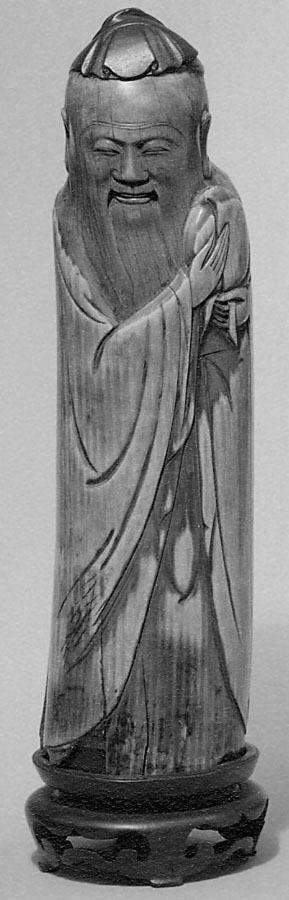
Executive Summary: The Ivory Statuette as a Strategic Heritage Code
This strategic standalone research paper, prepared for the leadership of Katherine Fashion Lab, analyzes a Chinese ivory statuette as a profound cultural artifact. Moving beyond mere aesthetic appreciation, this analysis decodes the object’s embedded narratives of symbolic power, historical adornment, and spiritual meaning. The objective is to extract actionable, non-literal heritage codes to inform a distinctive and culturally intelligent luxury strategy for 2026. In an era where luxury is defined by depth of narrative and ethical consciousness, this artifact provides a template for translating immutable cultural values into contemporary, desirable expressions of status and identity.
Deconstructing the Artifact: Ivory as a Medium of Meaning
The chosen medium—ivory—is the primary signifier of the statuette’s historical context and inherent value proposition. In Imperial China, ivory was not merely a material; it was a geopolitical commodity, a testament to craftsmanship, and a symbol of rarity and purity. Its procurement spoke of vast trade networks and imperial reach, while its carving demanded the highest levels of artisan skill, often associated with palace workshops. The material’s natural luminescence and smooth, warm tactility made it an ideal medium for representing divine or exalted figures, as it physically embodied notions of the sacred and the untarnished. For Katherine Fashion Lab, the strategic takeaway is not the material itself, which is rightly restricted today, but the value triad it represents: Rarity, Masterful Transformation, and Tactile Sanctity. This triad must be translated through alternative, sustainable mediums that carry equivalent symbolic weight—think of rare, innovative textiles, hyper-artisanal techniques, or finishes that change with intimate wear, possessing a luminous, personal patina.
Symbolic Power and the Language of Adornment
Chinese statuettes, whether depicting deities, scholars, or mythological beings, are dense with symbolic language. Every fold of a robe, every held object (a ruyi scepter, a scroll, a peach of immortality), and every accompanying animal (a qilin, a crane) communicates a specific aspiration or attribute. This is a non-verbal heraldry of the self. Historically, such objects were used in private chambers or scholarly studios not just for decoration, but as active tools of self-definition and aspirational identity. The owner aligned themselves with the virtues of the figure represented. In the context of historical adornment, this translates to the principle that clothing and accessories are not just coverings but are active talismans and status declarations. For our 2026 strategy, this suggests moving beyond overt logo-centric branding. Instead, Katherine Fashion Lab can design collections where structural silhouettes, embroidery patterns, or hardware details function as this coded symbolic language. A clasp shaped like a simplified ruyi (wish-granting scepter), a lining printed with a scholarly rockery pattern, or a garment cut that echoes the flowing lines of celestial robes—all become discreet, powerful signals to the culturally initiated, creating a layered narrative of belonging and sophistication.
Spiritual Meaning and the Sanctuary of the Personal
The spiritual dimension of such a statuette is often overlooked in Western luxury analysis, which frequently prioritizes the secular and the spectacular. In Chinese tradition, objects like these served as focal points for meditation, reverence, or the cultivation of personal qi (energy). They created a micro-sanctuary, a curated space of harmony and intention. This speaks to a modern luxury consumer’s deep desire for meaning, mindfulness, and personal sanctuary, especially post-pandemic. Luxury is increasingly experienced not just in public display but in private, sensory-rich moments of self-care and alignment. Katherine Fashion Lab can strategize around this by conceptualizing pieces that are intentionally designed for these moments of private luxury. This could involve: garments engineered for exceptional comfort and tactile pleasure (the "second skin" as sanctuary); ritualistic packaging that transforms the unboxing into a mindful ceremony; or collections themed around elements (wood, fire, earth, metal, water) that connect wearers to a broader cosmological order, offering not just an item but a tool for personal equilibrium.
Strategic Synthesis: The 2026 High-End Luxury Application
The synthesized insights from this heritage analysis provide a robust framework for distancing Katherine Fashion Lab from seasonal trends and anchoring it in perennial cultural intelligence. The 2026 strategy must be built on the pillars of Coded Symbolism, Tactile Narrative, and Private Sanctity.
Pillar 1: The New Heraldry (Coded Symbolism)
Develop a proprietary symbolic lexicon derived from Chinese art and philosophy, abstracted for modern relevance. Launch a high-jewelry or fine leather goods line where each piece is named and designed around a specific virtue (e.g., "Resilience" modeled on bamboo forms, "Clarity" inspired by water motifs). Accompany each item with a digital "codex"—a short, elegant documentary or text—that explains its heritage inspiration, transforming the client into a custodian of a story, not just a consumer of a product.
Pillar 2: Material Alchemy (Tactile Narrative)
Invest heavily in textile R&D to create modern analogues to ivory’s symbolic properties. Pioneer the use of innovative, sustainable materials that possess a unique hand-feel, luminosity, or aging quality. For example, develop a ceramic-fiber weave that feels cool and smooth, or a plant-based leather alternative that develops a unique patina. The narrative must emphasize the transformation of raw material through masterful craftsmanship, directly echoing the journey of the ivory statuette.
Pillar 3: The Ritual of Dressing (Private Sanctity)
Position the act of wearing Katherine Fashion Lab as a personal ritual. This can be achieved through sensorial design—fabrics that sound particular ways, closures that feel satisfying to fasten, weights and drapes that create a conscious, grounding sensation. Consider a "Studio Collection" focused on atelier and home wear, designed explicitly for environments of creation and retreat, directly linking to the statuette’s role in the scholar’s studio. The marketing shifts from showcasing crowded red carpets to depicting serene, focused moments of preparation and reflection.
Conclusion: From Museum Piece to Living Code
The Chinese ivory statuette, analyzed through the strategic lens of heritage curation, ceases to be a static relic. It is revealed as a dynamic system of communication about power, identity, and spirit. For Katherine Fashion Lab, the path to a resonant 2026 high-end strategy lies in the abstract translation of these codes. By moving away from literal appropriation and instead embedding the principles of coded symbolism, material alchemy, and personal sanctuary into every design and client interaction, the brand can build a luxury proposition that is both timeless and urgently contemporary. This approach cultivates a discerning clientele that seeks not just to be seen, but to be understood—and to understand the profound narrative they wear. This is the ultimate symbolic power: creating objects that adorn both the body and the intellect.