Executive Summary: Decoding the Cintamani-Tiger Motif for Contemporary Luxury
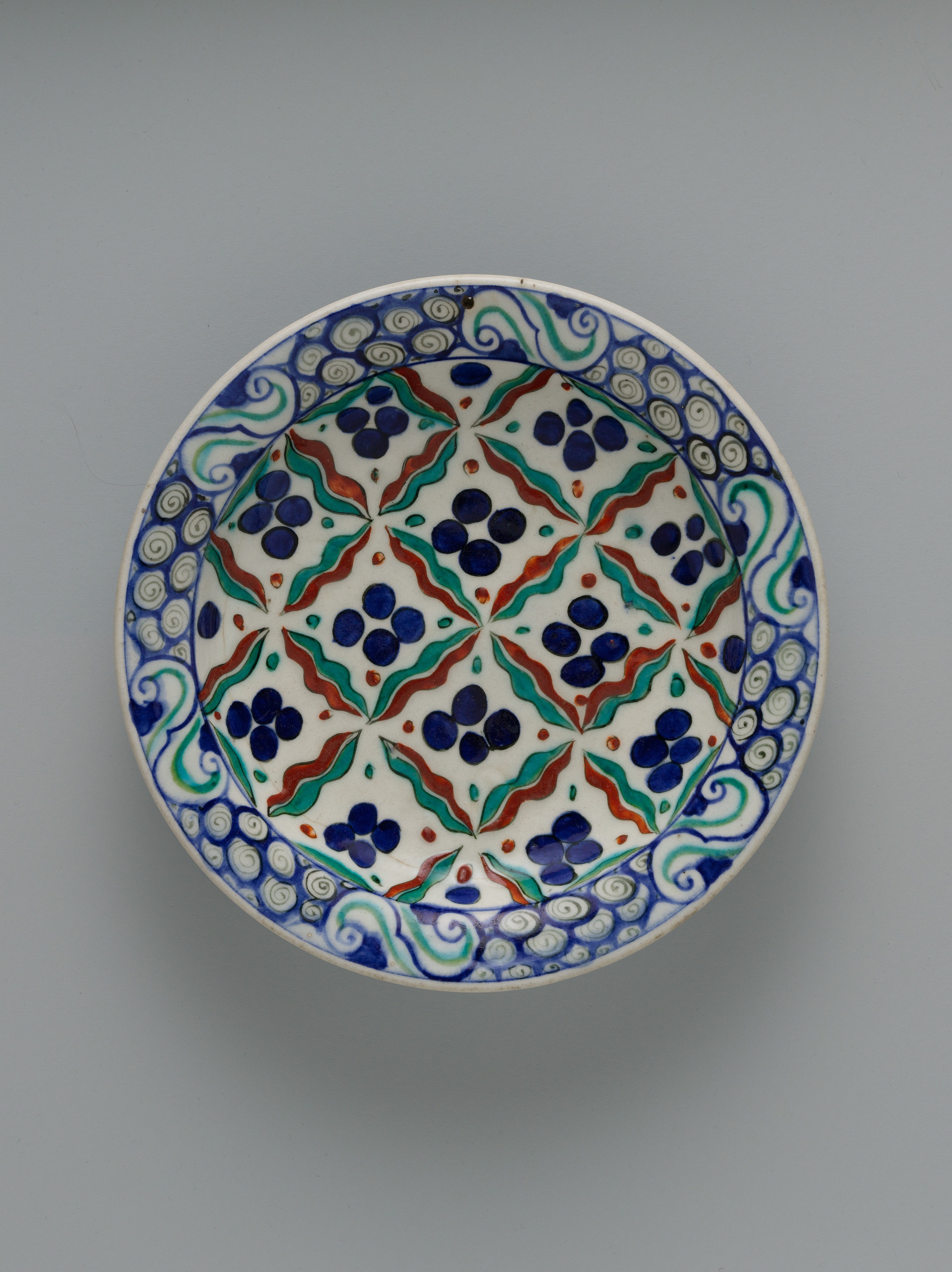
This strategic heritage analysis deconstructs the symbolic and material lexicon of the "Dish with 'Cintamani' and Tiger-stripe Pattern" to establish a foundational narrative for Katherine Fashion Lab's 2026 high-end luxury strategy. Originating from the sophisticated ceramic traditions of the Ilkhanid period (13th-14th centuries) in Persia or Mamluk Syria, this artifact is not merely a historical object but a concentrated vessel of cross-cultural power, spiritual aspiration, and regal identity. By examining its stonepaste medium, polychrome palette, and potent iconography, we extract core principles of timeless adornment. This research posits that the Cintamani and tiger-stripe motif provides a unique, non-Western-centric framework for building a luxury brand language rooted in talismanic power, sovereign strength, and narrative depth, directly appealing to the 2026 consumer's desire for meaningful provenance and spiritual resonance within material excellence.
Historical & Material Context: The Alchemy of Stonepaste and Sovereignty
The object's medium is its first statement of luxury. Stonepaste (fritware) was a revolutionary Islamic ceramic innovation, a sophisticated composite of quartz, glass frit, and white clay. This was not common clay, but an engineered material designed to achieve a porcelain-like whiteness and smoothness, upon which intricate narratives could be painted. The technique of polychrome painting under a transparent glaze required masterful precision; pigments had to be formulated to withstand the kiln's heat, and each layer—from the meticulous brushwork to the final crystalline glaze—represented a risk of failure. This alchemical process mirrors the very essence of haute couture and high jewelry: the transformation of base materials into objects of transcendent beauty through technical mastery and artistic vision. The dish itself, likely used for ceremonial display or elite hospitality, functioned as a performative asset, communicating the owner's access to networked trade routes (linking China, the Islamic world, and beyond), technological patronage, and refined aesthetic intelligence.
The Semiotics of Adornment: Cintamani and Tiger-Stripe as Power Code
The dish's adornment is a deliberate fusion of two of the most potent symbols traversing the Eurasian continent. The Cintamani, a motif of three dots often paired with wavy lines, is profoundly polyvalent. In Buddhist cosmology, it is the wish-fulfilling jewel, a symbol of spiritual enlightenment and benevolent authority. In Turkic and Mongol traditions, it represented leopard spots and waves, emblematic of celestial power and martial ferocity adopted by ruling elites like the Ilkhans. The tiger-stripe pattern is an unambiguous lexicon of raw, terrestrial power, fearlessness, and sovereign authority. Together, they form a complete semantic system: the Cintamani (spiritual, celestial, intellectual power) and the tiger-stripe (physical, protective, regal power). This is not mere decoration; it is a heraldic code, a wearable cosmology that armors the bearer with a complete spectrum of authority. For Katherine Fashion Lab, this translates to a design philosophy where pattern is never arbitrary but encoded with narrative, offering the wearer not just an item but an identity and a set of ascribed attributes.
Spiritual Meaning and Talismanic Function: The Luxury of Protection
Beyond the political, these symbols operated within a talismanic framework central to historical luxury. Objects were not passive; they were active agents believed to confer protection, fortune, and spiritual merit. The Cintamani, as the wish-fulfilling jewel, aligns with deep human desires for agency and destiny-shaping. The tiger, a guardian in many Asian traditions, offered apotropaic defense. This imbues the artifact with a layer of functional spirituality. In the context of 2026 luxury, this addresses a critical market shift: the search for meaning, mindfulness, and intangible value beyond logos. The modern luxury consumer seeks objects that serve as talismans for personal journey, resilience, and intention. A garment or accessory derived from this heritage is not simply "inspired by"; it is conceptually engineered to function as contemporary armor—a source of confidence, a marker of personal mythos, and a conduit for intentionality, thus achieving a higher order of emotional and spiritual engagement.
Strategic Application: The KFL 2026 Luxury Brand Strategy
For Katherine Fashion Lab's 2026 market entry and positioning, this analysis yields a concrete, multi-tiered strategic framework.
Brand Narrative & Philosophy: "Sovereign Codes"
The overarching brand narrative should be built on the concept of “Sovereign Codes.” This positions KFL as a decipherer and modern translator of ancient, non-Western languages of power and protection. It moves beyond fleeting trends to establish a timeless, intellectual, and empowering foundation. Marketing and communications will focus on the idea of wearing one's personal sovereignty, equipped with the symbolic tools (the jewel's clarity, the tiger's strength) to navigate a complex world.
Product Architecture & Design Language
The Cintamani and tiger-stripe motif provides a versatile, ownable graphic lexicon. Application must be deliberate and tiered: Haute Couture & High Jewelry: The Cintamani motif translates directly into exceptional gemstone settings—three stones configured as a narrative brooch, or engraved into precious metals. Tiger-stripes can be rendered in marquetry of rare woods, intarsia of exotic leathers, or the meticulous placement of embroidered threads and beads to create a textured, dimensional ferocity. The stonepaste technique inspires surface innovation: developing custom, luminous fabrics with a ceramic-like glaze or crackle finish. Ready-to-Wear & Leather Goods: Abstracted iterations—a subtle triple-knot fastening (Cintamani), a jacquard weave with a faint stripe, a leather embossing pattern that references both dots and fur. The key is subtle coding, where the symbolism is discovered, not shouted.
Client Engagement & Experiential Strategy
Heritage must be experienced, not just stated. Strategy includes curated client immersions: private viewings of related artifacts in museum collections, scholarly talks on Eurasian symbolism, and bespoke services where clients can "compose" their talismanic piece—selecting which aspect of the power symbology (the wish-fulfilling jewel or the guardian strength) they wish to emphasize in their commission. This transforms the purchase into a participatory act of personal myth-making.
Conclusion: From Ancient Artifact to Modern Armature
The "Dish with 'Cintamani' and Tiger-stripe Pattern" offers Katherine Fashion Lab a profound and differentiated strategic asset. It provides a deep well of material, symbolic, and spiritual capital from which to build a legitimate and compelling luxury identity. By interpreting the stonepaste's innovation as a commitment to material mastery, decoding the motif as a system of sovereign power, and harnessing its talismanic function for the modern psyche, KFL can position itself at the vanguard of meaningful luxury. For the 2026 consumer, an object born from this heritage is not an accessory but an armature—a thoughtfully designed interface between the individual and their aspirations, engineered with the historical depth and symbolic potency that defines true, enduring luxury.