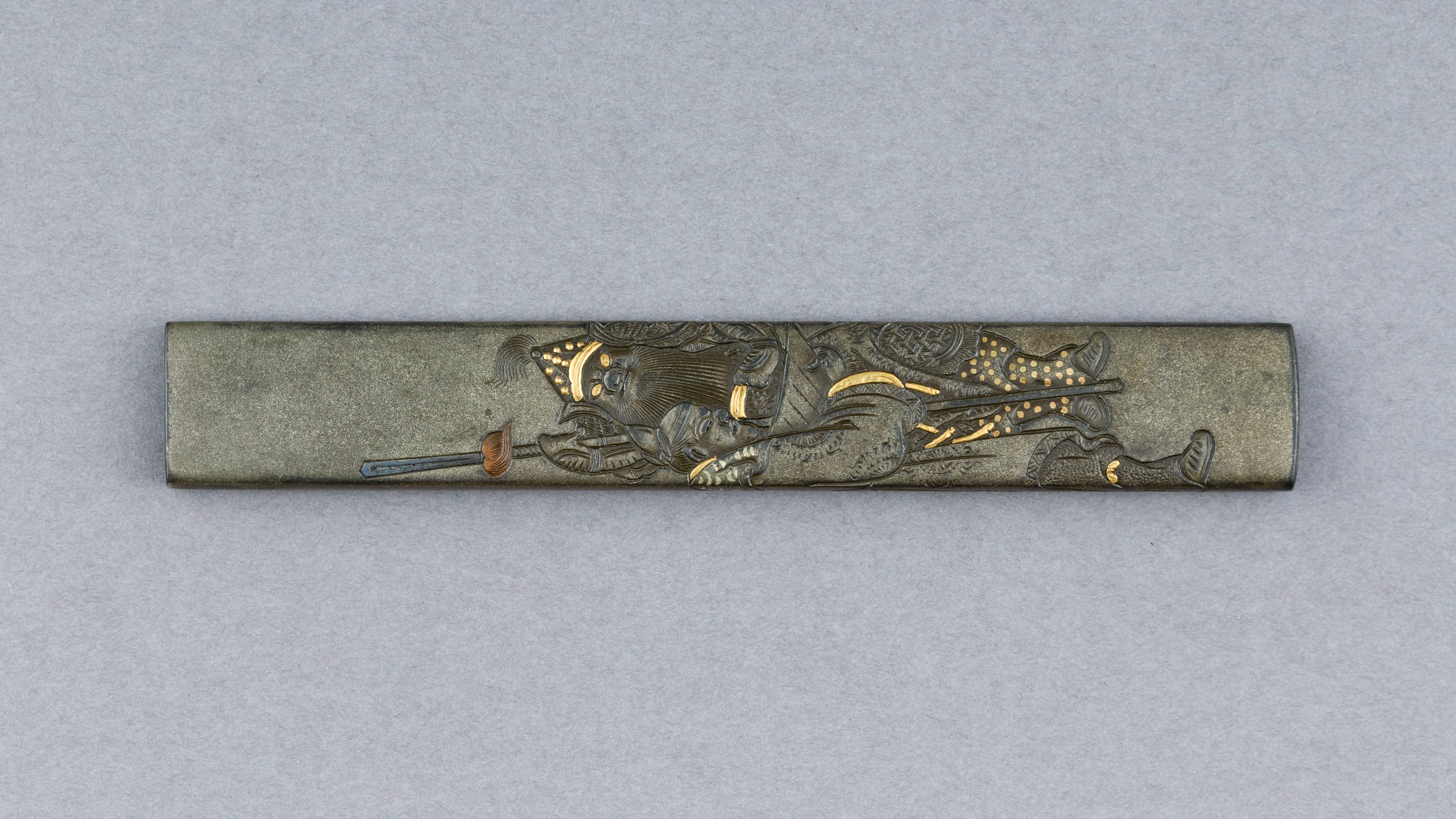
Executive Summary: The Kozuka as a Strategic Heritage Asset
This analysis positions the Japanese kozuka (small knife handle) as a foundational heritage object for Katherine Fashion Lab's 2026 luxury strategy. Beyond its functional role as part of the samurai's daishō (paired swords), the kozuka represents a concentrated nexus of symbolic power, masterful adornment, and profound spiritual meaning. Crafted from sophisticated alloys like shibuichi (copper-silver) and accentuated with gold, it was a portable canvas of identity and belief. For a forward-facing luxury brand, this artifact provides not merely aesthetic inspiration but a complete strategic framework: it embodies the concept of "armored elegance," communicates narrative through meticulous craftsmanship, and connects to a global luxury consumer's desire for authenticity, rarity, and personal talismans. This research advocates for the kozuka's motifs and material philosophy to inform a standalone collection that transcends seasonal trends, establishing a new, intellectually rigorous pillar within the brand's universe.
Historical Context & The Semiotics of Adornment
The kozuka, originating in the Muromachi period (1336–1573) and flourishing through the Edo period (1603–1868), occupies a unique space in the history of adornment. It was simultaneously a functional military accessory, a personal seal, and a public declaration. Mounted in the slot of the scabbard of the wakizashi (short sword), it was always visible, making it a primary site for non-verbal communication. In an era of enforced peace during the Edo period, the samurai's sartorial and accessory choices became critical arenas for displaying taste, erudition, and status when martial prowess could not be openly tested.
The Canvas of Identity
The decorative themes (motif) engraved, inlaid, or carved onto the kozuka's limited surface were meticulously chosen. Common motifs included natural elements (bamboo for resilience, cherry blossoms for ephemeral beauty), mythical creatures (dragons for wisdom and power, kirin for good omen), and scenes from classical literature like The Tale of Genji. Each selection was a coded message, reflecting the owner's clan affiliation, philosophical leanings, personal aspirations, or even a silent poem. This transforms the kozuka from an accessory into a heraldic device, a compact biography in metal. For Katherine Fashion Lab, this practice underscores a core luxury principle: that true luxury is personal narrative externalized through exceptional craft.
Material Alchemy & Spiritual Resonance
The materiality of the kozuka is where technical mastery meets spiritual intent. The predominant use of shibuichi ("one-fourth"), a variable alloy of copper and silver, is particularly significant. Unlike static, pure metals, shibuichi's patina and subtle, mottled grey hue change over time and with treatment, acquiring a soft, narrative depth. It is a material that embraces transience and legacy—key concepts in Japanese aesthetics (wabi-sabi). Gold (kin) was then applied sparingly as iroe (inlay) or kinpun (gold dust sprinkling) to highlight contours or details, acting as a luminous focal point against the shibuichi's subdued field.
The Talismanic Function
This material combination was not merely decorative. In the samurai's worldview, objects carried spiritual energy (tama). The kozuka, as a constant companion, served a talismanic purpose. A design featuring a coiled dragon near the water might be a prayer for protection during travel; a depiction of the thunder god Raijin could be an invocation of strength. The act of crafting these objects with spiritually resonant materials and motifs imbued them with a perceived power, transforming them into armor for the soul as much as an accessory for the sword. This deep-seated belief in the animism of crafted objects presents a powerful narrative for modern luxury, which increasingly seeks to offer meaning and intangible value beyond physical utility.
Strategic Integration: The 2026 High-End Luxury Framework
For Katherine Fashion Lab's 2026 strategy, the kozuka provides a multifaceted blueprint for a high-impact, standalone collection. The goal is not literal replication, but the abstraction and translation of its core principles into a contemporary luxury lexicon.
Pillar 1: Armored Elegance & Modularity
The kozuka embodies "armored elegance"—durability paired with refinement. This translates into structured, yet fluid, pieces in a collection: perhaps a minimalist clutch with a hidden, secure closure mechanism (the "blade" function), or a leather jacket with geometric, shibuichi-inspired alloy hardware. The kozuka's nature as a modular, interchangeable component of a larger system (the sword) suggests a strategy of modular accessories. Imagine a central bracelet or neckpiece with interchangeable plaques or charms, each featuring a different modernized motif (e.g., a geometric wave, a stylized bamboo stalk), allowing the client to curate their personal narrative.
Pillar 2: Narrative Materiality
Direct engagement with material storytelling is essential. Collaborations with master alloy artisans to develop a proprietary, contemporary interpretation of shibuichi—perhaps incorporating recycled platinum or titanium for a modern sheen—would be a cornerstone. This material would form the signature "canvas." The sparing, strategic use of gold or other precious elements would then act as the "iroe," highlighting seams, edges, or emblematic details. Marketing would focus on the alchemy and legacy of the material, its ability to develop a unique patina, connecting to the luxury consumer's desire for heirloom pieces that evolve with them.
Pillar 3: The Modern Talisman
The collection must be positioned as providing modern talismans. Each key piece should be anchored by a symbolic motif derived from, but not copying, kozuka iconography. A series of evening bags could be named "Kirin" (benevolence), "Ryū" (wisdom), or "Sakura" (moment). Accompanying digital content—short films, artisan interviews—would elucidate the original symbolism and its contemporary resonance. This approach taps into the growing market for meaningful consumption, where the object serves as a touchstone for personal values, aspirations, or protection in a complex world.
Conclusion: From Historical Artifact to Brand Pillar
The Japanese kozuka is a masterclass in concentrated luxury. It demonstrates how a small-scale object can carry immense symbolic weight, spiritual depth, and aesthetic sophistication through the intentional fusion of material, motif, and craft. For Katherine Fashion Lab, a strategic, non-literal interpretation of this artifact offers a path to distinct competitive advantage in the 2026 high-end landscape. By building a standalone collection on the pillars of Armored Elegance, Narrative Materiality, and the Modern Talisman, the brand can move beyond fashion to curate cultural value. This strategy does not merely reference heritage; it activates it as a living system, creating a resonant, intellectually credible, and deeply desirable new dimension to the brand's identity, appealing to the connoisseur who seeks both beauty and profound narrative in their possessions.