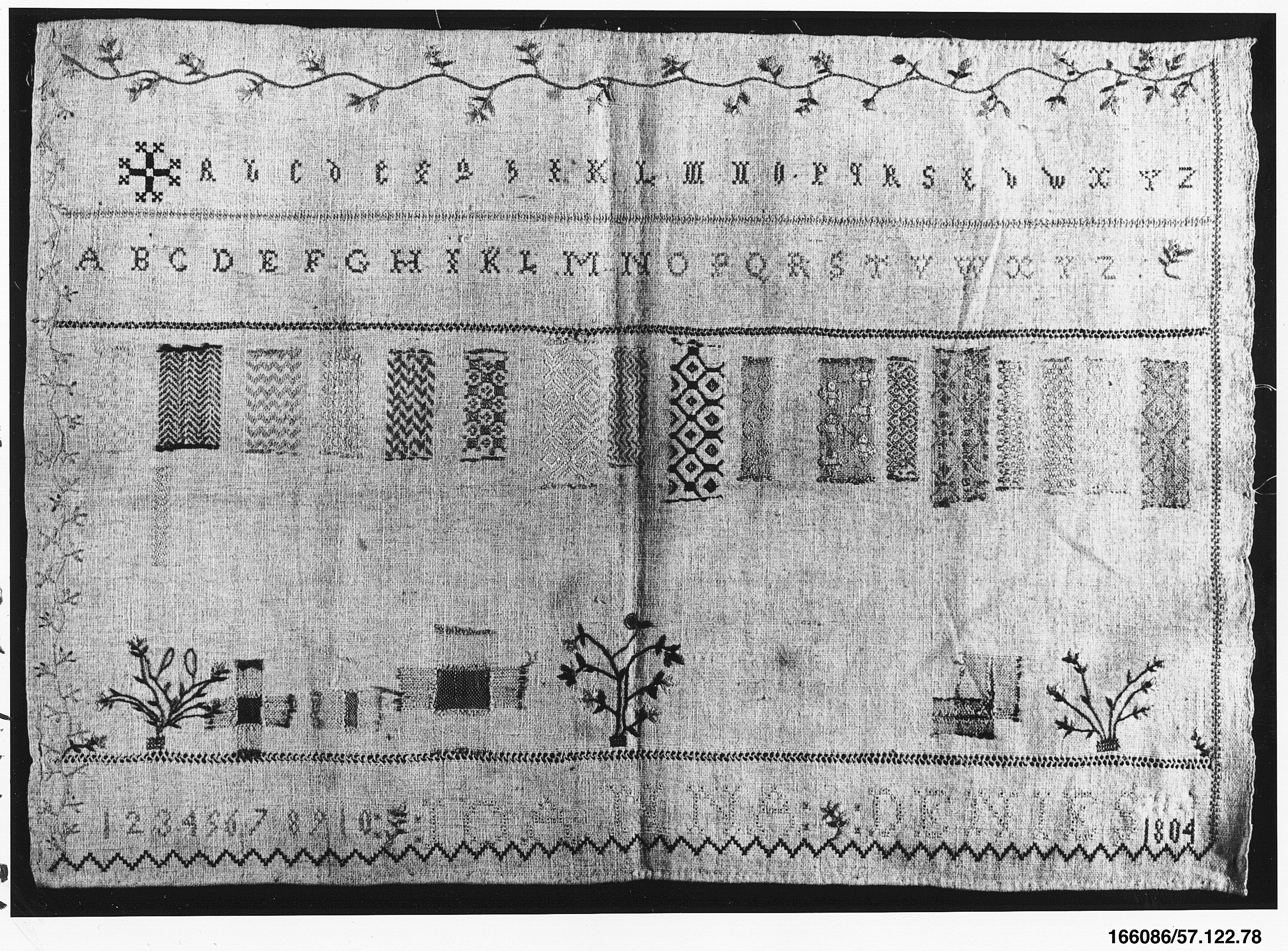
The Embroidered Darning Sampler: A Deconstruction of Mending as High Art
Within the hallowed archives of textile history, the humble darning sampler occupies a unique and profoundly undervalued space. Often dismissed as a mere pedagogical tool or a testament to domestic thrift, it is, in the lens of Katherine Fashion Lab, a foundational manifesto. This standalone study of a silk-on-cotton specimen of global heritage origin compels us to re-evaluate the very tenets of couture: the hierarchy of techniques, the philosophy of materiality, and the narrative power of repair. Far from a simple exercise, this artifact is a concentrated study in texture, structural reinforcement, and symbolic storytelling, presenting mending not as an act of concealment but as one of bold, declarative embellishment.
Material Dialectic: Silk on Cotton as Strategic Contrast
The foundational choice of cotton as substrate and silk as thread establishes a critical material dialectic central to the sampler's intellectual proposition. Cotton, the ubiquitous, democratic, and sturdy fiber, represents the everyday, the garment in constant use, the body's second skin subjected to the inevitable forces of friction and time. Silk, by contrast, is the luxury fiber par excellence: rare, lustrous, and historically laden with connotations of status, wealth, and ceremonial splendor.
This juxtaposition is neither accidental nor purely practical. By deploying silk—a material often reserved for pristine surfaces and opulent grounds—as the agent of repair, the sampler inverts traditional value systems. It argues that the point of rupture, the so-called flaw, merits the most precious material. The silk thread does not hide; it highlights. It transforms a site of potential weakness into a locus of reinforced strength and deliberate beauty. This strategic contrast is a core couture principle: the elevation of a garment through the intentional, artful application of contrasting yet complementary materials, where the value is added through transformative labor, not just intrinsic fiber cost.
The Grammar of Stitches: A Technical Lexicon of Resilience
Examined as a standalone study, the sampler reveals itself as a rigorous encyclopedia of structural solutions. Each bordered square or deliberate tear is addressed with a specific stitch vocabulary: the geometric precision of pattern darning, the woven density of a Swiss darn, the subtle flexibility of a running stitch lattice. This is not random practice but a codified grammar of resilience.
From a couture perspective, each stitch is a strategic decision with implications for drape, tension, and visual weight. A densely embroidered block darn creates a panel of increased structure, potentially sculpting a garment's form, while a more open, net-like mend allows for movement and breathability. The sampler demonstrates that mending techniques are, in essence, micro-engineering feats that must account for fabric grain, stress distribution, and aesthetic outcome. This technical lexicon prefigures contemporary couture’s obsession with hybrid constructions and engineered textiles, where the method of assembly becomes the primary design signature.
Narrative Imperfection and the Aesthetics of Wabi-Sabi
Perhaps the most radical couture proposition embedded in the darning sampler is its embrace of narrative imperfection. Unlike the seamless, immaculate ideal of traditional haute couture, which often presents itself as born perfect and timeless, the sampler is an artifact of time’s passage and its thoughtful mediation. It documents a story of wear, intervention, and continuation. This aligns profoundly with global philosophies such as wabi-sabi (Japan), which finds beauty in impermanence and repair, or kintsugi (Japan), the art of mending pottery with gold, and even the visible mending traditions found across European folk cultures.
This contextualizes the sampler not as a provincial craft but as an object of deep heritage wisdom. It champions an aesthetic where the history of the object—its interactions with life—is made visible and integral to its beauty. For modern couture, this is a transformative concept. It suggests that a garment’s value can accrue over time through personalized care and visible restoration, challenging the industry’s cycle of obsolescence and proposing a more sustainable, emotionally resonant model of luxury.
Couture Application: From Domestic Exercise to Atelier Principle
The translation of the sampler’s lessons to the couture atelier is both literal and conceptual. Literally, these precise darning techniques are directly applicable to the restoration and preservation of historic garments, a critical and often unseen couture service. More broadly, however, the sampler inspires a new design methodology.
Imagine a gown where seams are intentionally finished with decorative, silk-embroidered darning stitches, turning structural necessities into surface ornament. Envision a tailored jacket where areas of expected wear—elbows, cuffs—are pre-emptively "sampled" with exquisite embroidered reinforcements, blending foresight with decoration. The sampler advocates for a design process that integrates repair into the initial creative act, viewing points of stress as opportunities for embellishment and storytelling. This fosters a garment that is designed to evolve, to be annotated by time and care, becoming a collaborative artifact between the original couturier and its future wearer.
Conclusion: The Sampler as Foundational Code
This standalone study of the silk-on-cotton embroidered darning sampler concludes that it is far more than a domestic relic. It is a compacted treatise on material intelligence, structural honesty, and narrative depth. It deconstructs the false dichotomy between the pristine and the mended, the luxurious and the utilitarian, the strong and the delicate. For Katherine Fashion Lab, this artifact serves as a vital conceptual cornerstone. It reminds us that true luxury may lie not in flawless, untouchable perfection, but in the evidence of resilience, the artistry of care, and the bold, beautiful declaration that a thing—and by extension, a person—can be both profoundly used and exquisitely, resiliently beautiful. The sampler’s threads are not merely repairing cloth; they are embroidering a more thoughtful, sustainable, and intellectually rich future for couture itself.