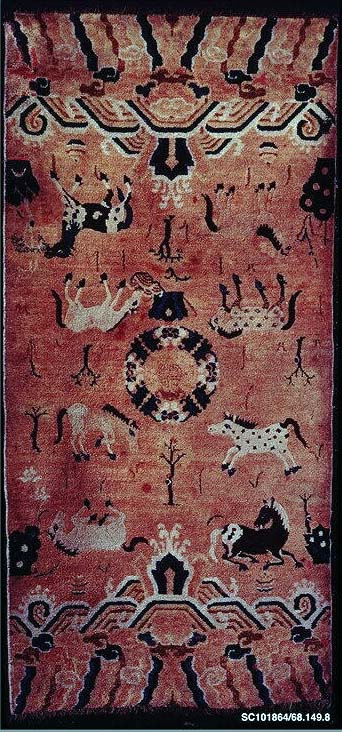
Deconstructing the Nomadic Tapestry: A Couture Analysis of the Saddle Rug
Within the curated archives of Katherine Fashion Lab, certain artifacts transcend their utilitarian origins to speak a profound language of materiality, craftsmanship, and cultural narrative. The subject of this standalone study—a Saddle or Traveler's Rug originating from China—is one such artifact. At first glance, a functional object for equestrian or nomadic life; upon closer inspection, a dense textile imbued with symbolic resonance and technical mastery. This analysis will dissect its physical composition, decode its aesthetic language, and project its potential as a foundational inspiration for avant-garde couture, treating the rug not as a mere accessory but as a portable landscape and a tactile archive of movement.
Material Syntax: The Foundation of Resilience and Symbolism
The material construction of the rug is a deliberate and intelligent system, each element serving a distinct functional and symbolic purpose. The foundation of cotton warp and weft establishes a critical framework. Cotton, a plant fiber known for its tensile strength and stability, provides a resilient, flat-woven ground. This grid is the silent, disciplined architecture upon which the narrative of the rug is built. It is the canvas, the dependable constant that must withstand immense physical stress—the weight of a rider, the friction of travel, the elements of the steppe or the mountain pass.
Upon this stable plane rests the expressive element: wool knotting. Wool, the product of animal husbandry, introduces warmth, elasticity, and a rich, chromatic potential through dyeing. The knotted pile—whether employing the symmetrical (Turkish) or asymmetrical (Persian) knot—transforms the two-dimensional weave into a three-dimensional, plush surface. This tactile duality is crucial: the flat, strong cotton base for endurance, the raised, soft wool surface for comfort and display. In couture terms, this is the fundamental dialogue between structure and embellishment, between the toile and the broderie. The wool knots are not merely decorative; they are insulated pixels, each one a decision point of color and pattern, collectively forming an image meant to be "read" from the vantage point of the rider or the observer on the ground.
Pattern as Cartography and Talisman
The rug’s patterns are rarely arbitrary; they are a coded visual language. Common motifs in Chinese saddle rugs might include geometric repeats (influenced by Central Asian traditions), stylized flora and fauna, or symbols such as the endless knot (symbolizing longevity and interconnection) or the bat (a homophone for good fortune). These are not simply decorations but talismans woven into the journey. They map a spiritual and protective geography onto the physical journey of the traveler.
For the couture analyst, this transforms the rug from a textile into a narrative map. The pattern repeats can be deconstructed into modular couture elements: a sleeve might emulate the border motif, a bodice could reinterpret the central medallion in padded embroidery. More abstractly, the concept of a "portable protective landscape" is a potent couture theme. Imagine a garment engineered not just for aesthetic form, but for psychological and symbolic utility—a coat whose lining is a meticulously mapped tapestry of personal sigils and guardian motifs, a direct translation of the rug’s apotropaic function.
Couture Translation: From Equine Drapery to Human Architecture
The true challenge and opportunity for Katherine Fashion Lab lie in transcending literal appliqué. The genius is in abstracting the rug’s core principles into a modern sartorial lexicon.
1. Structural Hybridity
The clear dichotomy between the cotton grid and the wool pile invites exploration in hybrid materiality. A couture ensemble could juxtapose a sleek, technical cotton gabardine—cut with precise, architectural lines to echo the warp and weft—with explosive, three-dimensional textures mimicking the knotted pile. This could be achieved through techniques like passementerie, raised velvet devoré, or even innovative 3D printing with varied filament densities. The garment itself becomes a terrain of contrasting tactility.
2. The Patina of Journey
A well-used saddle rug possesses a unique patina: areas of wear where the pile is compressed, subtle fading from sun and use, repairs that add a new layer of history. This aesthetic of honorable wear is antithetical to traditional couture’s pristine perfection but deeply aligned with modern concepts of sustainability and narrative. Techniques like strategic distressing, over-dyeing, and boro-inspired mending with contrasting threads could be employed to "write" a fictional journey onto a garment, creating an instant, profound depth of story.
3. Silhouette and Drape: The Unfurled Form
Consider the rug’s state in motion: draped over the living, breathing form of a horse, its patterns interacting with a dynamic curve. When not in use, it might be rolled or folded. This inspires fluid, transformative silhouettes. A coat that can be worn structured or unfastened to drape like a rug over the shoulders; a gown with a train that, when gathered, reveals a separate pattern—a hidden landscape. The design thinking shifts from static form to adaptive drapery, honoring the rug’s inherent flexibility.
Conclusion: The Rug as Conceptual Framework
This Chinese Saddle Rug, in its material intelligence and symbolic depth, offers far more than a pattern library. It presents a complete conceptual framework for nomadic luxury. It champions resilience through layered construction, narrates identity through symbolic coding, and embraces the beauty of adaptive utility. For Katherine Fashion Lab, it serves as a potent reminder that the most profound inspirations are often those born from intersection—where utility meets art, where animal and human interface, and where a journey is physically woven into the very fabric meant to protect it. The resulting couture direction would not be "equestrian" in a literal sense, but rather an exploration of armored softness, mapped intimacy, and wearable sanctuary—a direct, sophisticated lineage drawn from the humble, magnificent traveler's rug.