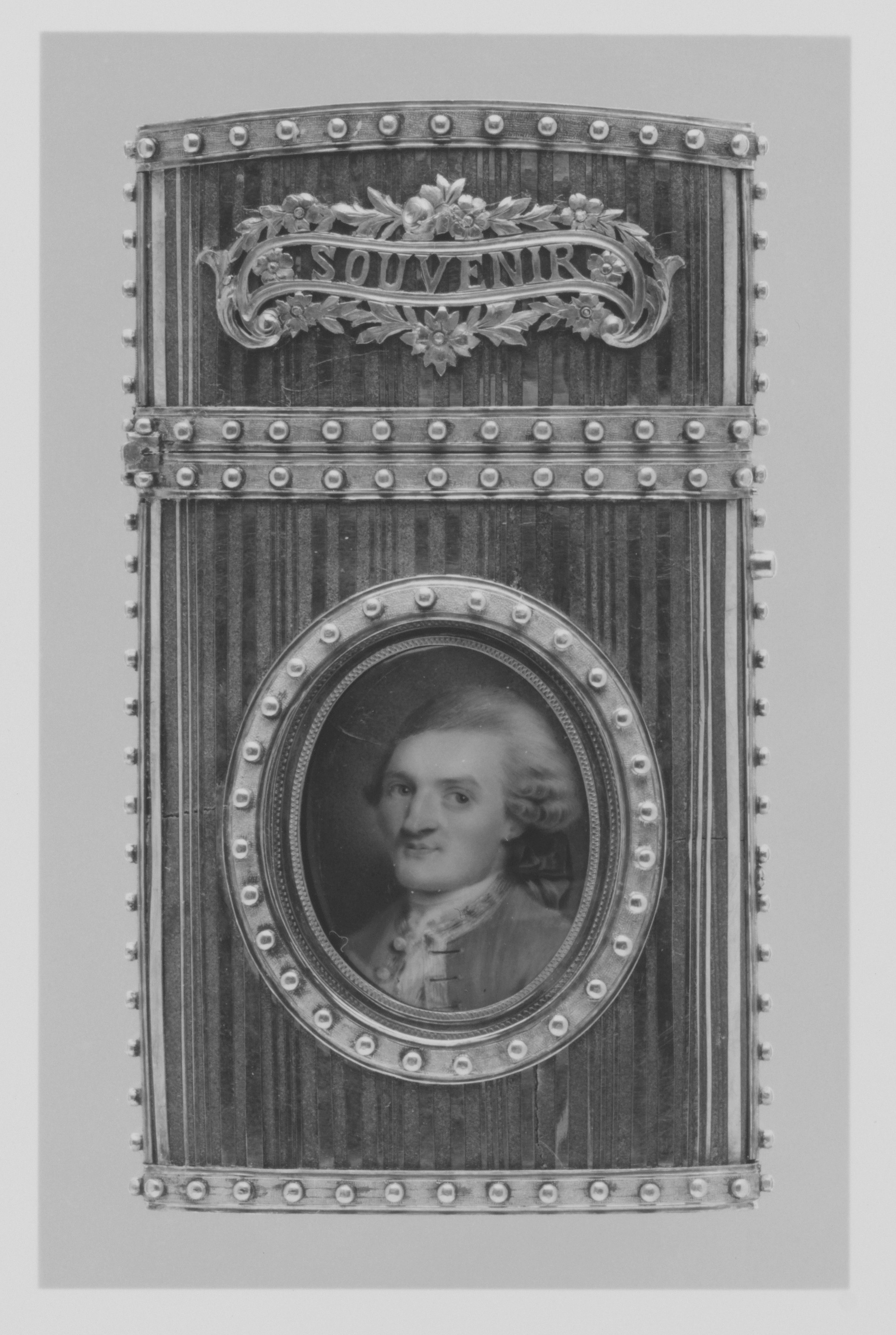
Deconstructing the Souvenir: A Couture Analysis of Memory, Material, and Masculinity
Within the curated silence of the Katherine Fashion Lab, an object of intimate grandeur demands a couture-level analysis that transcends mere artifact study. This souvenir with a portrait of a man, a nexus of gold, enamel, and ivory, is not a garment, yet it is profoundly dressed. It is an exercise in sartorial encoding, where material choices, compositional techniques, and global heritage converge to clothe memory itself in a language of luxury and permanence. As a standalone study, it offers a masterclass in the semiotics of personal adornment and the construction of identity through precious mediums.
The Fabric of Remembrance: A Material Semiotics
The material triad of this object forms a deliberate hierarchy of value and symbolism, each element performing a distinct narrative function. Gold, the primary matrix, is the ultimate couture fabric in the realm of metal. Its selection speaks not merely of wealth, but of an intention to immortalize. Like the foundational silk of a haute couture gown, gold provides a timeless, incorruptible base—a promise that the memory it holds will not tarnish. Its malleability under the artisan’s hand mirrors the way memory is shaped and refined, while its inherent luminosity suggests the subject was a source of light in the holder’s life.
Enamel, applied with miniature precision, is the embellishment, the broderie of this piece. This vitreous paste, fused to the gold at high temperature, introduces color, vitality, and pictorial detail. Its application is a technical marvel akin to the meticulous beading or featherwork on a garment, where risk of flaw is high and perfection is paramount. The enamel likely frames the portrait, perhaps in floral or geometric motifs, its colors chosen with the same deliberate care as a couturier selects a palette to complement a complexion. It softens the gold’s austerity, introducing a note of human artistry and delicate, enduring beauty.
Most critically, ivory serves as the canvas for the portrait itself. This choice is laden with complex heritage. Historically, ivory symbolized purity, prestige, and a connection to the exotic. Its smooth, warm surface allowed for fine, lifelike portraiture with a subtle glow. In a couture analysis, ivory functions as the equivalent of a pristine, heavyweight silk satin—a ground that accepts detail gloriously and carries an innate, controversial nobility. Its use anchors the object in a specific historical moment of global trade and aesthetic values, reminding us that luxury materials are often vectors of cultural narrative and exchange.
The Portrait as Silhouette: Composition and Context
The composition of the portrait is where this souvenir transitions from jewelry to biography. The man’s depiction—likely in a formal pose, with attention to the cut of his hair, the set of his shoulders, and the suggestion of period attire—is a study in constructed masculinity. We are not viewing the man, but his presented self, his social silhouette. This is the 18th or 19th-century equivalent of a curated social media profile, rendered in miniature. The artist’s hand has editorialized, emphasizing dignity, status, or character through slight emphasis on a jawline or the gaze.
As a standalone study, divorced from its original owner, the object becomes a universal cipher. It invites us to question: Was this a token of love, friendship, or political alliance? A memorial to a departed father, husband, or patron? The portrait’s function was to make absence present, to serve as a wearable or pocketable monument. In couture terms, it is an accessory of profound emotional utility, designed not to complement an outfit, but to complete the wearer’s emotional ensemble. Its value was its ability to communicate a relationship silently, a secret known only to the bearer, much like a custom-lined coat bearing a hidden embroidery.
Global Heritage: The Invisible Tapestry
The origin point of Global Heritage is crucial. This object is a confluence of streams. The gold may have been mined in Africa or South America, the ivory sourced from Africa or Asia, the enamelwork techniques refined in Europe (perhaps Limoges or Geneva), and the miniature portrait tradition honed in England or France. It is a product of a connected, often colonial, world—a testament to how luxury objects have always been global citizens. The souvenir, while intimate, is stitched together by long, often opaque, supply chains. This global pedigree does not diminish its personal significance; rather, it amplifies it, showing that the desire to commemorate a loved one could mobilize the entire known world’s resources of craft and material.
This interconnectedness mirrors haute couture itself, where Swiss silks, Italian wools, French craftsmanship, and global inspiration coalesce into a singular, personal expression. The souvenir is a microcosm of this system, making the personal geopolitically expansive.
Conclusion: The Couture of Memory
For Katherine Fashion Lab, this souvenir is a seminal study in how identity, memory, and status are fashioned. It demonstrates that couture principles—obsession with material integrity, mastery of technique, narrative depth, and personalized luxury—apply far beyond the atelier. The object is a bespoke garment for memory. The gold is its structure, the enamel its embellishment, the ivory its intimate lining, and the portrait its unique, irreplicable label. It teaches us that the most enduring fashion is not that which dresses the body, but that which dresses the heart and mind, crafted to withstand the relentless fashion of time. In analyzing it, we learn that true luxury is not just about what is worn, but about what is carried, remembered, and eternally preserved.