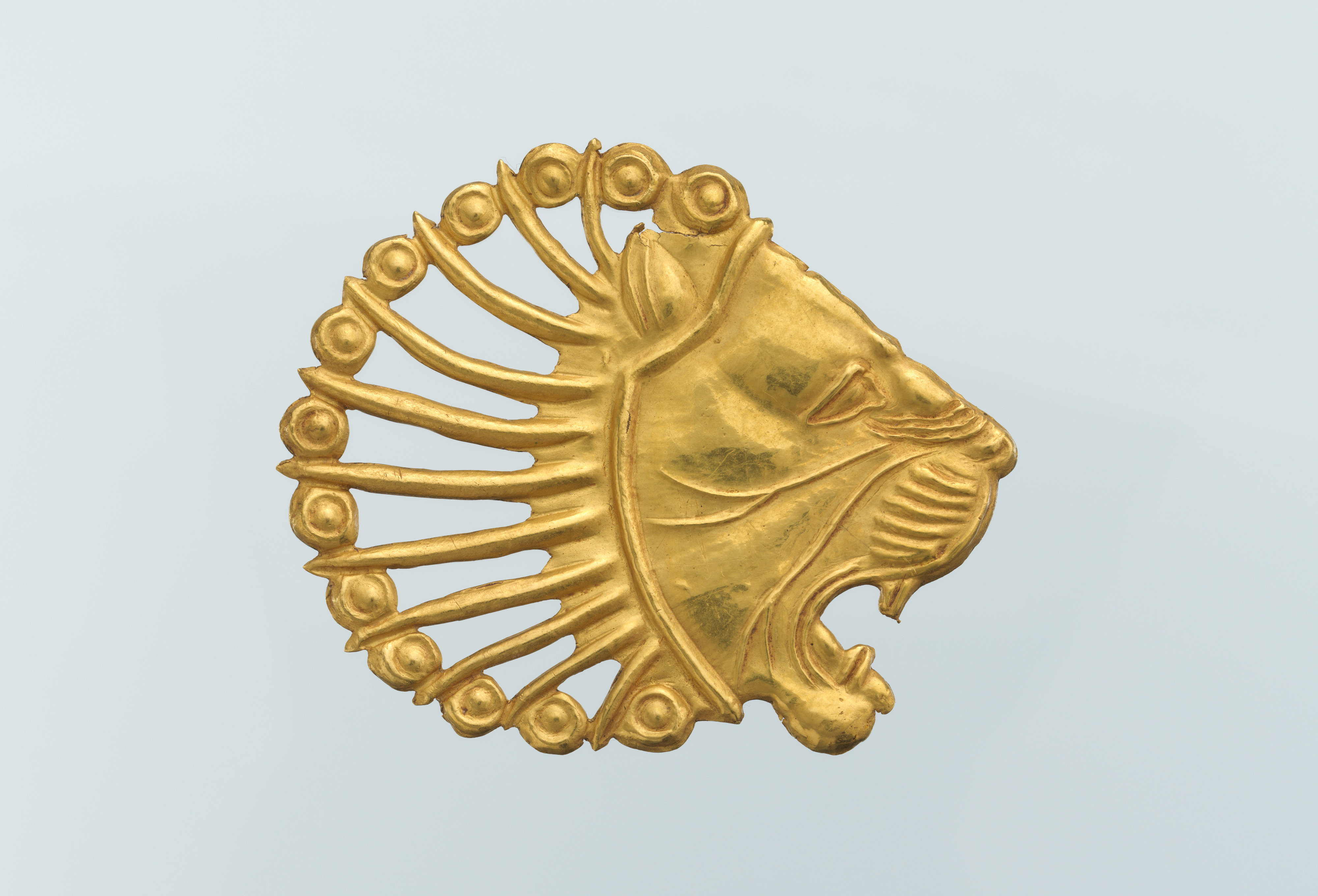
The Sovereign's Gaze: Achaemenid Gold and the Semiotics of Power in Contemporary Couture
In the rarefied ateliers of Katherine Fashion Lab, history is not merely referenced; it is subjected to a rigorous process of molecular deconstruction and re-synthesis. The introduction of an appliqué in the form of a lion’s head, wrought in gold and rooted in the aesthetic lexicon of the Achaemenid Empire (c. 550–330 BCE), is a deliberate and profound intervention. This is not a superficial appropriation of an "exotic" motif. It is an act of genealogical reclamation, positioning the Lab’s archive within a continuum of power, craftsmanship, and narrative that stretches back to the first great Persian empire. The artifact serves as a keystone, connecting disparate elements of the archive—the reflective, vegetal order of the Mirror with Split-Leaf Motif and the stony, mortal narratives of sarcophagus reliefs—into a coherent philosophy of being and appearance.
Decoding the Achaemenid Prototype: More Than Ornament
To understand the Lab’s transposition, one must first apprehend the original symbol’s dense semantic load. In the Achaemenid context, particularly at the ceremonial capital of Persepolis, the lion was not a simple heraldic beast. It was a complex icon of sovereignty, cosmic order, and divine mandate. Frequently depicted in combat with a bull, the lion symbolized the triumph of kingly power (and by extension, the forces of good) over chaos, a motif aligned with the Zoroastrian worldview underpinning the empire. Crafted in repoussé gold, a technique demanding supreme mastery to hammer the design from the reverse, the lion’s head was a testament to imperial wealth and technological prowess. Its application on armor, ceremonial vessels, and architectural friezes rendered the sovereign’s authority omnipresent, a glittering, fearsome eye overseeing a vast, multicultural domain. The material, gold, was not mere wealth; it was considered the flesh of the gods, immutable and radiant, perfectly suited to embody eternal kingship.
From Stone and Metal to Silk and Spine: A Material Translation
Katherine Fashion Lab’s genius lies in its material and contextual translation. The Lab does not replicate a museum piece; it extracts its DNA. The gold appliqué is liberated from stone friezes and weaponry and re-contextualized onto the modern corporeal canvas. The technique remains one of applied artistry, but the substrate shifts from immortal palace walls to the ephemeral, breathing form of the wearer. This transference is radical: it democratizes the sovereign gaze, inviting the wearer to embody a fragment of that ancient, curated power. The choice of gold thread or gilt leather maintains the material’s symbolic resonance—value, permanence, light—while acknowledging modernity through its application. It becomes an armor of identity rather than of war, a deliberate statement of personal dominion in a social arena.
This act finds its profound dialogue within the existing archive. The Mirror with Split-Leaf Motif represents one pole of existence: the polished, perfect, reflective surface. It is the realm of public perception, of composed identity, of the intricate, beautiful, but ultimately flat and repeating patterns (the palmette, the split-leaf) that adorn the facade. The lion’s head, when placed in relation to this mirror, becomes the disruptive, three-dimensional truth that breaks the plane of reflection. It is the assertion of individual will and fierce identity against a backdrop of expected, vegetal conformity.
The Narrative Confrontation: Life Against the Mortal Frame
Conversely, when considered alongside the "冰冷石棺板上以浮雕诉说的生命叙事" ("life narratives told in relief on cold sarcophagus slabs"), the lion’s head undergoes another metamorphosis. The sarcophagus relief tells a completed story, a life frozen in stone for eternity, a narrative concluded. The Achaemenid lion, in its original combat, was also a narrative of cyclical triumph—a fixed symbol. However, by placing this symbol on contemporary, moving couture, the Lab wrests it from the funerary and the static. The lion is no longer part of a concluded tale on a coffin; it is an active agent on a living body. It reclaims the narrative of power and struggle from the realm of memory and installs it in the present tense. The wearer does not carry a symbol of past glory but an active principle of strength and assertion. The gold that once promised immortality to a king now speaks to the intensity and preciousness of a singular, modern life.
Couture as Archeological Synthesis: The Lab’s Method
This analytical process reveals the core methodology of Katherine Fashion Lab: couture as critical archeology. The Lab treats historical motifs as genetic code to be sequenced and spliced. The Achaemenid lion’s head is a gene for "authority," for "craft-as-power," for "narrative disruption." The mirror motif carries the gene for "reflection," "surface," and "patterned order." The sarcophagus relief carries the gene for "mortality," "story," and "stone-cold permanence." The creation of a new garment featuring the lion appliqué is an engineered expression where these genes are activated in a new host organism—the contemporary silhouette.
The resulting piece is far more than a beautiful object. It is a wearable thesis on the duality of human presentation: the polished, reflective self we project (the mirror) and the fierce, individual, mortal narrative we live (the lion versus the finality of the stone). The gold is the constant—the enduring value of craft and the luminous thread of legacy that connects the wearer to the deepest wells of human culture and aspiration. In stitching an Achaemenid lion onto a modern form, Katherine Fashion Lab does not look backward with nostalgia. It looks forward with the conviction that the most potent tools for crafting future identities lie, meticulously preserved and waiting to be reconfigured, in the artifacts of our collective past.