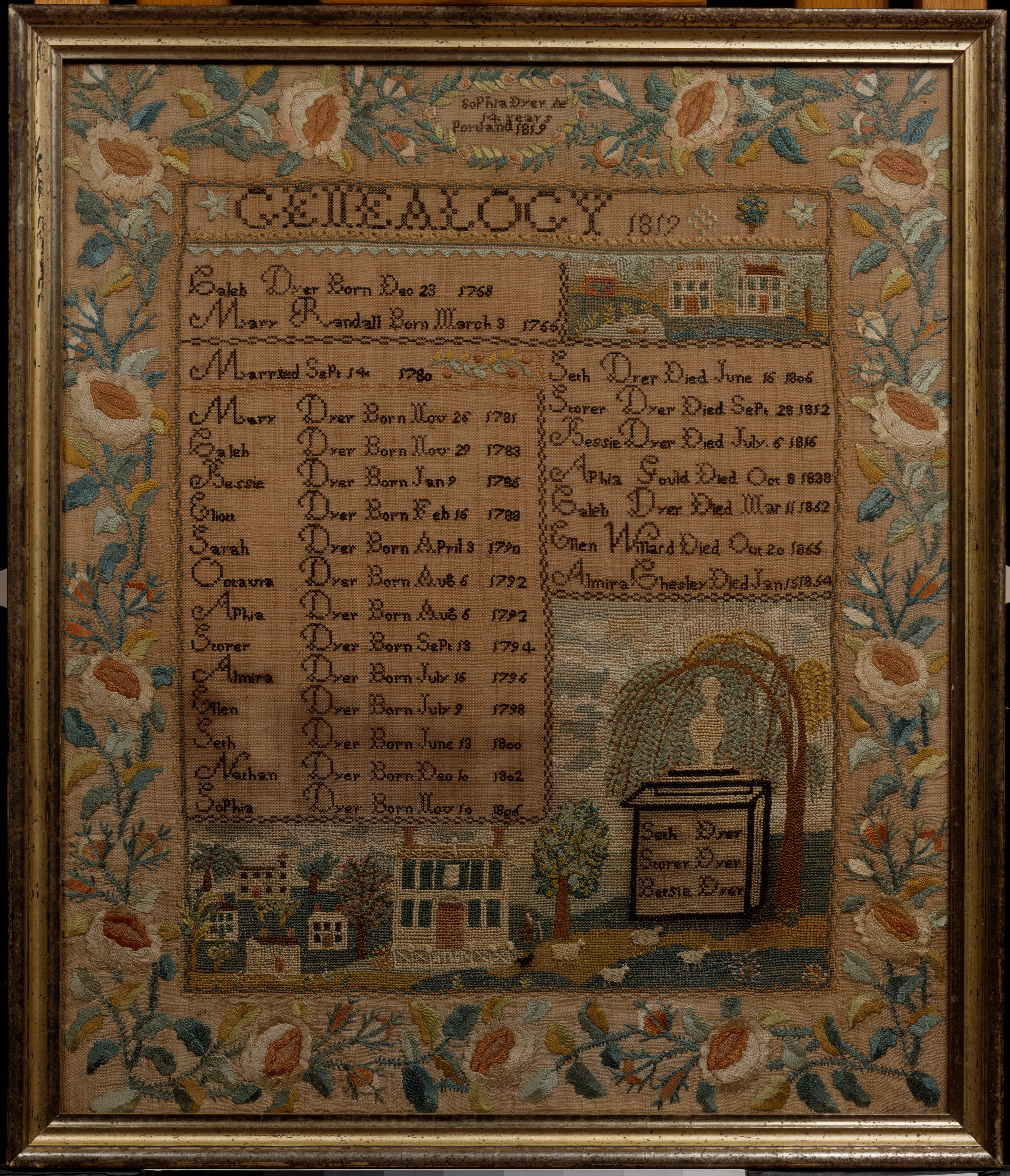
The American Sampler: From Pedagogical Tool to Conceptual Canvas
Within the curated silence of the Katherine Fashion Lab, a singular object commands a profound dialogue between hand, history, and haute intention. The American sampler, executed in silk embroidery on linen, transcends its traditional classification as a mere exercise in feminine accomplishment. When examined as a standalone study in textile couture, it reveals itself as a foundational manifesto of materiality, narrative encoding, and disciplined artistry—principles that resonate at the very core of contemporary high fashion. This analysis deconstructs the sampler not as a relic, but as a precursor to conceptual design, where linen forms the architectural "toile" and silk thread performs as both pigment and polemic.
Material Intelligence: The Couture Foundation of Linen and Silk
The specified material pairing—silk embroidery on linen—is a deliberate and sophisticated choice that establishes a hierarchy of values essential to couture philosophy. The linen ground is not a passive backdrop; it is the foundational canvas, akin to the premier *toile* in a Parisian atelier. Its sturdy, grid-like weave provides a technical discipline, a literal and figurative framework that governs every subsequent stitch. This inherent structure imposes a rigor upon the embroiderer, demanding precision and planning. The linen’s humble, domestic origin belies its couture function: it is the architectural substrate that ensures the integrity and longevity of the applied artistry, a principle mirrored in the emphasis on foundational construction in garments by designers like Cristóbal Balenciaga or Madame Grès.
Upon this disciplined ground, silk thread introduces the domain of luxury, color, and expressive flourish. The contrast is both tactile and symbolic. Silk’s luminous sheen catches the light, creating a subtle play of texture against linen’s matte, earthy surface. Each meticulously chosen hue represents a strategic investment of scarce resources, making every color decision consequential. The silk thread performs a dual role: it is the medium of pigment, creating imagery and alphabet, and a structural agent that alters the drape, weight, and topography of the linen. This transformative interaction—where a delicate material permanently reshapes a sturdy one—is the essence of couture’s transformative handwork.
Stitch as Syntax: The Grammar of Embroidery
In this standalone study, the sampler’s content—typically an alphabet, numerals, a moral verse, and figurative motifs—is secondary to the executional syntax of the stitches themselves. Each technique—the satin stitch for solid, gleaming fields; the cross-stitch for pixelated, rhythmic patterns; the chain stitch for flowing, linear outlines—constitutes a distinct vocabulary. The sampler is, in effect, a technical library, a physical catalog of possibilities. This mirrors the way a couture house maintains an archive of techniques: specific pleating methods, unique embroidery stitches, or proprietary fabric manipulations. The value lies not just in the depicted strawberry or tulip, but in the demonstrated mastery of variable density, texture, and relief.
The composition of a sampler is an exercise in visual management and balance. The layout must accommodate disparate elements—text blocks, borders, pictorial scenes—within a finite, often rectangular field. This requires a sophisticated understanding of negative space, alignment, and hierarchical focus. The creator acts as both designer and artisan, making macro-compositional choices before executing micro-detailed handwork. This holistic control, from concept to final stitch, prefigures the role of the modern couturier, who must envision the complete silhouette while orchestrating the specialized *petites mains* who bring each component to life.
Contextual Autonomy: The Standalone Study as Conceptual Object
The designation "standalone study" is critically important. It liberates the sampler from its historical narrative of gendered pedagogy and repositions it within a modernist framework of conceptual textile art. As a standalone piece, its purpose is self-referential; it exists to interrogate its own materiality and process. The sampler becomes a meta-object, a commentary on the very act of making. In this light, it shares intellectual territory with the work of artists like Sheila Hicks or the radical textile experiments of the Bauhaus, where the exploration of thread and weave was an end in itself.
This perspective allows us to decode the sampler’s motifs not merely as decorative or moralistic symbols, but as encoded data on resource management and aesthetic priority. The recurring border patterns speak to an understanding of infinite repeat and modularity. The alphabets are studies in typographic form and legibility through thread. The often-included signature and date are not just personal markers; they are a claim of authorship and a timestamp of technical proficiency, akin to a couture label stitched into a garment’s inner seam. The sampler, therefore, is a complete and closed system of meaning, a microcosm of a creative philosophy built on constraint, discipline, and the eloquent expression possible within strict boundaries.
Conclusion: The Sampler's Legacy in Contemporary Couture
The American sampler, in its precise embroidery on linen, offers a masterclass in principles that remain vital to fashion’s highest echelons. It champions the primacy of the hand, the intellectual weight of technique, and the narrative power of material contrast. Its legacy is visible in the intricate, story-laden embroideries of houses like Lesage for Chanel, in the conceptual textile manipulations of designers like Rei Kawakubo of Comme des Garçons, and in the renewed appreciation for artisanal, narrative detail across the industry. At the Katherine Fashion Lab, this sampler is not a quaint antique; it is a protocouture object. It reminds us that before the runway show, before the brand, there is the foundational dialogue between a hand, a needle, a thread, and a ground—a dialogue where discipline begets beauty, and where every stitch is a deliberate, enduring word in the language of luxury.