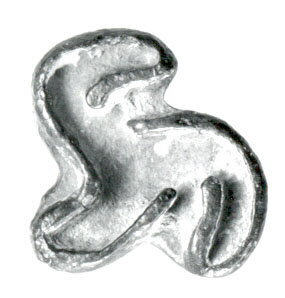
Executive Summary: The Bactrian Stamp Seal as a Proto-Luxury Artefact
This strategic standalone research paper, prepared for the leadership of Katherine Fashion Lab, presents a heritage analysis of a copper alloy stamp seal originating from the Bactria-Margiana Archaeological Complex (BMAC), circa 2200-1700 BCE. The analysis positions this artefact not merely as an archaeological curiosity but as a foundational prototype of luxury coding. It decodes the seal's intrinsic narrative of symbolic power, personal adornment, and spiritual meaning to inform a forward-looking, high-end luxury strategy for the 2026 collection and beyond. The BMAC seal offers a pre-literate blueprint for the very functions of modern luxury: identity assertion, status demarcation, and the sacralization of possession through exquisite craftsmanship and encrypted symbolism.
Historical and Cultural Context: The BMAC as a Nexus of Proto-Luxury
The Bactria-Margiana Complex, a sophisticated Bronze Age civilization centered in modern Central Asia, functioned as a critical nexus of early trans-Eurasian exchange. This was not a primitive society but a complex, urbanized culture engaged in long-distance trade of precious materials like lapis lazuli, tin, and gold. Within this context, personal seals transcended utilitarian purpose. Crafted from valued copper alloys, they were among the first truly personalized luxury objects, serving as both secure signature and portable identity. Their ownership was restricted to an elite stratum—administrators, merchants, priests—making them direct antecedents to the modern limited-edition timepiece or bespoke accessory. The medium itself, copper alloy, signifies an early understanding of material hierarchy, a deliberate choice over common stone, prefiguring the luxury industry's obsession with material innovation and pedigree.
Decoding Symbolic Power and Adornment
The power of the stamp seal resided in its dual nature as adornment and authority. Worn on the person, likely suspended on a cord or pinned to garments, it was a continuous, tangible display of the wearer's societal role. Its impression on clay seals for vessels, doors, or documents was an act of command, a physical extension of the owner's will and a guarantee of authenticity. This seamless fusion of the aesthetic and the administrative is a potent concept for modern luxury. It suggests that true high-end pieces should not only be beautiful but should also perform a function of identity—be it through a unique clasp mechanism, an embedded NFC chip for authentication and exclusive content, or a design that literally leaves its mark (e.g., in wax or personalized packaging). The seal was "wearable authority," a principle Katherine Fashion Lab can translate into designs that empower the wearer with a sense of agency and verification.
Spiritual Meaning and Esoteric Narrative
BMAC iconography is renowned for its intricate, often enigmatic symbolism, featuring composite animals, geometric deities, and mythological scenes. These were not arbitrary decorations but a complex visual language connecting the owner to cosmological orders and protective forces. A seal depicting a winged serpent or a master-of-animals motif was a talisman, a conduit for spiritual protection and a declaration of alignment with supernatural power. This imbues the object with a narrative depth that surpasses mere ornamentation.
For a 2026 luxury strategy, this underscores the critical importance of embedded narrative and intellectual esotericism. In an era of conscious consumption, luxury clients seek meaning and connection. Katherine Fashion Lab can leverage this by developing collections with "encrypted" symbolism—patterns that tell a story of ancient trade routes, motifs derived from BMAC mythological hybrids, or material combinations that reference the lapis-and-gold aesthetics of the region. The value is not just in the material, but in the story it contains and the spiritual resonance (protection, journey, wisdom) it offers the wearer. This transforms a garment or accessory from a product into a personal relic.
Strategic Application: 2026 High-End Luxury Framework
Integrating the BMAC seal's heritage into a forward-looking 2026 strategy requires moving beyond pastiche into the realm of conceptual translation. The goal is to embody the seal's principles, not to replicate its form. We propose a strategic framework built on three pillars derived from the analysis:
Pillar 1: The Authentication & Identity Matrix
Modern luxury grapples with authenticity in a digital age. The seal was the original authenticator. Katherine Fashion Lab's 2026 strategy should introduce a Physical-Digital Authentication System. Each premier piece could include a unique, seal-like medallion or clasp, perhaps in patinated copper alloy as a heritage nod. This physical element pairs with a digital ledger, providing provenance, craft journey, and access to exclusive content. This creates a closed-loop system of verification and community, directly descendant from the seal's function of securing and identifying value.
Pillar 2: Esoteric Craftsmanship and Symbolic Language
Develop a proprietary Symbolic Lexicon inspired by BMAC iconography. This involves working with artisans to create new, abstract motifs (e.g., for jacquard weaves, embossing, or jewelry) that reference BMAC themes—hybridity, cosmology, protection. Accompany each collection with a "Codex," a beautifully crafted booklet explaining the symbolism and its heritage inspiration, elevating the purchase to an acquisition of knowledge. Techniques should emphasize intaglio (the carving method of seals) translated into modern textiles: deep, precise embroidery, laser etching on leather, or stamped metallic details that create a textured, tactile impression of ancient authority.
Pillar 3: The Portable Archive Collection
Launch the flagship 2026 collection as "The Portable Archive." This concept frames each garment and accessory as a curated vessel of personal history and power, much like the seal was a portable archive of its owner's identity. Designs focus on modularity, security, and personalization: coats with integrated, seal-inspired fasteners; bags with customizable, interchangeable stamp-like locks; garments with hidden compartments or panels that "reveal" their symbolic narrative. The materials story is crucial: juxtapose modern tech fabrics with ancient-signifier materials like copper alloy filaments, deep indigo (echoing lapis), and undyed natural wools, creating a tangible dialogue between the Bronze Age and the 21st century.
Conclusion: From Bronze Age Seal to Future Legacy
The copper alloy stamp seal of the Bactria-Margiana Complex is a masterclass in primordial luxury strategy. It successfully fused material value, symbolic power, spiritual narrative, and a functional purpose for identity creation. For Katherine Fashion Lab, this artefact provides a profound and distinctive heritage foundation far removed from over-mined Western classical references. By strategically translating its core principles—wearable authority, encrypted symbolism, and sacralized authentication—into a 2026 high-end luxury framework, the Lab can position itself at the forefront of meaningful, intelligent luxury. This approach will resonate deeply with a discerning clientele seeking authenticity, narrative depth, and objects that confer not just status, but a sense of personal sovereignty and connected legacy. The seal’s impression, made millennia ago, provides the perfect template for stamping Katherine Fashion Lab's unique authority onto the future of luxury.