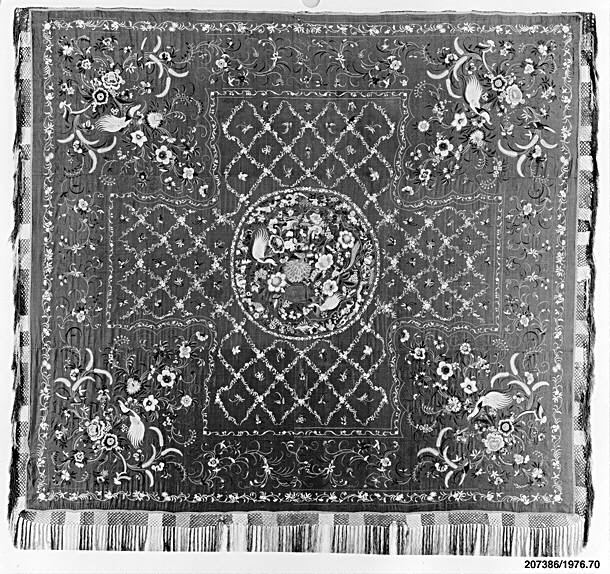
Deconstructing the Coverlet: A Tapestry of Heritage in Silk and Gold
Within the curated archives of Katherine Fashion Lab, the coverlet emerges not as a mere domestic textile but as a profound sartorial cipher. Its designation as a "Standalone study" is a deliberate provocation, challenging us to look beyond its traditional bedroom context and into its dense weave of global narrative, artisanal intelligence, and latent couture potential. Originating from a "Global Heritage" that spans the imperial workshops of China, the monastic ateliers of Europe, and the nomadic tribes of the Middle East, the coverlet is a palimpsest of human civilization. When its material lexicon is specified as "Silk and gold," we are presented with a foundational dichotomy: the organic, protean strength of silk against the inorganic, immutable luminosity of gold. This analysis will dissect the coverlet as a conceptual blueprint for avant-garde couture, exploring its structural, symbolic, and material paradigms.
Material Semiotics: The Dialectic of Silk and Gold
The specified materials are not arbitrary; they form a core dialectic that has driven luxury for millennia. Silk, a product of biological alchemy, represents fluidity, resilience, and a profound connection to terrestrial life. Its molecular structure allows for unparalleled dye absorption, creating depths of color, while its tensile strength permits astonishing fineness. In the context of a coverlet, silk provides the foundational canvas—the warm, breathable, and sensuous ground upon which meaning is embroidered.
Gold, by contrast, is the ultimate symbol of the eternal and the divine. In its thread form—often wound around a silk core—it is inert, non-corrosive, and reflective. Its application in coverlets, whether through brocade, embroidery, or couching, is an act of illuminating the narrative. This dichotomy between the earthly (silk) and the celestial (gold) establishes a microcosm of human aspiration. For the couturier, this translates to a philosophy of construction: a base garment of sublime, fluid drape (the silk) punctuated and structured by elements of deliberate, luminous rigidity (the gold). Imagine a gown where the bias-cut silk jersey forms a rippling pool, upon which gold bullion embroidery traces a architectural spine or a sleeve constructed from gold-threaded passementerie, imposing structure upon the softness it adorns.
Structural Archeology: From Bed to Body
The coverlet’s primary function—to envelop and protect—is inherently couture. Its construction offers masterclasses in volume, weight distribution, and layered storytelling. We must analyze its archetypes:
The Quilted Coverlet: A study in contained volume and tactile texture. The stitching that traps insulation is a topographic map of geometric or organic patterns. In couture, this translates to trapunto techniques, creating low-relief sculptural effects on a coat’s bodice or the sleeve of a dress. The padding, carefully restrained by channels of stitch, teaches control over silhouette expansion.
The Woven Coverlet (Brocade/Damask): Here, the narrative is integrated into the very warp and weft. The play of light on a damask rose or a brocaded phoenix creates a narrative that shifts with the viewer’s perspective. This is a direct analogue to jacquard weaving in couture, where pattern is structural, not applied. A contemporary interpretation might see a gown woven as a single piece, its story—a digitalized global motif—emerging from the fabric’s density.
The Embroidered Coverlet: This is additive storytelling. Goldwork embroidery—with its purls, chips, and bullions—adds a dimension of time and labor that is the very essence of haute couture. The way a coverlet’s edges are finished with a heavy gold fringe or its central medallion is emphasized speaks to principles of focal point and hem-weighting, crucial for a garment’s movement and drama.
Global Heritage as a Design Algorithm
"Global Heritage" is not a vague inspiration; it is a complex, non-linear database of techniques and symbols. The coverlet serves as a unifying object across these traditions. A Chinese kantha from Bengal utilizes running stitch to narrate folklore on silk, a principle of storytelling through suture. An Italian punto antico bedspread employs whitework on white linen, a study in texture and monochrome purity. A Persian coverlet might feature symmetrical garden motifs (boteh) in silk and gold, representing paradise.
For Katherine Fashion Lab, this heritage acts as a design algorithm. The process is not one of pastiche, but of transcoding. How does the communal, feminine narrative of a kantha translate into a modern, individualized gown? Can the rigid symmetry of a Persian motif be algorithmically disrupted and rendered asymmetrical in a laser-cut gold leather overlay? The coverlet becomes a medium through which these cultural data streams are filtered, merged, and rendered into a new, hybrid language of form that respects origin while speaking to the future.
Conclusion: The Standalone Garment as a World
To conclude this standalone study, the coverlet, in its ideal form, is a self-contained universe. It provides warmth (function), tells a story (narrative), displays status (material), and embodies skill (craft). These are the precise pillars of transcendent couture. A final garment born from this analysis would be one that does not simply reference a coverlet but embodies its ontological principles. It would be a piece where the lining is as considered as the exterior, where the internal structure tells a hidden story, where the weight of gold provides a grounding, ceremonial gait, and where the enveloping silhouette offers both protection and proclamation. In silk and gold, we find the dialogue between the mortal and the immortal; in the coverlet’s global heritage, we find a connected, human story waiting to be rewoven. At Katherine Fashion Lab, this analysis posits that the future of profound fashion lies not in inventing new forms from nothing, but in the deep, respectful, and radical re-contextualization of the world’s oldest and most cherished artifacts of daily life.